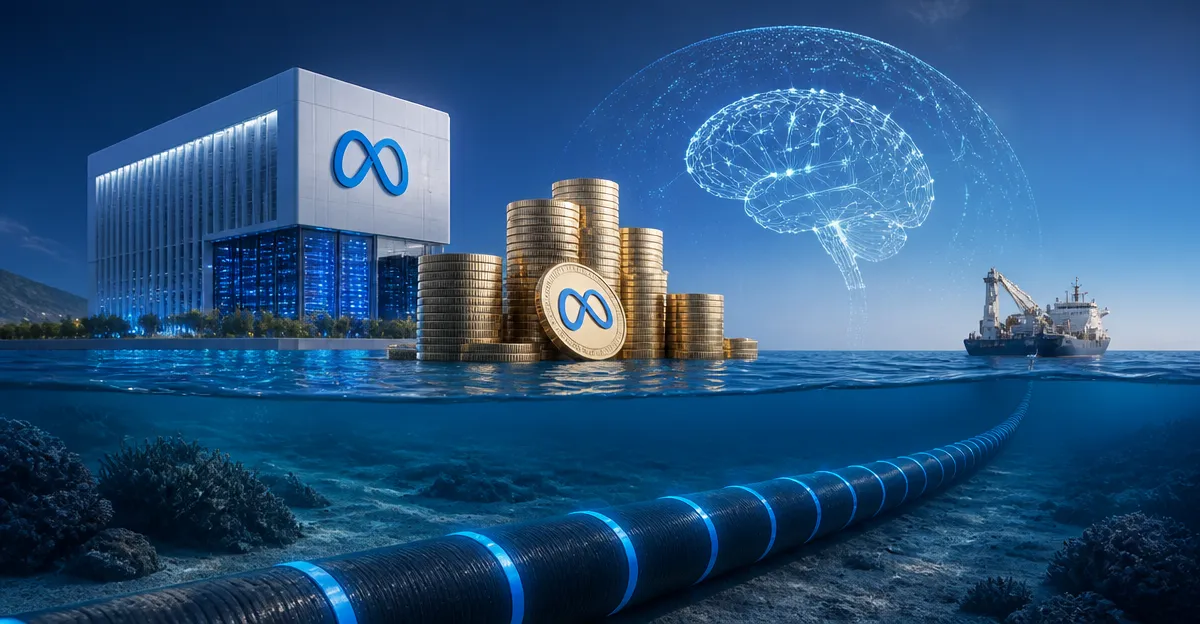
September 28, 2026, (Inside AI) — Meta has unveiled Petal, the first subsea cable with petabit capacity, linking the United States and France across roughly 7,000 kilometers. The company says the system doubles the capacity of today's most advanced transoceanic cables, marking the largest single generational capacity jump in undersea cable history.
The project, developed with NEC Corporation and Sumitomo Electric Industries, underscores a strategic shift: Meta is no longer just a social media giant but a major owner of the physical infrastructure that carries global internet traffic and, increasingly, AI data. Petal is the latest piece in a multi-billion-dollar push that includes Project Waterworth, a 50,000-kilometer subsea ring connecting five continents.
Why Petabit Capacity Changes The Game
Petal's breakthrough rests on a specialized 2-core fiber from Sumitomo Electric. This fiber delivers optical performance nearly identical to single-core fiber while eliminating measurable crosstalk between counterpropagating signals. That reduces interference and boosts reliability across the transatlantic route. The cable will carry over 99% of international data exchanges, the same undersea systems that handle video calls, stock trades, military communications, and everyday browsing.
Read: GlobalFoundries, Marvell Expand Chip Capacity Deal for AI Data Center Connectivity
Meta announced the project in a statement: "We're announcing Petal, the first subsea cable with petabit capacity to be deployed across an ocean. Petal will connect the US and France, spanning 7,000 km (over 4,300 miles) and doubling the capacity of today's most advanced transoceanic cables. This deployment marks the single largest generational increase in capacity of any transoceanic subsea cable system, ever." (Meta, company announcement)
Industry analysts note that petabit capacity is not just an incremental improvement. It is a fundamental enabler for AI training and inference, which require massive data transfers between data centers. By owning the cable, Meta avoids relying on external operators, giving it control over deployment timing, maintenance, and reliability.
Geopolitics And The AI Infrastructure Race
The strategic dimension extends beyond bandwidth. In February 2025, President Trump and Indian Prime Minister Modi issued a joint statement committing to co-develop undersea technologies as a defense partnership. India pledged to invest in maintenance, repair, and financing of undersea cables in the Indian Ocean using trusted vendors. That move signals how subsea cables now intersect with national security and technology competition.
Meta's previous projects include the Anjana cable, spanning 7,121 kilometers between Spain and South Carolina, and the 2Africa cable, a 45,000-kilometer system linking three continents with support from Orange, Vodafone, and China Mobile. These investments position Meta as a telecommunications infrastructure player, not just a platform company.
Competitors are responding. Google recently announced a subsea cable connecting Africa and Australia, plus two additional Pacific cables, with $1 billion invested to boost connectivity to Japan. The race to control data highways is intensifying as AI demand grows exponentially.
Meta's Petal announcement comes as public attention often fixates on consumer AI features like the Muse app. While investors debate Muse's positioning against Slack and Microsoft Teams, Meta quietly builds the foundation for global AI connectivity. That long-term infrastructure bet reflects confidence that AI will drive connectivity demand for decades.
Read: Meta Touts Cost-Saving Benefits of In-House AI Chips
Inside AI could not independently verify the final deployment timeline for Petal. However, the technical specifications and partnerships suggest the cable will begin service in the coming years, further cementing Meta's role in the physical layer of the internet.