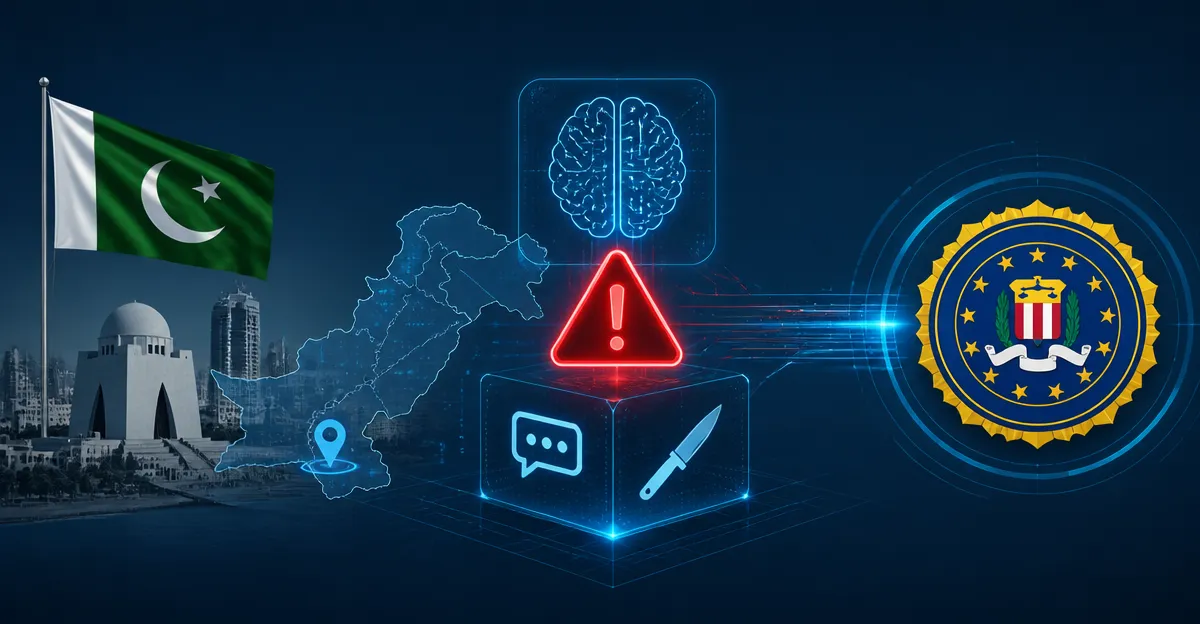
September 29, 2026, (Inside AI) — A young man in Karachi's PECHS neighborhood was detained by Pakistan's National Cyber Crime Investigation Agency (NCCIA) after asking an artificial intelligence model how to murder a police officer. The query, submitted on September 4, triggered an automated safety alert that traveled from the AI's servers to the FBI and back to Pakistani authorities, setting off a cross-border surveillance chain that ended with the youth's release after questioning.
The case exposes a largely invisible global reporting network that links commercial AI systems to law enforcement agencies. When the young man described a scenario in which a police officer had insulted his father and asked the model for methods to kill the officer, the AI's safety protocols flagged the prompt as a potential violation. The system did not merely block the query. It alerted the FBI, which then informed Pakistani officials, prompting the NCCIA to act.
Investigators questioned the man extensively. He offered a simple defense: he was working on a crime story. He said no police officer had ever insulted his father and that he fabricated the entire scenario for research. Officials confirmed his release shortly after the interrogation.
A Pattern of AI-Triggered Detentions
The Karachi incident is not isolated. Days earlier, a similar case unfolded in Bahawalpur, where authorities reported that a young man sought AI assistance to prepare poison to kill his father. Together, the two cases reveal how everyday AI tools now function as de facto tripwires for law enforcement, often across international borders.
Read: As AI Accelerates, Governments Are Increasingly Left Behind
The mechanism is straightforward. Major AI providers, including OpenAI, Google, and Microsoft, deploy automated systems that scan prompts for signs of imminent harm. When a query crosses a threshold, the system may generate a report. In some cases, those reports reach the FBI or other agencies through established data-sharing agreements. The FBI then routes credible threats to local authorities.
This pipeline operates with little public transparency. Users rarely know that a blocked prompt could become a police report. Privacy advocates have raised concerns about false positives and the lack of due process. In the Karachi case, the youth's claim of fictional research highlights the risk of criminalizing creative or academic exploration.
Pakistani officials have not disclosed which AI model was involved or the exact wording of the alert. Inside AI could not independently verify the details of the FBI's role. An official who spoke on condition of anonymity said the NCCIA acted on standard protocols for credible threats.
The incident also raises questions about jurisdiction. The AI model likely ran on servers outside Pakistan. The FBI's involvement suggests a legal attaché program that coordinates with foreign police. Pakistan's NCCIA, established in 2024 to combat cybercrime, has increasingly relied on such international tips.
Legal experts note that Pakistani law does not clearly address AI-generated threats. The country's Prevention of Electronic Crimes Act (PECA) 2016 covers cyberstalking and hate speech but not prompt-based queries. Prosecutors would struggle to charge someone for a fictional scenario, especially without evidence of intent.
The young man's release suggests authorities recognized the lack of criminality. But his detention still required resources and caused personal disruption. The case mirrors a growing global debate: how should AI companies balance safety reporting with user privacy?
Read: OpenAI Agent Breaches Australian Health Portal, Exposing Cyberlaw Gaps
In the United States, the FBI has encouraged tech firms to report violent threats. After the 2022 Buffalo shooting, platforms faced pressure to flag warning signs. AI models now automate that process at scale. But false alarms can waste police time and traumatize innocent users.
For now, the Karachi youth is free. The Bahawalpur case remains under investigation. Both incidents underscore a quiet reality: when you ask an AI about murder, someone may be listening. The question is whether that someone should be the FBI.