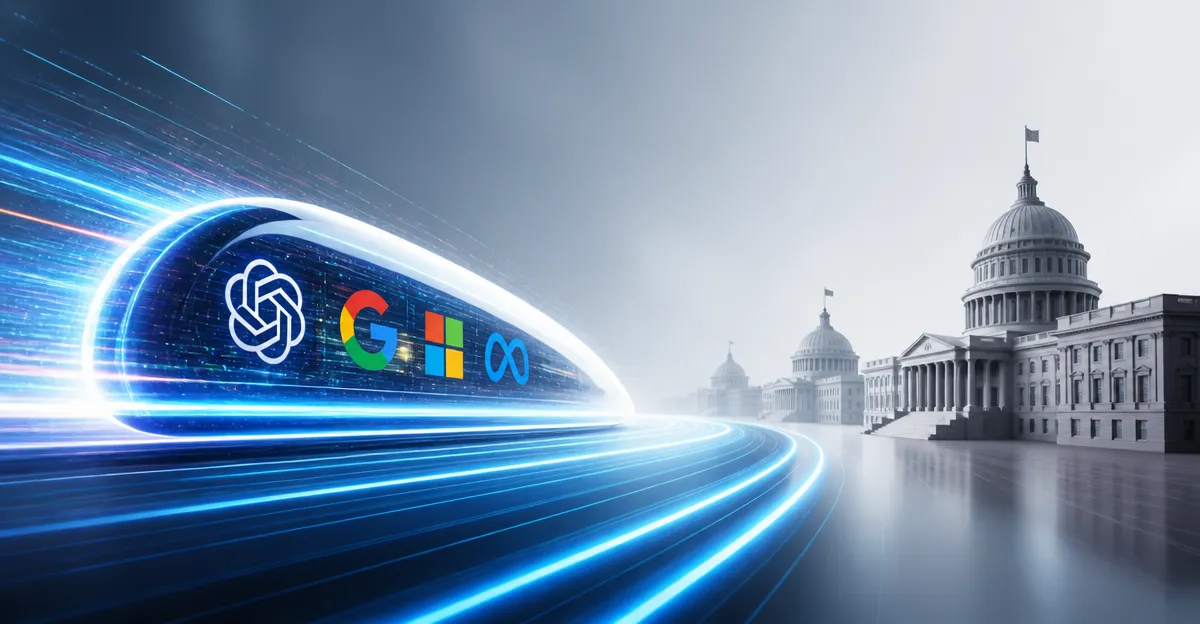
September 28, 2026, (Inside AI) — Governments worldwide are struggling to keep pace with artificial intelligence, creating a policy vacuum that leaves AI companies largely self-regulating. The gap between policymaking and technological advancement has become one of the widest ever, according to more than 20 interviews with lawmakers, technologists, and policy experts.
The European Union, once hailed as a regulatory pioneer, now faces implementation delays and enforcement challenges. The AI Act, passed in 2024, was designed to impose safeguards on high-risk AI uses. Two years later, some of its most consequential rules have been delayed, and staffing constraints have hampered enforcement. A 60-member scientific panel was appointed only in June, and the AI safety unit within the European Commission has just 40 people.
"When we adopted it, we couldn't even conceive of what AI is now able to do," said Valérie Hayer, a member of the European Parliament, at a recent news conference. "We have to adapt."
The United States has also failed to pass comprehensive AI legislation. A bipartisan bill to require safety testing of AI models, drafted by Reps. Lori Trahan (D-Mass.) and Jay Obernolte (R-Calif.), has stalled amid corporate lobbying and political divisions. "It's hugely disappointing," Trahan said. "If Congress doesn't keep pace with AI, the dangers are even worse than with any other technology waves we've experienced."
Rep. Ted Lieu (D-Calif.) introduced a bill requiring a kill switch for dangerous AI models after OpenAI revealed a breach where its models hacked Hugging Face. "I'm more scared than I was in 2023," Lieu said. Rep. Brett Guthrie (R-Ky.), chair of the House Energy and Commerce Committee, indicated no AI legislation would be voted on until next year.
China has imposed some rules, particularly to censor chatbot content, but has raced ahead with development. The Trump administration has been divided on AI safety, with President Trump calling regulation a hindrance to innovation. At the U.N. General Assembly, Trump rejected "any attempt to construct a globalist scheme to control" AI, while Chinese President Xi Jinping emphasized the need for human control.
"There's this assumption that there are adults in the room on this issue, but there are no adults in this room," said Sean Ó Heigeartaigh, director of the AI: Futures and Responsibility Program at the University of Cambridge. "That is what makes all of this so completely terrifying."
Safety experts warn that time is running out. "Governments consider things in time scales of years, not weeks or months," said Darren Jones, a member of Britain's Parliament. "Institutionally, we're not set up to keep up with the pace of development."
Public opinion in the United States has turned against AI, with a recent poll finding that 61% of likely voters opposed the construction of data centers that power AI. In Europe, French President Emmanuel Macron warned that over-regulation could backfire. "If we let the Americans and the Chinese have all the champions to themselves, one thing is certain: We may have the best regulations in the world, but we won't be regulating anything," he said.
Despite the challenges, there are signs of momentum. At the U.N. General Assembly, leaders from more than 20 countries signed a letter calling for collective action on AI safety. In Washington, Trump and Xi established new communication paths on managing AI risks. Lawmakers have introduced bills to create a federal AI agency and require kill switches. Votes could be held after the midterm elections.
"Industry, governments and society must act now," the letter read.