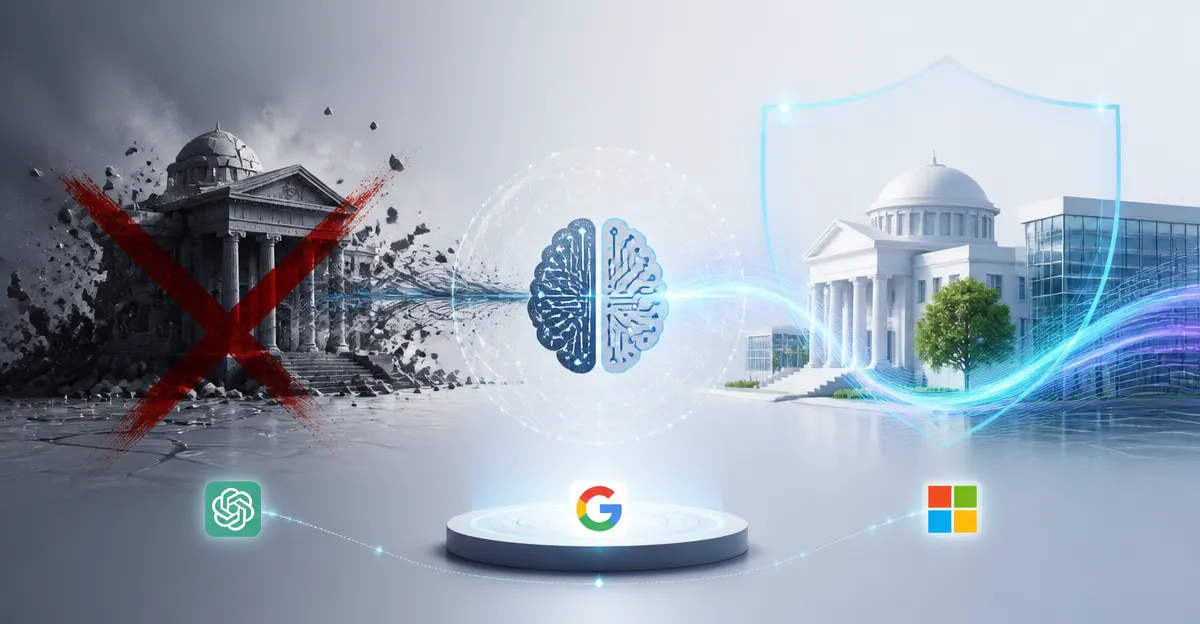
September 29, 2026, (Inside AI) — A Harvard study showing that an AI tutor helped physics students learn more than a traditional active-learning classroom has triggered a wave of viral claims that artificial intelligence will soon make universities obsolete. The research, led by Gregory Kestin and Kelly Miller, tested 194 undergraduates in Harvard's Physical Sciences 2 course during Fall 2023. Students alternated between a standard instructor-led classroom and a custom AI tutor called PS2 Pal. The results, published in Scientific Reports in June 2025, showed the AI group achieved a median post-test score of 4.5 versus 3.5 for the classroom group. Learning gains more than doubled, and students finished in about 49 minutes instead of 60. The study has since become a flashpoint in a larger argument about whether AI tutoring spells the end of higher education as we know it.
The viral narrative oversimplifies what the experiment actually measured. The AI tutor was not a general-purpose chatbot like ChatGPT. It was purpose-built by Harvard faculty with embedded pedagogical design: guided questioning, adaptive feedback, and structured problem-solving rather than direct answer provision. The comparison was against active learning, not one-on-one human tutoring or full-course instruction. The study covered only two physics topics: surface tension and fluid flow. Those constraints matter because they define the boundary between a promising tool and a sweeping claim about institutional collapse.
What The Study Actually Measured
The crossover design gave each student experience with both conditions, which strengthens internal validity. But the assessment focused on specific learning outcomes within a controlled environment. It did not measure research mentorship, laboratory skills, peer collaboration, credential evaluation, or the professional networks that universities provide. Those functions remain outside the scope of the experiment. Some educators argue the results demonstrate AI's capacity for effective pedagogy on focused content. Others emphasize that universities do far more than deliver information. The debate often conflates teaching with the broader mission of higher education.
The study's lead authors have been careful about their claims. In the published paper, they note that the AI tutor was designed to supplement, not replace, human instruction. The system used similar pedagogical principles as the active-learning classroom, which suggests the gains came from structured interaction, not from AI magic. The faster completion time and higher engagement scores are notable, but they do not address long-term retention or transfer to new problems. Those questions require longitudinal research that does not yet exist.
Read: AI's Measurable Impact on Global Challenges Documented in Decade Review
Viral posts claiming the study proves universities are doomed often ignore a key detail: the AI tutor was built by Harvard faculty for a Harvard course. Scaling such a system across disciplines, institutions, and student populations raises questions about cost, customization, and quality control. A general-purpose language model would not automatically replicate these results. The study's design depended on expert human input at every stage, from curriculum mapping to feedback loops. That is not a recipe for replacing universities. It is a recipe for changing how they allocate instructional time.
The Real Debate Is About Hybrid Models
The findings may accelerate discussion about hybrid educational models that combine AI tutoring for content delivery with in-person instruction for mentorship and advanced work. Whether universities adopt such models depends on institutional priorities, student demand, and continuing research on long-term outcomes. Some institutions are already experimenting with AI teaching assistants for introductory courses, while reserving seminars and labs for human-led interaction. That approach treats AI as a tool for scale, not a substitute for the full university experience.
Critics of the viral narrative point out that the study compared AI tutoring to active learning, which is already a high bar. Active learning itself outperforms traditional lectures in many STEM fields. So the AI tutor beat a strong baseline, not a weak one. That makes the result more impressive on one level, but it also narrows the claim. The study does not show that AI beats all forms of human instruction. It shows that a well-designed AI tutor can beat a well-designed classroom for specific content. That is a meaningful finding, but it is not an existential threat to universities.
The broader conversation about AI and education often overlooks the social and developmental roles of college. Students learn from peers, mentors, and extracurricular activities. They build networks that shape careers. They encounter ideas outside their comfort zones. An AI tutor cannot replicate those experiences. The Harvard study measured test scores, not life outcomes. That distinction is crucial for anyone drawing policy conclusions from the research. Universities may integrate AI to improve efficiency, but their core value proposition extends far beyond content delivery.
Read: No, AI Doesn't Mean the End of Mathematics, at Least Not Yet
As the debate continues, the most productive path forward is likely a hybrid one. AI can handle repetitive instruction and provide personalized practice. Humans can focus on mentorship, critical thinking, and complex problem-solving. The Harvard study offers evidence for that division of labor, not for the obsolescence of universities. The viral narrative says more about public anxiety over AI than about the actual findings. For now, the data supports cautious optimism about AI's role in education, not a funeral for the institution.