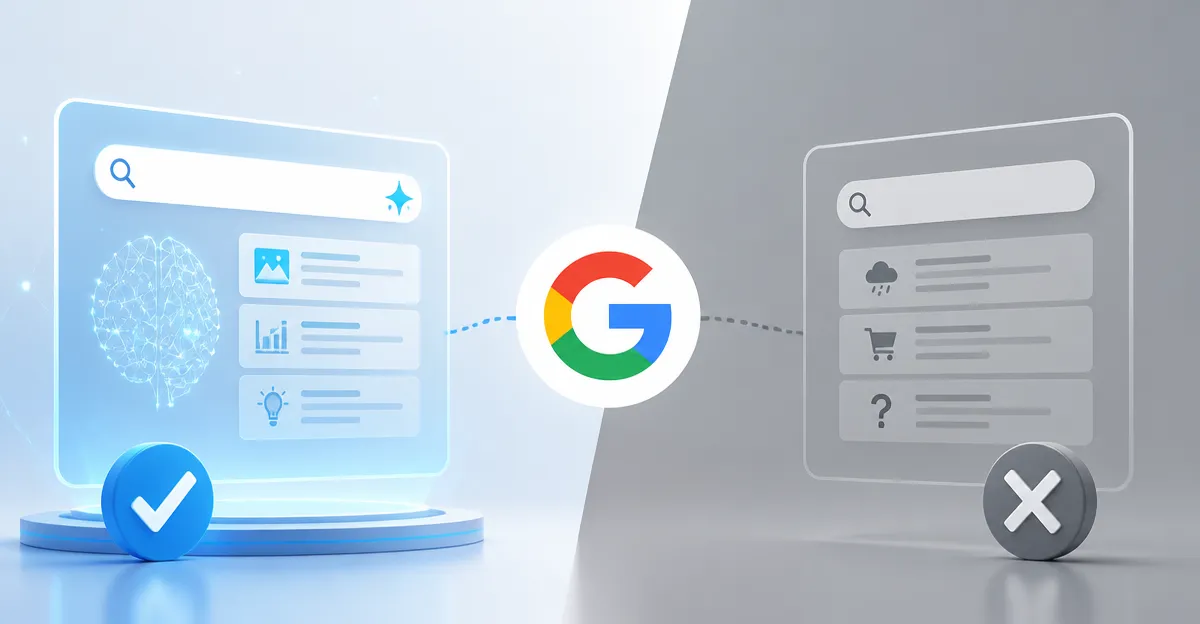
October 2, 2026, (Inside AI) — Google's AI Overviews now appear on a large share of search results pages, a shift that has reshaped how millions of people find information online. The feature, which generates a summary answer at the top of results, has moved from experiment to default for many queries. But search analysts and user-experience researchers say the tool works best for some tasks and fails badly at others, and knowing the difference has become a basic digital skill.
The core tension is simple. AI Overviews excel when a question has a stable, consensus answer that appears across many high-quality sources. They struggle when the topic is contested, fast-moving, or dependent on local and personal context. Google has not published a comprehensive guide on when its own AI summaries are reliable, leaving users to develop their own rules of thumb.
That gap has real consequences. A 2024 study from Columbia Journalism Review's Tow Center found that AI search summaries sometimes repeated false or misleading claims from low-quality sources. Google has since improved grounding and added links to sources inside the overview box. Still, the company's own documentation notes that AI Overviews "may not always be accurate" and advises users to verify important information independently.
When AI Overviews Earn Their Place
For straightforward factual queries, AI Overviews can save time. Ask for the boiling point of mercury, the population of Lagos, or the year a treaty was signed, and the summary usually pulls from authoritative references like encyclopedias, government databases, and established news outlets. The answer appears without a click, and the cited sources sit just below.
Read: Cloudflare AI Search Goes GA with Multimodal Embeddings and New Pricing
Google has invested heavily in this layer. At its 2024 I/O developer conference, the company said AI Overviews would reach more than 1 billion users by the end of that year. By 2026, the feature is available in more than 100 countries and dozens of languages. That scale makes it the most widely used AI product in the world by reach, even if most users never think of it as AI.
Search industry analyst Danny Sullivan, who has tracked Google for two decades, has argued that the feature is best understood as a new kind of featured snippet rather than a replacement for search. "It's another way to get answers, not the only way," he wrote in a public post. Sullivan's point matters because Google's own interface still presents traditional blue links below the AI box, and those links remain the primary source for deeper research.
For navigational queries, AI Overviews are largely irrelevant. If a user types "Amazon customer service" or "IRS refund status," the intent is to reach a specific page, not to read a summary. Google's AI often recognizes this and suppresses the overview, but not always. When it does appear, it adds friction rather than removing it.
The Cases Where Skipping Makes Sense
AI Overviews become risky for breaking news, medical decisions, legal questions, and anything involving local businesses or real-time data. In those cases, the underlying sources change by the hour, and a summary generated from stale crawl data can mislead. Google's AI also struggles with sarcasm, niche community knowledge, and queries that require reading a full document to understand context.
Privacy-focused alternatives have leaned into this weakness. DuckDuckGo continues to emphasize traditional web links and has added its own AI chat feature that users must opt into. Microsoft's Bing offers a similar choice, blending AI answers with conventional results but allowing users to toggle the AI layer off. These competitors frame the decision as a matter of user control, a contrast Google has been slow to match.
Google does allow users to filter AI Overviews in some regions, but the setting is buried in search preferences and not available everywhere. The company has also tested a "Web" filter that shows only text links, a nod to users who want the old experience. Inside AI could not independently verify how widely that filter is deployed.
Read: Google Photos Expands AI Wardrobe Tool to US, Brazil, India
For professionals who rely on search for research, the practical rule is to treat AI Overviews as a starting point, not an endpoint. Check the cited sources. Look for dates. If the topic is contested, open multiple links. If the answer involves numbers, verify them against a primary source. These habits take seconds and prevent the most common errors.
Google's parent company Alphabet has not signaled any retreat from AI in search. If anything, the company is pushing further, integrating AI into shopping, maps, and travel planning. The question for users is no longer whether AI will appear in search results. It is whether they will use it wisely or let it use them.