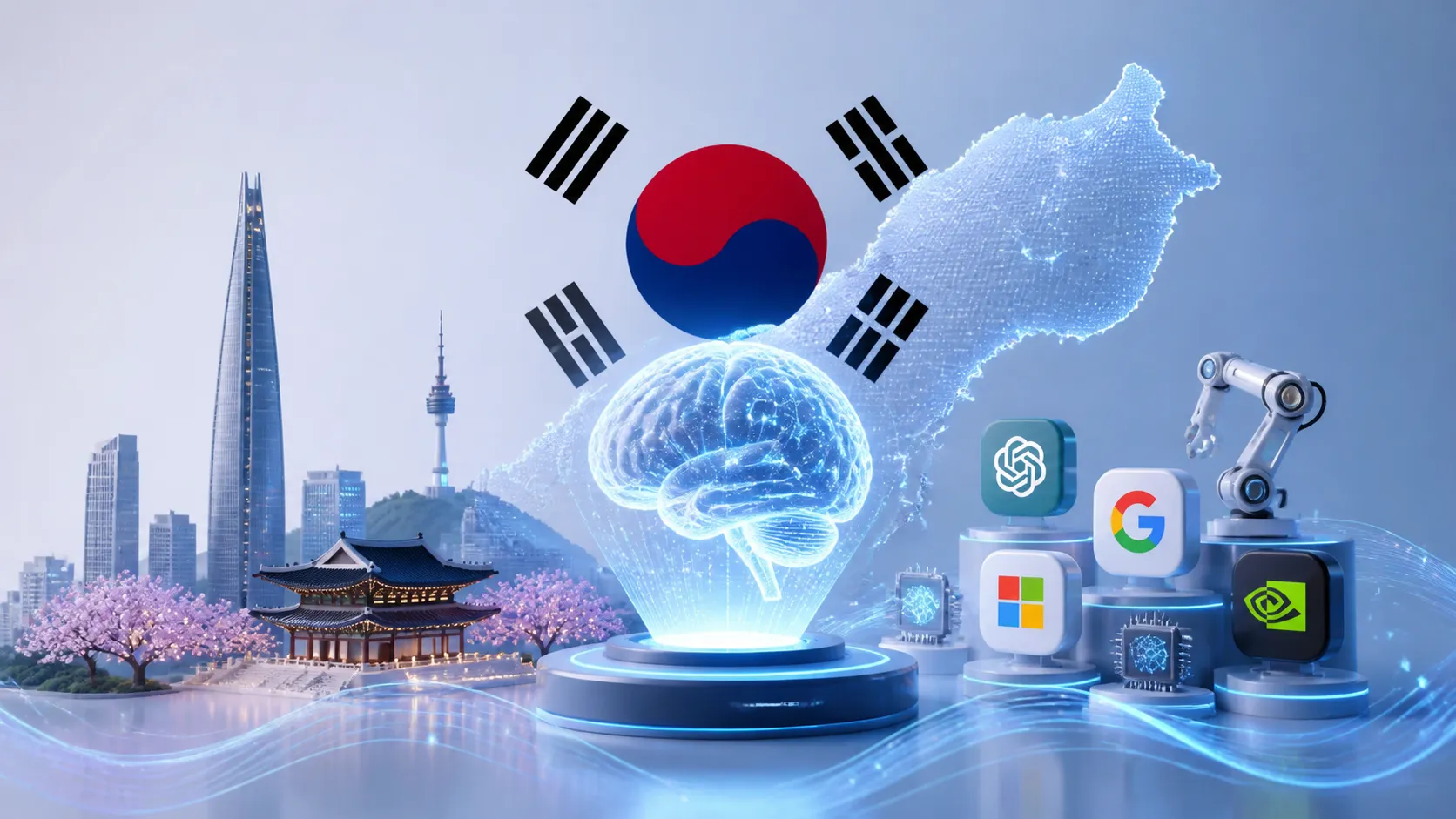
June 16, 2026, (Inside AI) — In Seoul, a robot on wheels waits at a crosswalk to deliver dinner, an unmanned immigration gate scans faces, and a bus stop kiosk soon answers questions in multiple languages. South Korea is sprinting toward an AI-powered future, and its citizens are cheering it on. Only 16% of South Koreans say they are more concerned than excited about AI, the lowest rate among 25 countries surveyed by the Pew Research Center. By contrast, 50% of Americans express more worry than enthusiasm.
This optimism is no accident. It has been carefully cultivated by a national strategy that treats AI as an engine of economic growth. From government ministries to K-pop fandoms, South Koreans are embracing AI assistants, virtual idols, and eldercare robots with a fervor that sets them apart on the global stage.
A State-Driven Love Affair
South Korea’s techno-optimism is rooted in its postwar transformation. The country vaulted from poverty to prosperity by mastering steel, ships, semiconductors, broadband, and smartphones. Now, Samsung and SK Hynix supply most of the world’s high-bandwidth memory chips, which power Nvidia hardware for AI training. Both companies are valued above $1 trillion, and the main equity index, Kospi, hit record highs in 2026 on their soaring shares.
Chihyung Jeon, a professor of science and technology policy at the Korea Advanced Institute of Science and Technology, explains the government’s role.
“The South Korean government has designated an AI-powered Fourth Industrial Revolution as the country’s path forward and aggressively promoted and invested in it. South Koreans have consistently and relentlessly been told by the government about AI’s potential to create a better future.”
President Lee Jae-myung, who took office in 2025, launched the Presidential Council on National AI Strategy to secure massive computing power and fund homegrown AI models. The AI Basic Act, passed in 2024, was one of the first comprehensive AI laws, designed to accelerate development with light-touch regulation. The 2026 Stanford AI Index found that 70% of South Koreans prioritize AI-driven scientific advances over protective regulation.
When Progress Overshadows Caution
Yet the single-minded focus on economic growth has blind spots. Jeon warns that critical reflection on societal impacts is often sidelined.
“Because the national agenda on AI prioritizes economic development, there isn’t much reflection on the social, political, ethical dimensions of the technology.”
In 2025, the government faced a fierce backlash after deploying AI textbooks riddled with factual errors and privacy risks without pilot testing. Labor tensions also simmer. After Hyundai announced plans in January to deploy Atlas humanoid robots in its factories, the Hyundai Motor Group union protested vehemently.
“Without labor-management agreement, not a single robot using new technology will be allowed to enter the workplace.”
Surveys show 64% of South Koreans fear AI could displace jobs and worsen inequality, even as 52% believe it can boost productivity. This tension plays out in daily life. A 29-year-old insurance agent in Seoul, who asked not to be named, uses ChatGPT for work tasks, stock tips, and even fortune-telling. She fears losing her job but cannot stop using the tool.
“I sometimes fear AI, but for now, it’s just so useful.”
Her habit reflects a broader trend: 46% of South Koreans in their 20s have used a chatbot to read their fortunes, according to a Korea Gallup survey. For a generation facing unemployment, dead-end jobs, and unaffordable housing, AI offers a portal to a better future, even if that future remains uncertain.
A Global Benchmark with Local Risks
South Korea’s AI push is yielding results. The Stanford AI Index ranked it third globally for notable AI models, based on state-of-the-art advancements and high citation rates. For a country of its size, AI is a chance to punch above its weight. But as the nation races ahead, the gap between engineered enthusiasm and genuine preparedness may widen. The challenge is not just building smarter machines, but ensuring that the humans who depend on them are not left behind.