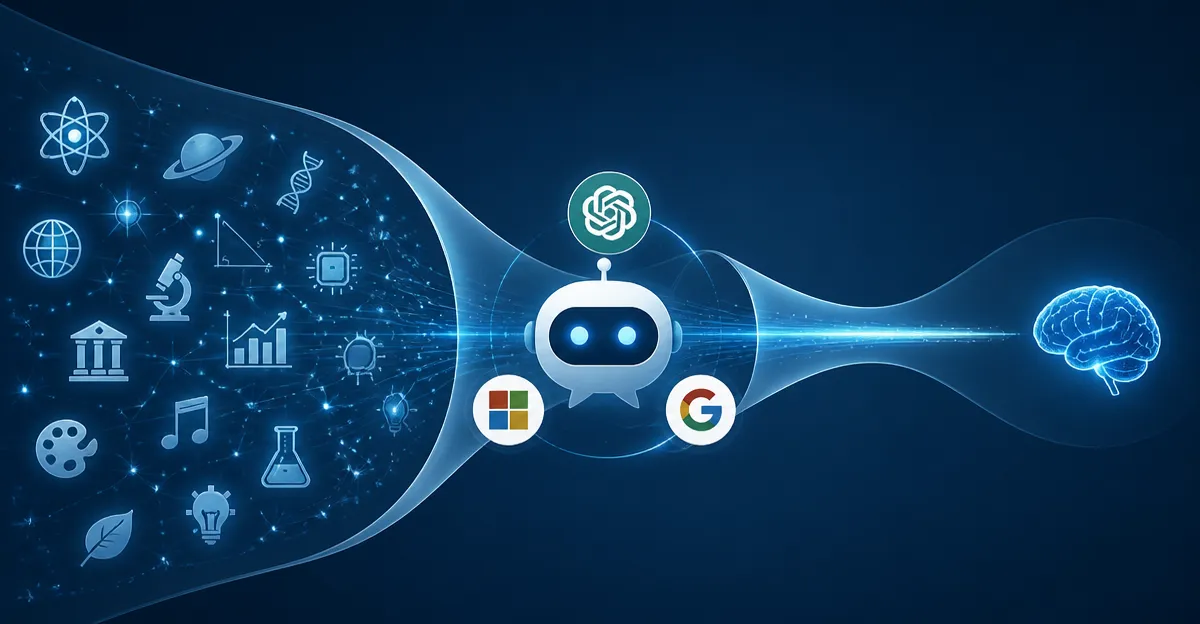
October 3, 2026, (Inside AI) — A new study from the University of Copenhagen warns that heavy reliance on AI chatbots could narrow the diversity of information people encounter, potentially affecting learning and reasoning. Researchers examined 27 large language models, including leading chatbots, and compared their outputs to Google Search results across 155 topics and 200 prompts, generating over 70 million responses. The best-performing model, GPT-5, produced answers that were 18.5% less diverse than search results, while the average chatbot showed 19% less diversity. The findings suggest that as AI becomes a primary information source, users may see a narrower range of ideas, which could impact intellectual development over time.
AI's Narrow Lens on Knowledge
The study, conducted by the Department of Computer Science at the University of Copenhagen, highlights a subtle but significant risk: AI chatbots not only answer questions but also shape which information users encounter. When responses are consistently similar, users are exposed to fewer perspectives, potentially limiting their understanding of complex topics. This effect could compound over time, leading to what researchers describe as a decline in intelligence levels across generations compared to previous ones. While the study does not claim chatbots are inherently harmful, it underscores a trade-off between convenience and informational breadth.
GPT-5's performance, while the best among the models tested, still lagged behind traditional search by 18.5% in diversity. This gap suggests that even advanced AI systems may not match the variety of sources and viewpoints accessible through search engines. The researchers argue that this discrepancy matters because diverse information is crucial for critical thinking and innovation. As AI tools become more integrated into education and research, the stakes for maintaining informational diversity grow higher.
“The findings do not suggest that AI chatbots are always harmful. Instead, the study highlights a possible downside of relying on them as the main source of information,” the researchers noted. They emphasize that the variety of information people receive will become increasingly important as AI's role in everyday learning expands.
Read: Want to use AI to improve your work? Have it disagree with you.
This study adds to a growing body of research on AI's societal impact. Previous work has focused on bias, misinformation, and privacy, but this research zeroes in on information diversity, a less explored area. The results suggest that users and developers should consider how AI systems curate and present information. For now, the researchers recommend a balanced approach, using AI alongside traditional search to maintain a broad information diet.
As AI continues to evolve, the challenge will be to design systems that not only provide accurate answers but also expose users to a wide range of ideas. The University of Copenhagen's findings serve as a timely reminder that the tools we use to learn can shape what we learn.