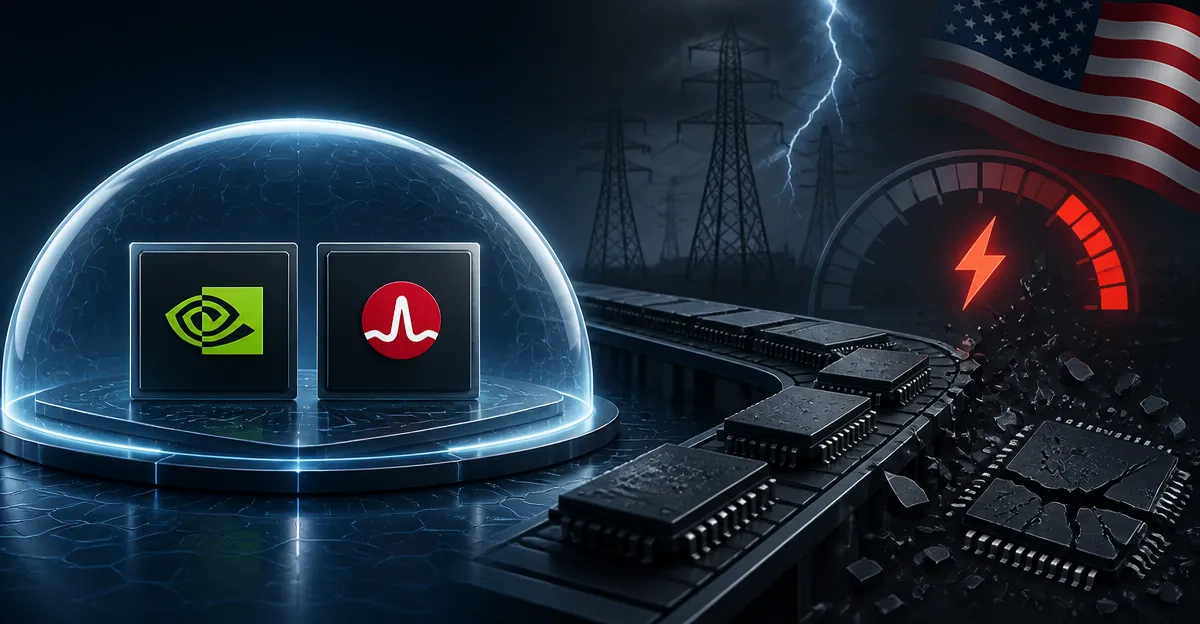
October 5, 2026, (Inside AI) — A new analysis from Morgan Stanley warns that a growing power shortage in United States data centers is creating a two-tier supply chain, leaving leaders like Nvidia and Broadcom relatively protected while threatening smaller chipmakers that depend on the pace of AI infrastructure buildouts. The investment bank said on Monday that while power constraints could delay some AI deployments, the immediate financial risk is concentrated among suppliers of memory, optical components, and other secondary chips.
The findings land as utilities and grid operators struggle to keep up with electricity demand from AI training clusters, which can consume as much power as small cities. Morgan Stanley’s note suggests that the bottleneck is shifting from chip fabrication to the physical power infrastructure needed to run those chips. That shift matters because it changes which companies absorb the pain of a slower rollout.
Nvidia and Broadcom sit at the center of the AI hardware stack. Nvidia’s graphics processing units dominate AI training, and Broadcom supplies custom accelerators and networking silicon for hyperscale data centers. Their products are essential and often booked years in advance, giving them leverage to prioritize shipments to customers with secured power. Secondary suppliers lack that cushion. Memory makers, optical transceiver vendors, and providers of power management chips face order cuts or delays when a data center project slips by even a few quarters.
Morgan Stanley did not name specific secondary suppliers, but the logic follows recent earnings commentary across the semiconductor sector. Several memory and optical firms have already flagged uneven demand as cloud providers recalibrate construction timelines. The bank’s analysis implies that investors should watch power availability as closely as they watch chip lead times.
The power crunch has been building for over a year. In Northern Virginia, the world’s largest data center market, utilities have delayed new connections for large customers. Similar constraints have appeared in Texas, Arizona, and parts of Europe. AI models are growing larger, and each generation of GPUs draws more watts per rack. The result is a physical limit that no amount of chip design can immediately solve.
Some industry analysts argue the risk to Nvidia and Broadcom is overstated. They point out that both companies sell into a global market, and demand from sovereign AI projects and non-US cloud providers could offset American delays. Others counter that the power shortage is global, with grid congestion reported in Ireland, Singapore, and Japan. If the constraint is universal, even the largest chipmakers cannot escape a slowdown forever.
What remains unclear is how long the power bottleneck will last. Building new transmission lines and power plants takes years, not months. Some data center operators are turning to on-site gas turbines and nuclear power agreements, but those solutions are expensive and face regulatory hurdles. Morgan Stanley’s note does not forecast a timeline, but its framing suggests the issue is structural rather than temporary.
Read: AI Data Center Backlash Reaches San Jose, Silicon Valley's Biggest City
For now, the market appears to be pricing in resilience at the top of the supply chain. Nvidia and Broadcom shares have held up better than smaller semiconductor peers in recent months. That divergence may continue as long as power, not silicon, remains the binding constraint on AI growth. The next test will come when hyperscalers report capital expenditure plans later this year, and investors will listen for any mention of power-driven delays.