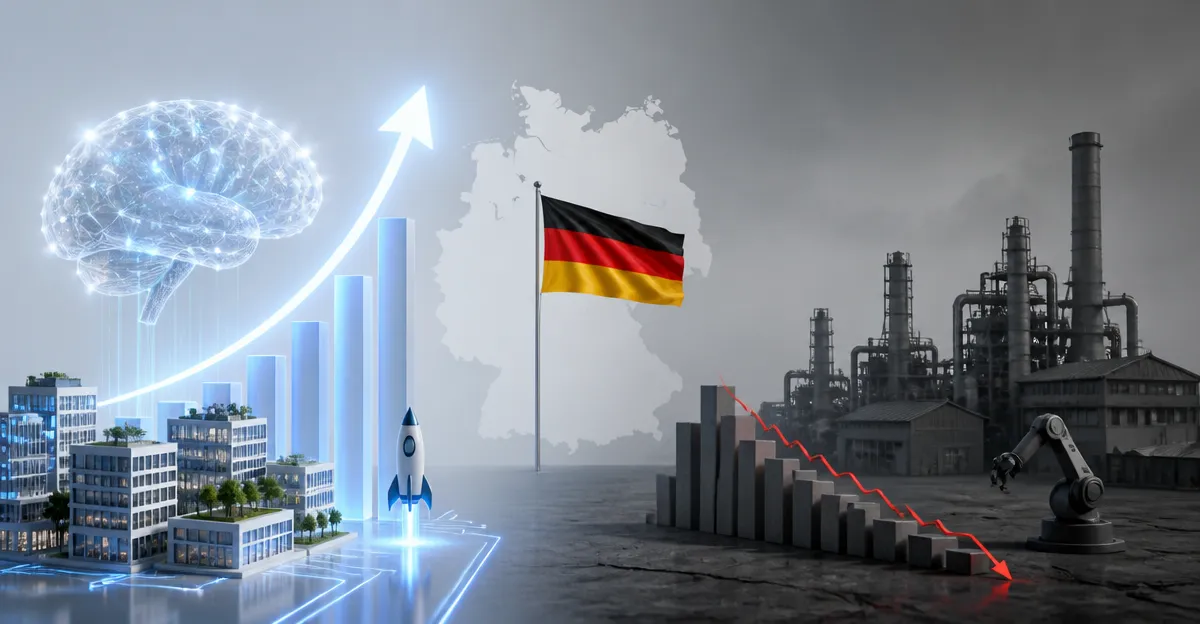
October 6, 2026, (Inside AI) — Germany's industrial heartland is contracting, but its startup scene is expanding at a record pace. More than 3,000 startups were founded in the country in the first half of 2026, according to economy ministry data, a 52% jump from the previous six months and an all-time high. Roughly one-third of those new companies focus on artificial intelligence, a surge fueled by global AI demand and a growing pool of available capital.
The boom arrives as traditional German industry sheds jobs. The German Economic Institute IW estimates the country lost around 400,000 industrial positions between 2019 and 2025, with automakers like Volkswagen and Mercedes and heavy industry giant Thyssenkrupp among the hardest hit. That contraction has pushed skilled workers toward entrepreneurship and created a market for AI tools that help legacy firms cut costs and automate routine tasks.
"The momentum is coming at the right time," said Verena Pausder, head of the German Startup Association. "Large parts of our industry are fighting for their existence."
Software dominates the new company formation, accounting for 28% of all startups founded. Healthcare follows at 9%, and food at 6%. The geographic spread remains concentrated in established hubs like Berlin, but the surge is national in scope.
Read: AI's $30 Trillion Bet: Productivity Gains Remain Elusive
Funding has kept pace. German startups raised €8 billion in venture capital between January and September 2026, surpassing the total for all of 2025, according to the German Startup Association's Startup Monitor. Yet AI-specific funding tells a more complicated story. German AI startups pulled in just €5.7 billion over the same period. In the United States, the figure reached nearly €308 billion, a gap that underscores how far Europe's largest economy trails in the global AI investment race.
The disparity has not deterred founders. Hendrik Hofstadt, chief technology officer at Berlin-based Langdock, sees opportunity in Germany's industrial weakness. His company, founded three years ago, now employs around 60 people and generates €50 million ($56 million) in revenue. Langdock's software helps companies adopt AI tools and integrate them into existing workflows.
"We have a lot of legacy industry that does now have to reinvent itself," Hofstadt said. "It's actually a pretty great market for new players to get into, because there's a real openness towards new solutions."
The boom extends beyond enterprise software. Polina Sergeeva launched Menstruflow in 2023, selling a device that uses transcutaneous electrical nerve stimulation, or TENS, to ease menstrual pain. The technology already sees wide use in reducing labor pain, but Sergeeva adapted it for a consumer health market that had few dedicated solutions. Her company's sales rose 300% year-on-year in the first quarter of 2026, and she now aims to secure medical certification and move into retail stores.
"When your pain is so bad it destroys your holidays, your plans and everything, then you start thinking, 'Is there something no one's ever thought of?'" Sergeeva said at a founders' event in Berlin.
Not every founder comes from a technical background. Paulina Lutz left a six-figure salary at a venture capital fund after a transformative night at KitKatClub, a legendary Berlin venue, prompted her to reconsider her career path. In December 2024, she launched Nghty, Berlin's first lingerie brand of its kind. The company has since added a second collection and opened its first pop-up store after starting online-only.
"You work with other founders on their ideas and their dreams and you really start to question: why am I not on the other side of this?" Lutz said.
Read: Deutsche Telekom Targets €2.5 Billion in AI Savings by 2030
Berlin's Policy Push Meets A Funding Gap
Government officials recognize the moment. Chancellor Friedrich Merz's cabinet adopted a Startup and Scaleup Strategy in July, laying out 152 measures to improve conditions from founding through international expansion. The plan targets reduced bureaucracy and aims to mobilize more private capital for technology, biotechnology and defense sectors.
The urgency is clear. Of around 1,800 companies surveyed by the German Startup Association, only about one-third rated Germany as an attractive place to start a business. Founders cite regulatory hurdles, slow permitting and limited access to late-stage funding as persistent obstacles.
"If these companies quickly move elsewhere looking for funding, then the ideas we develop here end up creating value somewhere else," said Timo Wollmershaeuser, head of forecasts at the Ifo Institute for Economic Research.
The concern is not hypothetical. German AI startups often seek larger rounds in London, Stockholm or the United States, where investors show greater appetite for scale. Retaining those companies could determine whether the current wave becomes a durable economic engine or a short-lived spike.
For now, the numbers suggest momentum. The 52% half-over-half increase in new company formation marks the sharpest rise on record. Whether that translates into long-term growth depends on whether Germany can convert its industrial crisis into a foundation for new industries, and whether the capital required to scale them stays within its borders.