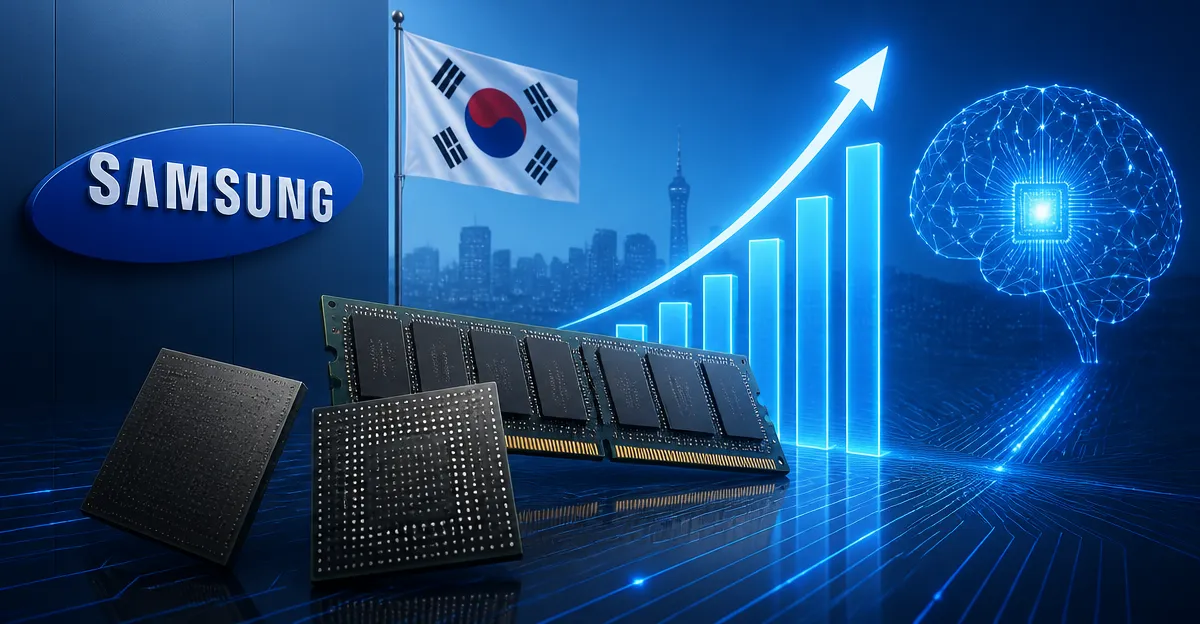
October 8, 2026, (Inside AI) — Samsung Electronics on Thursday projected a nearly nine-fold jump in third-quarter operating profit, a record-breaking result that underscores how the artificial intelligence infrastructure boom has fundamentally reshaped the global memory chip market.
The South Korean giant estimated operating profit of 107.4 trillion won ($80.17 billion) for the July-September period, up from 12.17 trillion won a year earlier. The figure beat an LSEG SmartEstimate of 106.1 trillion won, according to a regulatory filing. Revenue likely rose 127% to 195 trillion won.
This marks Samsung's fourth consecutive quarter of record operating profit. The surge reflects a structural imbalance: demand for AI memory has outpaced supply growth, a gap analysts expect to persist into 2027.
At the center of this boom is high-bandwidth memory (HBM), a specialized chip that stacks DRAM layers to feed data-hungry AI accelerators. Prices for conventional DRAM and NAND have also soared due to tight inventories.
Read: Tin Prices Surge Past $50,000 as AI Data Centers Drive Demand
"Samsung's HBM bit shipments expanded by close to 50% quarter-over-quarter in the third quarter," said Douglas Kim of Douglas Research Advisory. He added that demand for the next-generation HBM4 remains strong.
Analysts expect conventional DRAM bit shipments to remain broadly flat because of limited inventories. HBM shipments, however, could rise sharply from the previous quarter. The company will release detailed results, including a breakdown by business division, on October 29.
Yet the memory boom presents a paradox for Samsung. Higher chip prices benefit its semiconductor arm but raise component costs for its own smartphone and consumer electronics divisions, squeezing margins in those businesses.
A stronger South Korean won may have also offset some gains by reducing the value of dollar-denominated overseas sales when converted into local currency.
The imbalance between supply and demand is expected to widen in 2027 as AI-related demand absorbs an increasing share of global memory capacity. This dynamic has turned memory chips from a cyclical commodity into a strategic asset for the AI era.
Samsung's results mirror a broader industry trend. Competitors like SK Hynix and Micron have also reported soaring memory revenues. The race to secure HBM supply has become a bottleneck for AI chipmakers like Nvidia, whose processors rely on these memory stacks.
Read: Nebius raises AI cloud prices again as demand for computing power soars
For now, Samsung's record profit cements its position as the world's largest memory chipmaker. But the company must navigate the delicate balance of fueling the AI boom while managing costs across its diverse product lines.