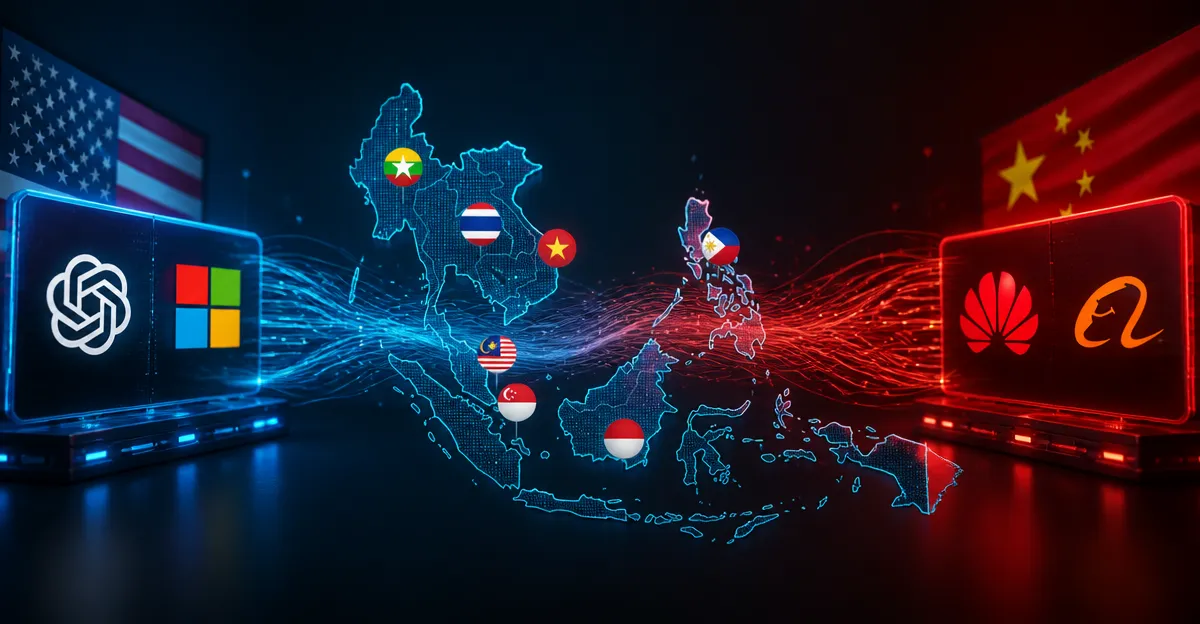
October 17, 2026, (Inside AI) — Southeast Asian nations are being pulled into the escalating artificial intelligence rivalry between the United States and China, raising fears that they may be forced to choose sides, with serious consequences for security and business. The warning comes as both superpowers deepen their AI alliances and export controls, leaving countries like Singapore, Malaysia, and Vietnam to balance competing demands.
The region has long hedged by maintaining ties with both powers, but the rapid militarization and economic weaponization of AI are narrowing that space. Governments worry that picking a side could disrupt supply chains, limit access to critical technology, and expose them to retaliation.
At the heart of the tension is the U.S. strategy of restricting advanced AI chips and tools to China, and China's counter-efforts to build its own tech ecosystem. Southeast Asian countries, which rely heavily on both U.S. and Chinese investment, find themselves in an uncomfortable middle. The stakes are high: AI is projected to add nearly $1 trillion to Southeast Asia's GDP by 2030, according to a 2020 report by Bain & Company, making access to AI technology a core economic interest.
The dilemma is not new. During the Cold War, Southeast Asia struggled to stay non-aligned. Today, the AI divide echoes that era, but with faster-moving technology and deeper economic integration. Unlike traditional trade disputes, AI controls can cut off entire industries overnight.
Read: Opinion: America Can Regulate AI and Still Win the AI Race
For business, the uncertainty is already palpable. Tech firms in the region face conflicting regulations and the risk of being caught in export control dragnets. Security analysts warn that AI systems used for surveillance or defense could become points of leverage. The U.S. has been pressing allies to exclude Chinese equipment from 5G networks, and a similar approach may extend to AI infrastructure.
China, meanwhile, has been courting Southeast Asia with its Global AI Governance Initiative and investments in smart cities and data centers. Chinese tech giants like Huawei and Alibaba have deep ties in the region. The U.S. counters with its own initiatives, such as the Indo-Pacific Economic Framework, which includes AI cooperation.
But the region's governments are wary of any arrangement that forces a choice. "We want to work with all partners," said a senior official from a Southeast Asian trade ministry, speaking on condition of anonymity. "But the pressure is increasing."
The lack of a unified regional stance complicates matters. ASEAN has issued guidelines on AI governance, but they are non-binding. Individual countries are pursuing their own strategies: Singapore aims to be a neutral hub, while others lean closer to one side or the other.
The U.S. has not publicly demanded that Southeast Asian countries choose, but its export controls and diplomatic pressure create de facto divisions. China, too, has warned against "technology containment." The result is a slow-motion bifurcation that could leave the region fragmented.
Read: South Korea to Launch $3.5 Billion Frontier AI Model Program in 2027
For now, Southeast Asian countries are trying to buy time. They are investing in domestic AI capabilities and seeking diversified partnerships. But as the U.S. and China race to set standards and control supply chains, the space for neutrality is shrinking. The region's ability to navigate this divide will shape its economic and security future for years to come.