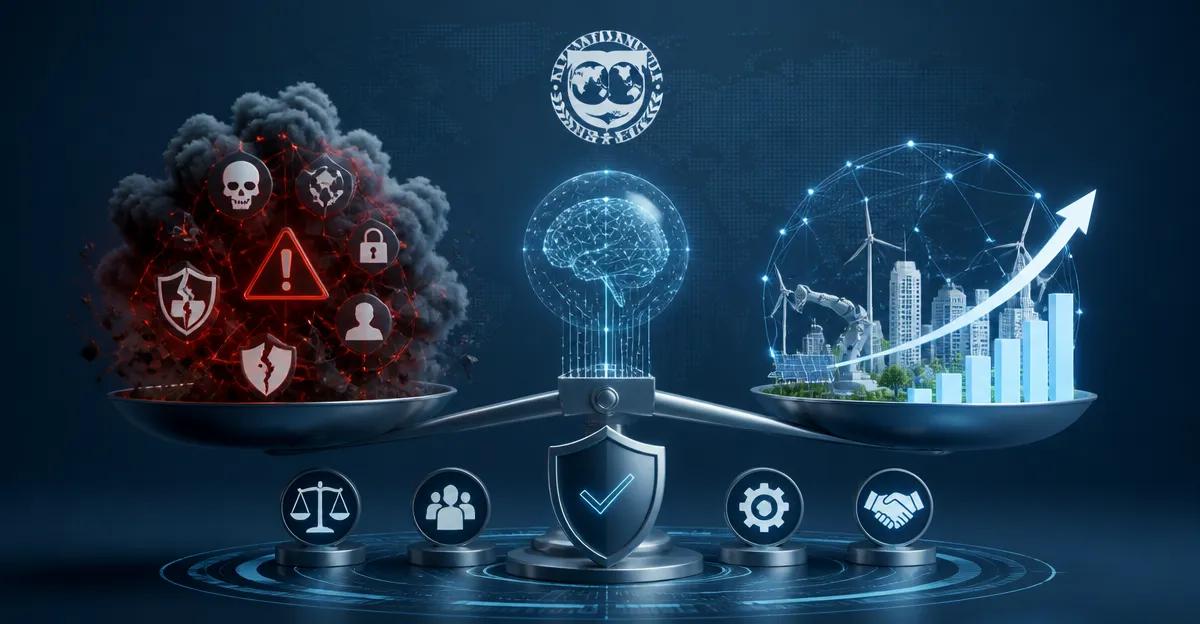
October 16, 2026, (Inside AI) — The International Monetary Fund's managing director, Kristalina Georgieva, warned on Friday that artificial intelligence could pose greater risks than rewards unless governments and industry establish robust safeguards and an ethical framework. Speaking at the IMF and World Bank annual meetings in Bangkok, Georgieva called for a blend of industry self-regulation and input from key governments, arguing that the technology's rapid evolution has outpaced society's ability to govern it.
"If there are no safeguards, then the risks may exceed the opportunities. And above all, we do need an ethical foundation, and I'm not sure we are there as a society," Kristalina Georgieva, Managing Director, International Monetary Fund said during a panel discussion that included Anthropic co-founder Jack Clark.
The warning came as the IMF flagged significant growth and financial stability risks from a potential end to the AI investment boom, high debt levels, and a prolonged war in the Middle East. Georgieva's remarks underscore a growing unease among global financial leaders that the AI frenzy, which has driven record capital expenditures in data centers and semiconductors, may not deliver the productivity gains needed to justify the spending.
Georgieva outlined preconditions for broad-based AI benefits, including access to digital infrastructure, reliable electricity, and adequate regulation. She likened the current state of AI development to Formula One race cars speeding without barriers to protect the audience, a metaphor that Clark extended.
"I think it's Formula One at night, without maybe brakes in the cars," Jack Clark, co-founder, Anthropic said. He argued that setting standards was feasible and already underway through early policy frameworks in the European Union and voluntary commitments in the United States.
Clark said his company regularly tests its systems, publishes details on the tests, and shares the information, but he does not believe such measures should remain entirely voluntary. Asked if he would favor regulation from countries that produce AI, he replied: "Yes. We need common sense standards, and that's how you ultimately give confidence in the technology and build the economy."
The debate over AI governance extends beyond safety to macroeconomic stability. Joachim Nagel, president of the Bundesbank, warned that AI has the potential to increase global imbalances. "That is clear when one considers the large investments required for AI, both in hardware and software development," Nagel said during a separate panel.
Dani Rodrik, a Harvard economist, described AI as a double-edged sword. If productivity gains materialize, they could bring substantial job losses and displacement. If they fail to appear, heavy investment in data centers could trigger a costly financial correction. "We don't know which one of those two crises we're going to have to deal with -- whether it's the jobs crisis or the financial crisis," Rodrik told Reuters after the interdisciplinary WZB Conference in Berlin last week.
The IMF's own analysis, released earlier this week, highlighted that an abrupt end to the AI investment boom could ripple through global markets, especially given elevated debt levels in both advanced and emerging economies. The fund has repeatedly called for a balanced approach that fosters innovation while mitigating concentration risks in the AI supply chain.
Not everyone shares the IMF's risk-focused lens. Erin Browne, US Treasury Undersecretary, said the IMF was too fixated on downside risks and should give more weight to positive economic shocks, such as AI, which the US government now calls "super intelligence." Browne told Reuters on Thursday that Washington was in talks with other IMF shareholders about adopting the new moniker in a joint statement being drafted by the fund's steering committee.
Read: Trump Names Jay Clayton, Three Others to Lead 'Super Intelligence Force' on AI
The terminology shift drew mixed reactions. "I will continue to call it artificial intelligence," Lars Klingbeil, German Finance Minister said. Andrew Bailey, Governor of the Bank of England, struck a more hopeful note on alignment, telling a meeting of the Institute of International Finance that he was more optimistic than a month ago that countries would reach consensus on testing standards for AI. "I'm not sure whether we're supposed to talk about AI now, are we? I did use the phrase the other day 'the artist formerly known as AI'," Bailey said.
Kevin Warsh, Chair of the Federal Reserve, added a lighter moment during a separate panel, telling Georgieva: "Kristalina, you pronounce it AI. In the US we now pronounce it SI."
The push for international standards reflects a broader recognition that AI's cross-border nature defies unilateral regulation. The European Union's AI Act, which entered into force in 2024, remains the most comprehensive regulatory framework to date, while the United States has relied on voluntary commitments from major labs. China has implemented targeted rules for generative AI, and India has issued advisories for responsible AI development.
Industry self-regulation, Georgieva argued, is appropriate given that governments are not well-placed to oversee a constantly changing sector. However, she insisted that self-regulation must include engagement with society and involve countries with the biggest AI sectors, including the US, China, and India, along with nations in the AI supply chain.
The IMF's stance reflects a delicate balance. On one hand, it acknowledges AI's potential to boost productivity and growth. On the other, it warns that without guardrails, the technology could exacerbate inequality, displace workers, and create financial instability. The fund's recent Global Financial Stability Report noted that AI-related equities have become increasingly concentrated, posing risks if sentiment shifts.
As the annual meetings conclude, the conversation around AI governance is far from settled. The divide between those who see AI as "super intelligence" and those who prefer the traditional term underscores a deeper disagreement about how to frame the technology's promise and peril. What remains clear is that the window for establishing effective safeguards is narrowing, and the decisions made in the coming months will shape the global economy for years.