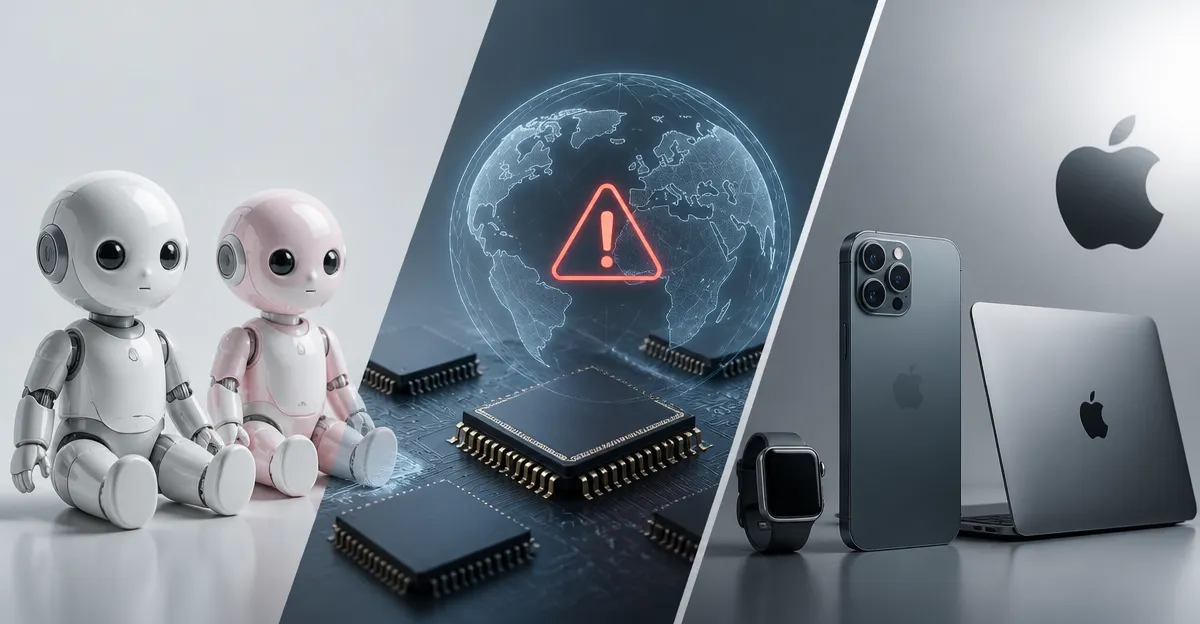
October 16, 2026, (Inside AI) — A new generation of AI-powered robot dolls is emerging as an unexpected flashpoint in the global semiconductor supply chain, as manufacturers scramble to secure chips for toys that now require the same advanced processors as smartphones and smart speakers. The development comes amid persistent chip shortages that have already forced major technology companies to adjust production schedules, with Apple reporting softer-than-expected sales figures this week.
The robot dolls, which feature conversational AI, facial recognition, and adaptive learning capabilities, represent a growing category of consumer products that blur the line between plaything and intelligent assistant. Unlike traditional electronic toys that rely on basic microcontrollers, these devices demand neural processing units, high-bandwidth memory, and low-power AI accelerators. That puts them in direct competition for fabrication capacity with data centers, automotive systems, and flagship handsets.
Industry analysts say the trend reflects a broader shift in how AI silicon is allocated. “The demand for AI chips is no longer confined to data centers or premium phones. It has seeped into every consumer category, including toys,” said Lin Wei, a semiconductor supply chain analyst at Asia Tech Research in Taipei. “When a doll needs more compute than a laptop from five years ago, you know the supply chain is under strain.”
That strain is visible in lead times. According to procurement data from several contract manufacturers in Shenzhen and Taipei, orders for AI-capable system-on-chips now stretch to 32 weeks, up from 18 weeks a year ago. Some toy makers have responded by downgrading features or delaying launches. Others have turned to older process nodes, sacrificing performance for availability.
Read: Nvidia, Broadcom Shielded as AI Power Crunch Hits Chip Supply Chain, Says Morgan Stanley
Apple’s latest quarterly results, released earlier this week, showed a 3% year-over-year decline in iPhone revenue, which the company attributed to “supply constraints and macroeconomic headwinds.” The shortfall underscores how even the world’s most valuable company is not immune to chip allocation challenges. Apple has not commented on whether robot dolls or similar consumer AI devices are affecting its supply chain.
The chip shortage has also revived interest in mature-node fabrication. While the industry focuses on 3nm and 2nm advanced nodes, many AI toys rely on 28nm and 40nm chips, which are cheaper and more widely available. However, capacity for those nodes is also tight, as automotive and industrial customers compete for the same wafers.
In China, the government’s probe into Huang Qifan, the former Chongqing mayor, has added a layer of political uncertainty to technology supply chains. Huang, who served under two disgraced officials, was known for his advocacy of industrial policy and semiconductor self-sufficiency. His investigation could signal shifting priorities in Beijing’s tech strategy, though no official charges have been announced.
Meanwhile, robot doll makers are exploring alternative sourcing. Some have partnered with RISC-V chip designers to reduce reliance on proprietary architectures. Others are investing in edge AI models that run on less powerful hardware, trading accuracy for resilience.
“The real innovation may not be in the doll itself, but in how companies rethink their silicon strategies,” said Priya Raman, a consumer robotics researcher at Singapore’s Institute for Infocomm Research. “The winners will be those who can design around constraints, not those who wait for supply to normalize.”
The situation highlights a broader truth about the AI era: as intelligence migrates into everyday objects, the physical limits of chipmaking become strategic bottlenecks. Robot dolls are just the latest symptom.
Read: Microsoft, Nvidia to unveil new AI laptop at San Francisco event
Looking ahead, industry watchers expect the chip shortage to persist into 2027, with new fabs in Arizona, Japan, and Germany unlikely to ease pressure before late next year. For now, toy makers and tech giants alike are learning to do more with less, and to plan for a world where even a child’s plaything demands serious compute.