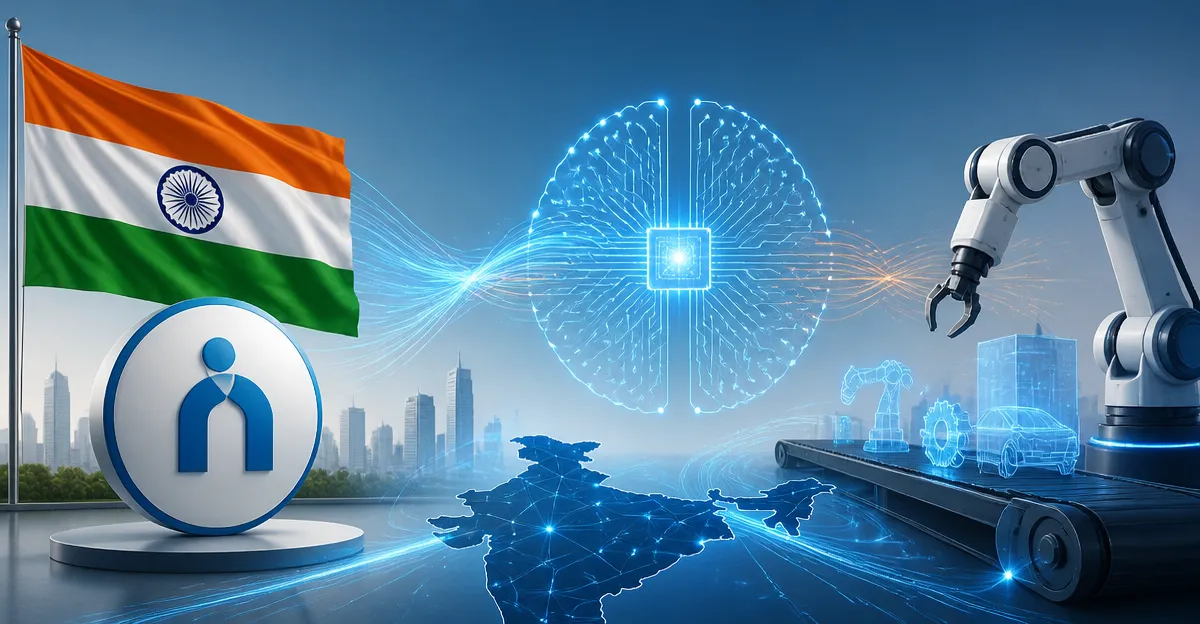
October 31, 2026, (Inside AI) — Kris Gopalakrishnan, the co-founder of Infosys and chairman of Axilor Ventures, has a message for India's $250 billion IT services industry: the AI transition will not destroy it, but it will expose how badly the country has neglected risk capital and research spending. Speaking in a wide-ranging interview, Gopalakrishnan argued that the same horizontal force that is automating code is also opening new integration and data-curation work for services firms. Yet he warned that entry-level hiring has collapsed to near zero and that the market's pessimism, while overdone, reflects a real structural lag.
The stakes are hard to overstate. India's technology services sector employs roughly 6 million people directly and has been the country's most reliable engine of middle-class mobility for three decades. If AI erodes the pyramid model that put fresh graduates on billable projects, the social contract around engineering education changes with it. Gopalakrishnan's diagnosis is that the disruption is real but temporary, and that the bigger long-term risk is a national reluctance to fund the research and product bets that would let India own its AI future rather than rent it.
"AI too is a horizontal technology, but for the first time, we are grappling to understand it. The immediate impact is democratisation of intelligent productivity," Gopalakrishnan said.
He placed the current cycle in a lineage that stretches back to the early 1990s, when Indian firms built the global delivery model on cheap talent and remote software development. That model worked because computing was horizontal and every business process needed automation. AI, he argues, is the same kind of horizontal shock, except this time the country is not simply applying someone else's technology. It is trying to build on top of it while still learning what it does.
Why Entry-Level Hiring Has Frozen
The most immediate casualty is software development itself, which Gopalakrishnan estimates at 15 to 20 per cent of total IT effort. AI can write code faster than humans, though a human remains in the loop to catch bugs. That speed advantage is already reshaping hiring. Entry-level recruitment across major Indian IT firms has fallen to almost zero, a shift that Gopalakrishnan attributes partly to university curricula that take three to four years to adapt.
"If you are passing out this year or the next, you will find it challenging to get a job in the IT industry unless you have AI skills," he said.
His forecast for the sector is steady revenue growth of 3 to 4 per cent with high profitability, a combination that may satisfy operators but disappoint investors accustomed to double-digit expansion. He described the market reaction as an overreaction to an extreme, noting that Indian IT firms remain debt-free, profitable and deeply embedded with clients built over decades.
The deeper analytical point is that India's services model has always absorbed technology shocks by moving labor up the value chain, not by shedding it. The global delivery model survived the internet, cloud and mobile because reskilling happened at a lower cost base than in the West. AI compresses that runway. If a firm can automate junior-level coding, the traditional apprenticeship ladder loses its bottom rung, and the industry must invent a new way to convert raw graduates into experienced engineers. That is a workforce design problem, not merely a technology problem, and no Indian IT major has yet published a credible answer.
"Reskilling happens at a lower cost economy. That's why the profitability is still high. You don't see mass layoffs," Gopalakrishnan said, pointing to global capability centres as evidence that multinationals still trust Indian talent.
On the product economy, he was blunt about the binding constraint. Indian software services were built without venture capital, by bootstrapping on talent and cost. Products require the opposite: upfront risk capital and access to large markets. The domestic market is too small to create global enterprises, which is why Indian software-as-a-service companies relocate to the United States. He noted that the top three banking products in the world and the best logistics products are of Indian origin, and that Indians populate the upper tiers of global product companies. The capability exists. The capital ecosystem does not.
"We have to change our risk appetite as a society," he said, adding that first-generation entrepreneurs are now proving the model works.
On research and development, Gopalakrishnan was more critical of the status quo. He argued that India underinvests because the necessity has not been felt, and that a strong India requires owning the intellectual property that matters strategically. Government can create IP, he said, but only the private sector can commercialise it, market it and build industries around it. He pointed to IIT Madras Research Park, where he was the first investor in 2001, and to IISc as emerging hotbeds, and insisted there are no infrastructural constraints to building world-class labs in India.
Read: Frugal AI Hub's Serish Gandikota: Why Silicon Valley's AI Playbook Is Failing the World
His outlook to 2035 is expansive. He expects India's 4,500 deep-tech startups to grow to at least 45,000, creating product categories and technologies the country owns. He frames healthcare as the sector where India can become a laboratory for the 21st-century world, arguing that the current model spends 70 per cent of healthcare money in the last three years of life when it should be spent from age 20 on wellness and healthy living.
"India has the opportunity to become a laboratory for the 21st-century world," he said.
The cautionary note came from renewables, where solar farms built on assumed government subsidies failed when subsidies disappeared and unit prices fell. Gopalakrishnan said the industry must take big bets knowing many will fail, and that Indian society needs to build failure into its cultural mindset. That may be the hardest reskilling of all.