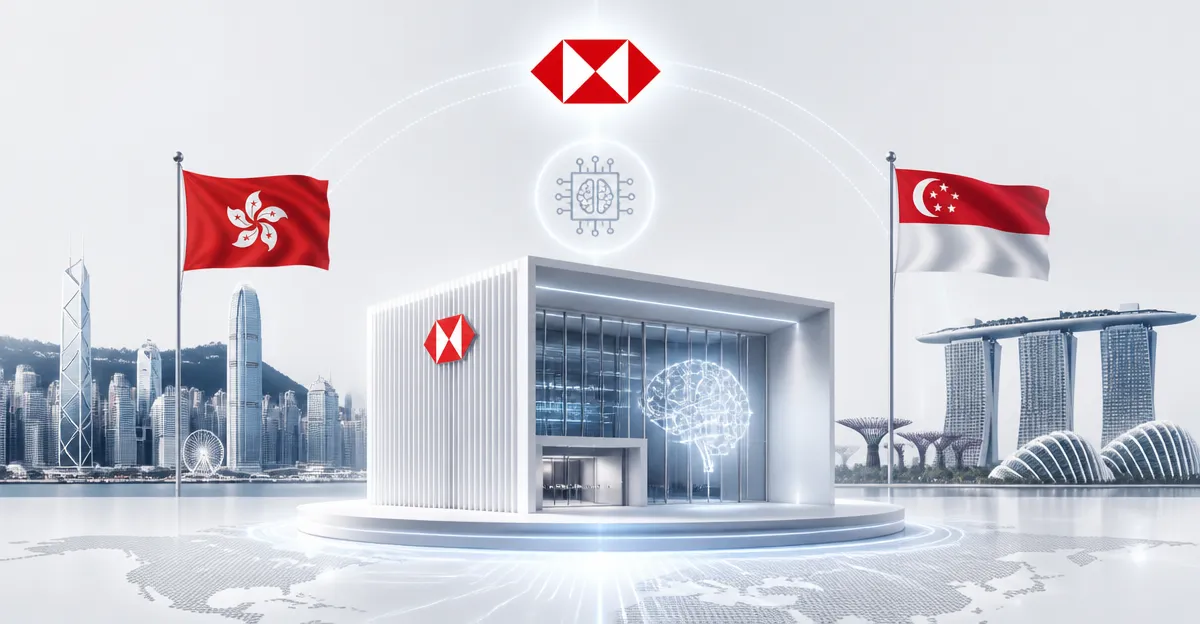
November 2, 2026, (Inside AI) — HSBC will establish an artificial intelligence and emerging technology institute in Hong Kong, aiming to launch it in the first quarter of 2027, Chief Executive Georges Elhedery announced Monday at Hong Kong Fintech Week. The move follows the bank's July launch of an AI centre in Singapore, where it plans to hire more than 100 specialists.
The Hong Kong institute will partner with Hong Kong University of Science and Technology as its anchor academic partner, Elhedery said. He did not disclose headcount details. The bank intends to relocate the centre to Hong Kong's Northern Metropolis, a mega development bordering mainland China, once its site there is ready.
The announcement lands as global banks accelerate AI-driven overhauls that are reshaping workforces. Citi, Standard Chartered, and Barclays have all unveiled plans this year to cut thousands of jobs, citing AI and automation. HSBC, one of Hong Kong's largest private-sector employers with 28,000 local staff, is simultaneously rolling out AI training for its entire global workforce of roughly 200,000 people.
"AI is going to be disruptive. It's going to transform jobs," Elhedery said.
Read: Credit Saison Reports 954% ROI from ChatGPT Enterprise Pilot
The Hong Kong push also reflects broader adoption across the city's banking sector. Around 80% of all banks in Hong Kong are already adopting AI or generative AI, according to Eddie Yue, chief executive of the Hong Kong Monetary Authority, the city's de facto central bank.
Why Hong Kong Is Betting Big on AI
HSBC's decision to anchor the institute at HKUST signals a deeper integration between academia and finance. The partnership could help the bank tap local research talent and build custom models for risk, compliance, and customer service. The Northern Metropolis location, meanwhile, positions HSBC near the Greater Bay Area, a region Beijing has promoted as a technology and innovation hub.
The timing is notable. Hong Kong has faced talent outflows and competition from Singapore as a financial hub. By launching AI centres in both cities, HSBC spreads its bets while aligning with government-backed innovation agendas. The bank has not said how the two centres will divide responsibilities or whether they will collaborate.
HSBC's investment comes amid a broader wave of AI adoption in finance. Banks are using AI for fraud detection, credit scoring, and algorithmic trading, but generative AI tools for customer-facing roles and internal workflows are newer. The bank's global training program suggests it sees AI as a general-purpose technology requiring widespread literacy, not just specialist hires.
The job cuts at peer banks underscore the tension. AI can automate routine tasks, but it also requires new skills. HSBC's approach of training all 200,000 employees contrasts with narrower specialist hiring. Whether that strategy protects jobs or simply reshapes them remains an open question.
HSBC's Hong Kong institute will likely face scrutiny over data privacy, model governance, and the use of customer data. Hong Kong's regulators have been developing AI guidance for financial institutions, and the HKMA has encouraged responsible adoption. The bank has not detailed how it will address these concerns.
Read: Microsoft Offers Voluntary Exit to 60,000 Staff as AI Layoff Narrative Falters
The Northern Metropolis project itself is still under development. HSBC's commitment to move the institute there once a site is ready could take years. In the meantime, the bank will likely operate from existing facilities.
For now, HSBC's announcement adds to a growing list of AI investments by global banks. The focus on Hong Kong and Singapore reflects Asia's importance to the lender. HSBC generates most of its profit in Asia and has been restructuring to focus on the region.
The bank's shares have been under pressure as investors weigh restructuring costs and the impact of AI on profitability. HSBC has not disclosed how much it will invest in the Hong Kong institute.
Elhedery's comments at Fintech Week were brief, but they signal that HSBC sees AI as central to its future. The bank's ability to execute on training, partnerships, and infrastructure will determine whether the institute becomes a model for others or a cautionary tale.