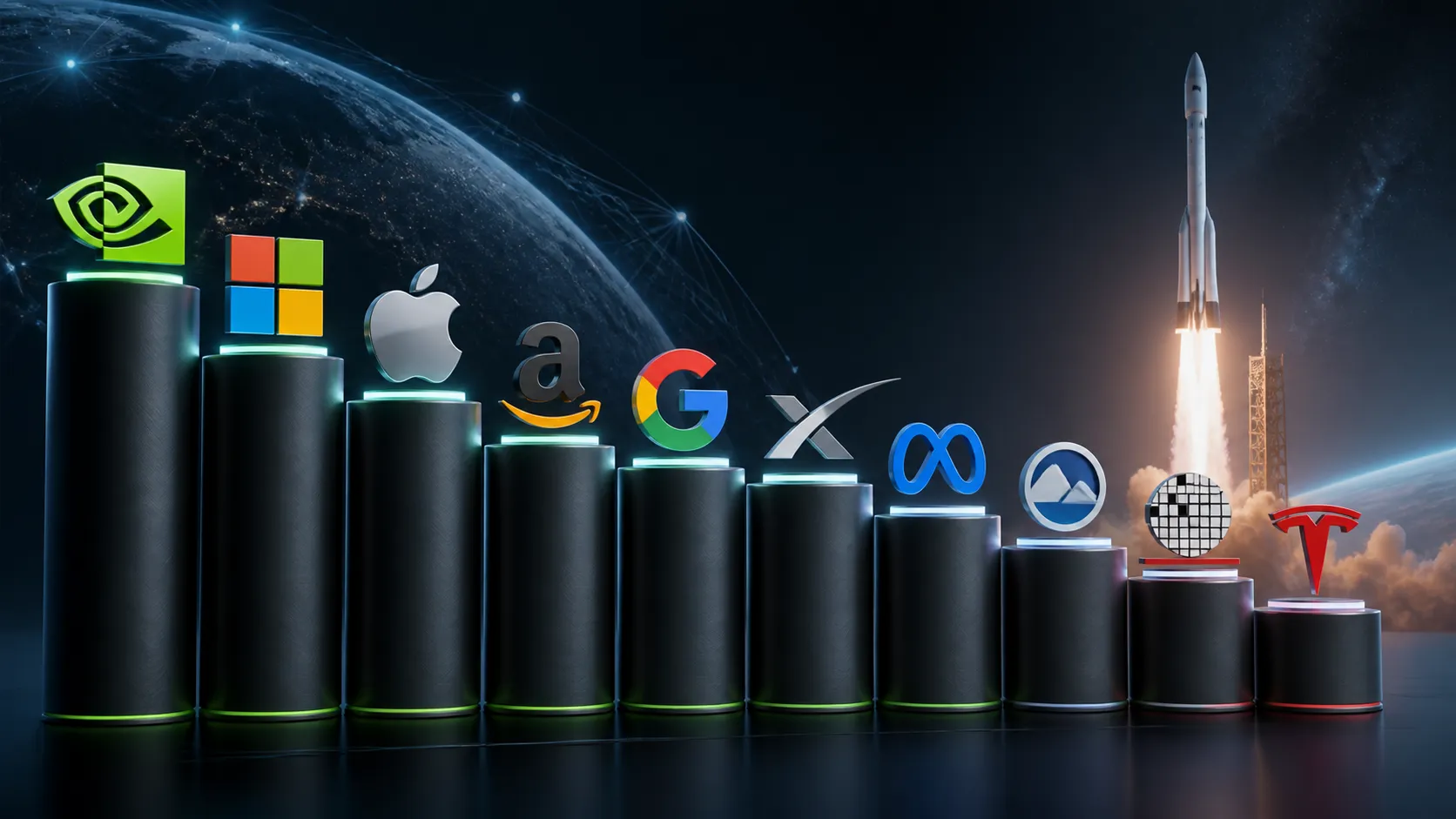
June 16, 2026, (Inside AI) — NVIDIA now holds the top spot among the world’s largest companies by market capitalization, according to 2026 data from companiesmarketcap.com. The chipmaker reached a valuation of $5.145 trillion, overtaking familiar tech titans. Alphabet (Google) follows at $4.479 trillion, with Apple at $4.353 trillion and Microsoft at $2.969 trillion.
The New Hierarchy of Corporate Giants
This year’s ranking underscores a dramatic shift in economic power toward AI infrastructure. NVIDIA’s ascent from a graphics card maker to the essential provider of AI computing hardware has redefined its market position. The list includes seven U.S.-based companies, with Taiwan’s TSMC and Saudi Arabia’s Saudi Aramco as notable exceptions.
Elon Musk’s SpaceX entered the top ten at #6 with $2.519 trillion, a striking valuation for a privately held company. This reflects investor confidence in satellite internet and space exploration. TSMC, the world’s largest contract chipmaker, sits at #7 with $2.289 trillion, while Broadcom claims #8 at $1.874 trillion.
Why NVIDIA’s Lead Matters Beyond the Numbers
Jensen Huang’s company now supplies the GPUs that power most advanced AI systems. Its market cap exceeds the GDP of many nations. This concentration of value in a single hardware firm raises questions about supply chain fragility. Any disruption in NVIDIA’s production could ripple across the global AI industry.
Alphabet and Microsoft, though still massive, have seen their growth rates slow relative to pure-play AI infrastructure providers. Apple’s position at #3 shows resilience but also a dependency on consumer hardware cycles. Amazon’s $2.646 trillion valuation at #5 highlights the enduring power of cloud services and logistics.
SpaceX’s Unusual Path to the Top
SpaceX remains privately held, so its valuation comes from secondary market transactions and funding rounds. Its inclusion at #6 signals that investors see satellite-based internet and space transport as trillion-dollar markets. The company’s Starlink service now has over 10 million subscribers globally.
Critics note that private valuations can be opaque. Public markets might assign a different price. Yet SpaceX’s revenue growth and government contracts provide tangible backing for its $2.519 trillion figure.
The Shifting Sands of Energy and Automotive
Saudi Aramco fell to #9 at $1.721 trillion, a decline from its peak years ago. The transition to renewable energy and fluctuating oil prices have tempered its dominance. Tesla, once the most valuable automaker, now sits at #10 with $1.544 trillion. Increased competition in electric vehicles and Elon Musk’s divided attention may explain the slide.
TSMC’s rise to #7 underscores the geopolitical importance of semiconductor manufacturing. The company’s advanced fabs in Taiwan remain critical for global tech supply chains. Broadcom’s $1.874 trillion valuation at #8 reflects its diversified chip and software portfolio.
What the Ranking Leaves Out
Market capitalization captures equity value but not debt, real assets, or societal impact. Companies like Huawei or ByteDance are absent due to private ownership or regulatory hurdles. The list also reflects a moment in time; tech valuations can swing wildly. Still, the 2026 ranking cements AI hardware as the defining economic force of this decade.
Looking ahead, NVIDIA’s lead may face challenges from custom AI chips by cloud providers. SpaceX’s valuation could test public markets if it ever goes public. For now, the top ten reveal a world where silicon, software, and space shape the largest fortunes.