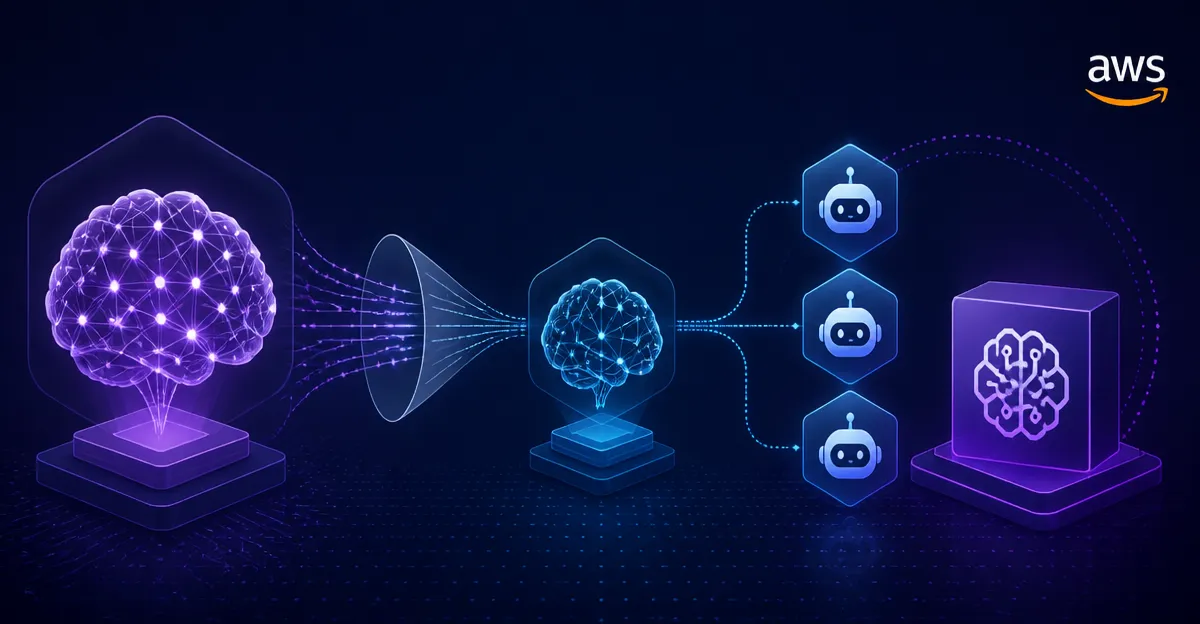
November 3, 2026, (Inside AI) — Amazon Web Services has published a detailed technical walkthrough showing how developers can cut the cost of running AI agents by distilling a large frontier model into a smaller, cheaper model using sequence-level knowledge distillation on Amazon SageMaker AI. The method, outlined in a post from the AWS machine learning team, demonstrates that a 4-billion-parameter model can match the task success rate of a frontier teacher roughly ten times its size on a shopping assistant benchmark, while being cheap enough to host on a single mid-range GPU instance.
The core problem the post addresses is the economics of agentic AI. Unlike a single chatbot query, an agent performs multiple model calls per task: searching, reading results, refining queries, and verifying constraints. Each of those calls to a frontier model costs money, and at production scale that per-task expense compounds quickly. The AWS team argues that knowledge distillation offers a way out by transferring the behavior of a large teacher model into a smaller student model, preserving much of the quality at a fraction of the serving cost.
Why Frontier Models Are Too Expensive for Agents
The walkthrough focuses on a specific technique called sequence-level knowledge distillation, or SeqKD. It uses a teacher model to generate complete multi-step trajectories, keeps only the ones that solve the task, and then fine-tunes a smaller student model on those successful runs using supervised fine-tuning. The approach requires only the teacher's text outputs, not its internal logits or weights, which makes it compatible with closed API-only frontier models like those available on Amazon Bedrock.
The AWS post is careful to frame SeqKD as a cost-effective first step rather than a complete solution. It notes that some of the strongest small reasoning models, including the DeepSeek-R1 distilled variants, were built in significant part with this method. The technique works best when the task is within the student's capacity and when high-quality target outputs are scarce or expensive to produce manually.
For the demonstration, the team used GLM-5.3 on Amazon Bedrock as the teacher and a Qwen3.5-4B model as the student. The task was ShoppingBench, a benchmark of 750 synthesized shopping problems split into training and held-out evaluation sets. The teacher generated two trajectories per training problem at temperature 1.0, producing 850 runs. The benchmark's own programmatic scorer then filtered those down to only the trajectories that met every stated constraint, yielding about 2,600 training rows after encoding each step as a separate chat turn.
The training itself ran on SageMaker AI model customization with serverless supervised fine-tuning, using a LoRA rank of 64 and a sequence length of 16,384 tokens. No training script or container management was required. The resulting model package was then evaluated in two stages: first a low-cost managed pre-check using SageMaker AI model evaluation, then a full end-to-end agent loop on the held-out test set.
The 4B Student Matches Its Teacher
The headline result is striking. On the 324 held-out ShoppingBench problems, the distilled 4B student achieved an Absolute Success Rate of 0.541, essentially matching the sampled GLM-5.3 teacher at 0.511 and the greedy teacher at 0.540. The base Qwen3.5-4B model without fine-tuning scored significantly lower. A medium-sized frontier model run as an agent served as a practical ceiling, and the student approached that level as well.
The AWS team also quantified the importance of keeping the teacher's reasoning in the training targets. When the same student was trained on the same trajectories but with the reasoning stripped out, leaving only bare tool calls, average success rate dropped from 0.541 to 0.415. The reasoning between actions is not narration to discard, the post argues, but part of the behavior that solves the task.
The tradeoff is a measurable loss in general instruction-following ability. On the IFEval benchmark, the student's prompt-strict score fell from 0.819 to 0.741, and its instruction-strict score dropped from 0.872 to 0.813. The AWS team describes this as the expected cost of specialization and notes that a much larger drop would signal that distillation had narrowed the model too far.
The economic logic is as much about cost structure as model size. A frontier API charges per token on every step of every task, so expenses scale with usage. A distilled student hosted on a dedicated endpoint bills by the hour regardless of traffic, turning a variable per-request cost into a fixed infrastructure cost. The smaller the model, the smaller that fixed cost. AWS declined to publish a per-task cost or latency figure, noting that those depend on traffic patterns, sequence lengths, and concurrency, and encouraged teams to measure on their own workloads.
The post also candidly addresses limitations. SeqKD transfers a distribution the student can already represent, not raw capability it lacks. If the gap between task difficulty and student capacity is too large, the student learns to imitate the teacher's format without learning to solve the problem. Traces lengthen while accuracy stays flat. The AWS team recommends growing the student or lowering task difficulty when that symptom appears. SeqKD also plateaus on the hardest problems where the student must recover from its own mistakes, which is where on-policy methods become necessary as a second stage.
For deployment, the distilled student runs as a LoRA adapter on top of the base model, served as two inference components on a single real-time SageMaker endpoint. The base weights load once, and the adapter adds only adapter-sized memory, allowing side-by-side comparison of base and distilled models on the same hardware. The team used the Deep Java Library Large Model Inference container with the vLLM engine pinned to a specific version for reproducibility.
Read: Zhang Yiming Says ByteDance’s Seed Team Won’t Rely on AI Distillation
The broader significance is that agentic AI deployments have reached a point where cost engineering matters as much as model capability. As enterprises move from prototypes to production, the per-task economics of multi-step agents become a board-level concern. AWS's walkthrough offers a concrete, reproducible recipe for teams facing that pressure, though it also makes clear that distillation is not a one-time fix. The hardest tail of problems still requires on-policy methods that let the student learn from its own rollouts, which the post explicitly leaves for a future installment.