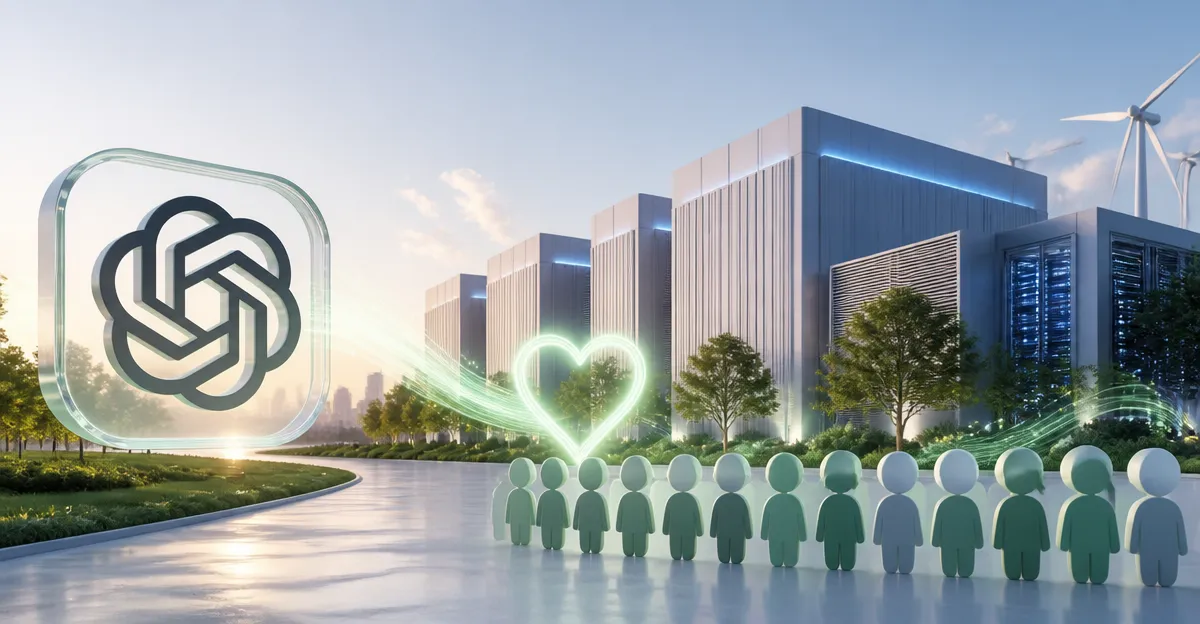
November 5, 2026, (Inside AI) — OpenAI on Thursday unveiled a set of policies aimed at rebuilding public trust in its data center expansion, just days after U.S. midterm elections delivered a sharp rebuke to the tech industry's infrastructure plans. The company said it will stop using non-disclosure agreements with public officials during site negotiations and will give residents access to construction plans detailing traffic, noise, and lighting impacts. The move comes as Democrats flipped governorships in Texas, Georgia, and Ohio with candidates who pledged to pause new data center permits, and as 40 of 41 data center-related ballot measures voted on this week went against such projects, according to Ballotpedia.
The timing is not coincidental. OpenAI's policy rollout, in the works since August, follows an election cycle that has turned data centers into a political flashpoint. Investors responded swiftly: shares of data center operators and power companies tumbled on Wednesday as markets bet on tougher permitting and slower construction. For OpenAI, the stakes are existential. The company relies on partners like Oracle to build and own much of its infrastructure, and any permitting slowdown directly threatens its ability to scale. The charm offensive is less a PR exercise than a survival strategy.
Can Job Promises Outweigh Voter Backlash?
OpenAI's chief global affairs officer, Chris Lehane, argued that modern AI data centers differ fundamentally from the warehouse-style facilities that sparked local opposition. "These projects are not the types of data centers that people have historically thought about, which are some version of a black box in a pasture that did very little in terms of the economic utility for the communities they were in," Chris Lehane, chief global affairs officer at OpenAI, told reporters. He said hardware inside the centers needs updating every three to five years, creating ongoing jobs rather than one-time construction work. One facility in southern Ohio is expected to create 2,500 long-term jobs with an average annual salary of $80,000, he said.
Yet the electoral evidence suggests voters are not buying that argument. The Democratic sweep included governorships in states that have been prime targets for data center development. In Ohio, where OpenAI's facility is planned, the incoming governor has promised to tighten construction rules. The ballot measure results were even more lopsided: only one of 41 measures supported data centers. That is a near-total rejection at the local level, and it signals that job promises alone may not overcome concerns about energy use, water consumption, and land impacts.
OpenAI's new transparency measures are a direct response to those concerns. By ending NDAs with public officials and sharing construction plans, the company hopes to defuse accusations of backroom deals. But the policies stop short of granting communities veto power or committing to specific environmental standards. The company also faces skepticism from Democrats, despite Lehane's deep ties to the party. He served as a top lawyer and spokesperson during the Clinton administration and was press secretary for Vice President Al Gore's presidential campaign. When asked how OpenAI would address Democratic skepticism, Lehane pointed to that experience.
The political shift has broader implications for the AI industry. OpenAI officials, like many peers, spent the last two years cultivating ties with the Trump administration, with CEO Sam Altman donating $1 million to Trump's inaugural committee and attending his second inauguration. Greg Brockman, OpenAI's president, donated $25 million in his personal capacity to a Trump super PAC last year. Now, with Democrats gaining ground in states critical to data center buildout, those relationships may offer less cover. "We need to do a better job of really communicating to people, to local communities, about why data centers can be beneficial to them," Greg Brockman, president of OpenAI, said at a separate event on Wednesday.
The company's challenge is compounded by the structure of its infrastructure deals. Partners like Oracle build and own the facilities, meaning OpenAI does not directly control construction timelines or community engagement. That separation could complicate efforts to present a unified front. It also raises questions about whether OpenAI's new policies will apply to partner-built sites or only to facilities it directly manages. The company did not specify.
For the AI industry, the midterm results represent a warning. The data center boom has been a major driver of stock market gains and energy demand, but it has also generated local opposition that politicians are now eager to harness. OpenAI's response, while swift, may be too late in states where permits are already under review. The company's ability to adapt to this new political reality will determine whether it can maintain its aggressive expansion plans.
Read: Oracle Cancels $7B Tencent AI Chip Lease Under US Pressure
Other tech giants are watching closely. If OpenAI's transparency measures succeed in shifting public opinion, they could become a model for the industry. If they fail, the backlash could intensify, leading to stricter regulations and higher costs across the board. For now, OpenAI is betting that openness and job promises can win over skeptical communities. The coming months will reveal whether that bet pays off.

Sofia spent years studying how machines parse human language before pivoting to cover the systems now rewriting it. She reads technical papers the way others read news and looking for what the numbers are actually saying beneath the headlines.