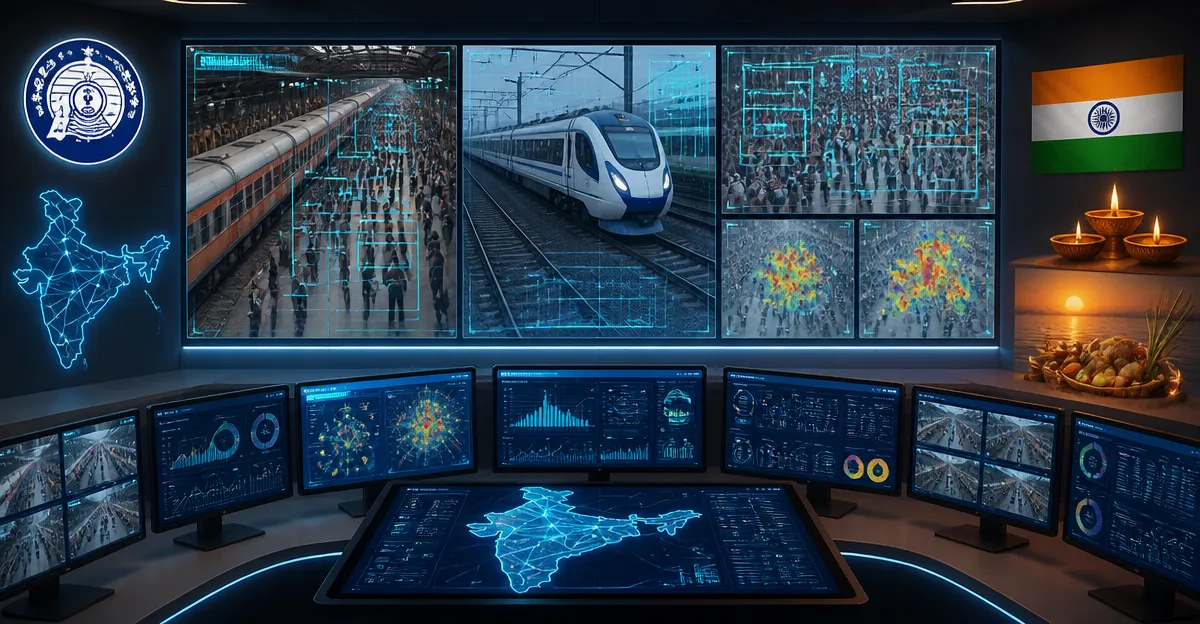
November 7, 2026, (Inside AI) — Indian Railways has deployed an AI-powered war room at Rail Bhawan in New Delhi to manage the festive rush of Diwali and Chhath Puja, Railway Minister Ashwini Vaishnaw said after reviewing the facility on Saturday. The centralised monitoring hub tracks live CCTV feeds from 28 major railway stations and uses AI to analyse crowd movement and incidents in real time.
The system covers platforms, foot-over bridges, and station surroundings, allowing officials to zoom in on specific locations and coordinate responses. It also monitors train movements and delays, helping officials identify disruptions and take corrective action. The war room is part of a broader effort that includes more than 18,000 special trains this year, up from around 12,000 last year, and 700 AI-enabled cameras deployed for monitoring.
Vaishnaw said preparations for the festive rush began nearly six months in advance, with special attention to the expected increase in passengers ahead of Chhath Puja. The war room is among several measures, including dedicated passenger holding areas at around 20 stations, separate ticket counters, and multiple scanning facilities.
Inside the High-Tech Hub
The war room at Rail Bhawan serves as a centralised monitoring and coordination facility. Live CCTV feeds cover important areas such as platforms, foot-over bridges, and station surroundings. Officials can zoom in on individual camera feeds to closely examine specific locations and assess situations.
Read: USDA AI validation tool
AI-based systems support the real-time monitoring process by helping officials analyse activities and incidents at different locations and initiate timely responses. Apart from crowd management, the war room also helps track train movements and delays in real time. By identifying disruptions and analysing their causes, officials can take corrective measures to improve punctuality and ensure smoother train operations.
"The war room is a game-changer for crowd management during festivals," Vaishnaw said. "It allows us to monitor 28 stations simultaneously and respond quickly to any situation."
The 28 stations monitored through the war room include New Delhi, Anand Vihar Terminal, Hazrat Nizamuddin, Secunderabad, SMVT Bengaluru, MGR Chennai Central, Chennai Egmore, Mumbai Central, Lokmanya Tilak Terminus, CSMT Mumbai, Ahmedabad, Surat, Udhna, Pune, Varanasi, Banaras, Gorakhpur, Sealdah, Howrah, Jaipur, Dadar, Nagpur, and Vijayawada, among others. War rooms have also been established at major stations, where officers from all departments work in coordination to manage crowd situations.
The use of AI in railway crowd management is not entirely new. Indian Railways has been experimenting with AI-based surveillance systems at select stations since 2021, when it piloted a project at New Delhi and Varanasi stations. The system uses computer vision to detect overcrowding and alert officials. However, the scale of the current deployment, covering 28 stations and 700 cameras, marks a significant expansion.
Industry analysts note that such systems can improve response times but also raise privacy concerns. "AI surveillance can be effective for crowd management, but it must be accompanied by clear data protection safeguards," said a senior official at the Centre for Railway Information Systems (CRIS), who spoke on condition of anonymity. "The railways have been careful to limit data retention and access."
Inside AI could not independently verify the exact capabilities of the AI systems or the data retention policies.
Will AI Ease the Festive Crush?
The festive season in India sees millions of passengers travelling by train, often leading to overcrowded stations and delays. The war room aims to address these challenges by providing real-time visibility and enabling quick decision-making. The minister's review comes at a critical time, as Chhath Puja, which involves mass travel to home towns, is approaching.
Read: AI-assisted board governance
Vaishnaw highlighted that the number of special trains has increased by 50% compared to last year, which should help accommodate the surge. However, experts point out that infrastructure constraints at major stations remain a challenge. "AI can help manage crowds, but it cannot create more space," said a railway official not authorized to speak to the media. "We need long-term solutions like station redevelopment."
The war room also integrates with other railway systems, such as the National Train Enquiry System (NTES) and the Passenger Reservation System (PRS), to provide a comprehensive view of operations. This integration allows officials to correlate train delays with passenger flow and adjust resources accordingly.
While the use of AI in railway operations is expanding, the railways has not disclosed the cost of the war room or the AI systems. The minister did not provide details on the budget or the vendors involved.
As the festive season progresses, the effectiveness of the war room will be closely watched. If successful, it could serve as a model for other public transport systems in India and beyond. For now, the railways is betting on technology to ensure a smoother experience for millions of passengers.

Shamil has a low tolerance for AI that only works in controlled demos. He covers agentic systems and generative AI with the skepticism of someone who has seen too many “revolutionary” tools quietly disappear six months after launch.