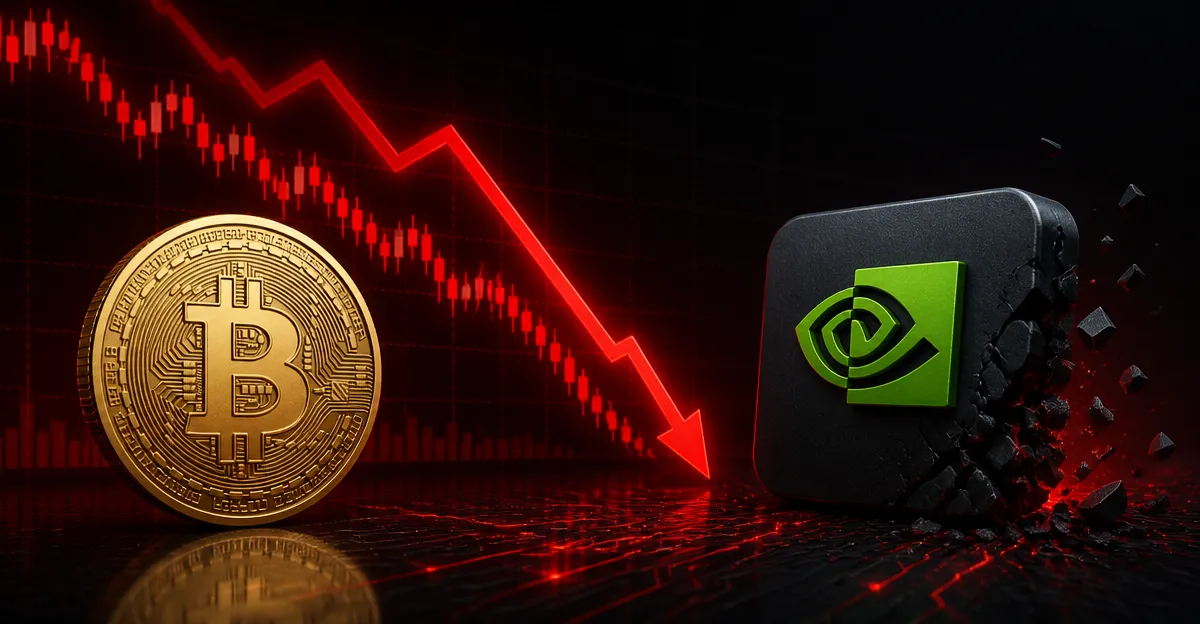
November 13, 2026, (Inside AI) — Bitcoin dropped below $72,000 on Thursday for the first time since August 20, as US financial markets absorbed the shock resignation of Nvidia CEO Jensen Huang. The leading cryptocurrency fell as much as 3.5% during the session and has now lost 7.4% in November. Nvidia shares plunged nearly 13% at the opening bell before paring losses to around $160, still down 7.2% on the day. The chipmaker named CFO Colette Kress as interim CEO while the board searches for a permanent successor.
The dual selloff underscores how tightly crypto and AI-linked equities have become intertwined. Nvidia, the world's most valuable semiconductor firm, has served as the bellwether for the entire AI trade. When its leadership falters, risk appetite across digital assets follows. Bitcoin's slide below its 21-week simple moving average of $73,078 signals deeper technical weakness. Crypto liquidations hit roughly $730 million in 24 hours, according to market data, reflecting heightened volatility. Investors now await Friday's US Producer Price Index report, which could ease fears of further Federal Reserve rate hikes if inflation comes in lower than expected.
Why Nvidia's Leadership Shock Reverberates In Crypto
The resignation of Huang, who built Nvidia into the backbone of the AI boom, caught markets off guard. His departure raises immediate questions about the company's strategic continuity. Nvidia's GPUs power everything from large language models to data center infrastructure, and its stock has become a proxy for AI sentiment. Colette Kress, a seasoned finance executive, steps into the interim role. But the board's search for a permanent leader introduces uncertainty into a sector that thrives on clear vision.
Bitcoin's correlation with tech stocks has strengthened over the past two years. Institutional investors often treat both as risk-on assets. When Nvidia sneezes, crypto catches a cold. The liquidation cascade of $730 million shows how leveraged positions unwind quickly. Analysts point to the 21-week moving average as a key trend indicator. Bitcoin's break below that level could invite further selling pressure.
"A lower-than-expected inflation reading could ease concerns about additional Federal Reserve interest rate hikes and support a recovery in risk assets," said one market strategist who spoke on condition of anonymity. The PPI report on Friday will be scrutinized for clues about the Fed's next move. Any sign of cooling inflation might stabilize both equities and crypto.
This is not the first time Nvidia news has moved crypto markets. In past cycles, earnings surprises or product delays from the chipmaker have triggered short-term volatility in Bitcoin. The difference now is scale. Nvidia's market capitalization exceeds $1 trillion, and its leadership transition carries outsized weight. The company's interim CEO, Kress, has served as CFO since 2018 and is well-regarded on Wall Street. Yet the absence of a permanent AI visionary at the helm leaves a gap that competitors like AMD and Intel may exploit.
For crypto traders, the focus remains on macro data. The $730 million liquidation event wiped out leveraged longs, but spot volumes remain relatively healthy. Some analysts argue that Bitcoin's drop below $72,000 is a buying opportunity. Others warn that a break below $70,000 could accelerate losses. The 21-week moving average has historically acted as support during bull runs. Its breach now suggests a shift in momentum.
Nvidia's stock recovery from its opening plunge to $160 indicates some dip-buying interest. But the 7.2% daily loss still ranks among the worst single-day performances this year. The company's board has not set a timeline for naming a permanent CEO. Kress will manage day-to-day operations while the search proceeds. Investors will watch for any strategic missteps or executive departures in the coming weeks.
Beyond the immediate price action, the episode highlights a structural risk in the AI trade: concentration. Nvidia's dominance means its internal stability affects the entire ecosystem. Bitcoin, often touted as an uncorrelated asset, has proven sensitive to tech sector shocks. That correlation may persist as long as institutional capital flows through the same risk channels.
Friday's PPI report could provide a temporary reprieve. A soft inflation print might revive hopes for a Fed pause, lifting both Nvidia and Bitcoin. But the leadership vacuum at Nvidia remains a wildcard. The board's next move will be watched closely by AI investors and crypto traders alike. For now, the market has delivered a clear verdict: when Nvidia stumbles, Bitcoin feels the tremors.

Shamil has a low tolerance for AI that only works in controlled demos. He covers agentic systems and generative AI with the skepticism of someone who has seen too many “revolutionary” tools quietly disappear six months after launch.