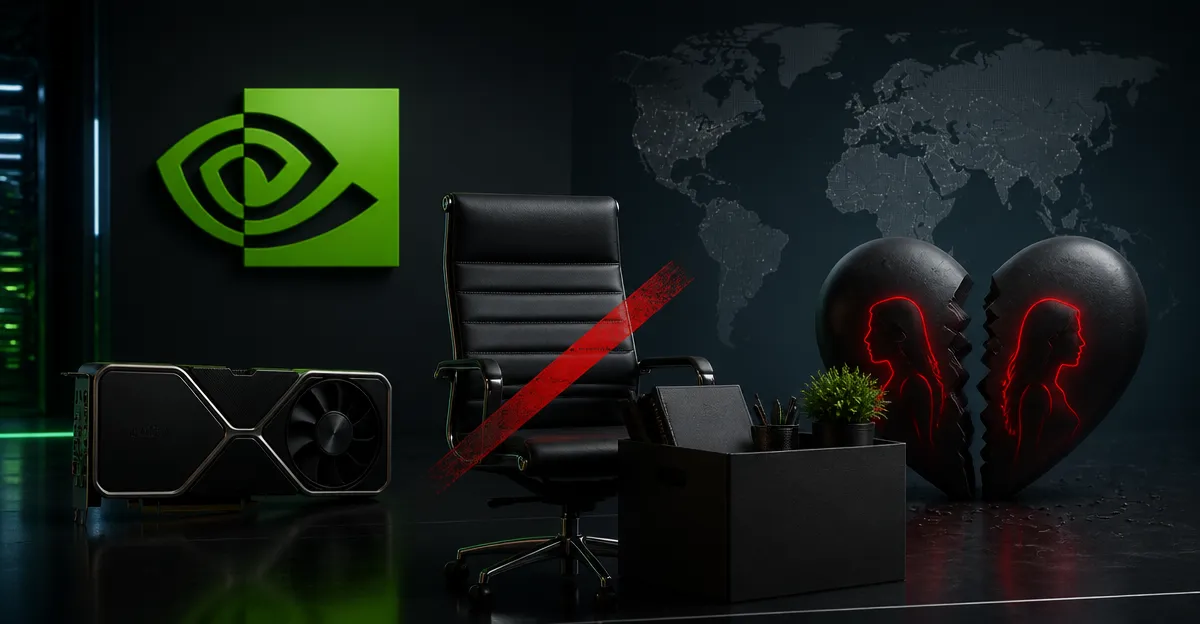
November 12, 2026, (Inside AI) — Jensen Huang has resigned as chief executive of Nvidia, the world's most valuable semiconductor company announced on Thursday, days after revelations about his affair with a woman who is accused of being a Chinese spy.
The announcement follows news reports on ...
The resignation marks a stunning fall for Huang, who co-founded Nvidia in 1993 and built it into a $3 trillion giant powering the global AI boom. His departure raises immediate questions about leadership stability at a company whose chips underpin everything from ChatGPT to autonomous vehicles.
Nvidia's board said it had accepted Huang's resignation and would name an interim CEO shortly. The company's shares, which had already fallen sharply on the affair allegations, were halted in premarket trading.
The woman at the center of the scandal has not been publicly identified. U.S. officials have not commented on the espionage accusation, which Inside AI could not independently verify.
The timing is critical. Nvidia is in the middle of a massive production ramp for its Blackwell and Rubin AI chips, and faces antitrust scrutiny in multiple jurisdictions. A leadership vacuum could disrupt supply chain negotiations and partnerships with Microsoft, Google, and Amazon.
Huang's resignation also complicates the U.S. government's AI chip export controls, which he had personally lobbied against. His successor will inherit a delicate balancing act between Washington's security concerns and Nvidia's global sales.
The board's handling of the affair allegations will be closely watched. Corporate governance experts say the spy accusation, if substantiated, could trigger national security reviews and force Nvidia to sever ties with certain suppliers or customers.
Huang has not commented publicly. His lawyer did not respond to requests for comment.
Nvidia's co-founders, Chris Malachowsky and Curtis Priem, remain on the board but have not been named as candidates for CEO. The company's president, Colette Kress, is seen as a possible interim leader.
The scandal has already reverberated through Silicon Valley. Rivals AMD and Intel saw their shares rise on hopes of Nvidia weakness. The broader AI sector, however, fell on fears of contagion.
Analysts at Morgan Stanley said in a note that Nvidia's technology roadmap is likely safe in the near term, but customer confidence could erode if the leadership transition drags on.
Huang's personal fortune, tied largely to Nvidia stock, has shrunk by billions since the allegations surfaced. He had been one of the most visible CEOs in tech, known for his leather jackets and marathon keynote presentations.
The company will hold a press conference later today. Inside AI will update this story as more information becomes available.

Shamil has a low tolerance for AI that only works in controlled demos. He covers agentic systems and generative AI with the skepticism of someone who has seen too many “revolutionary” tools quietly disappear six months after launch.