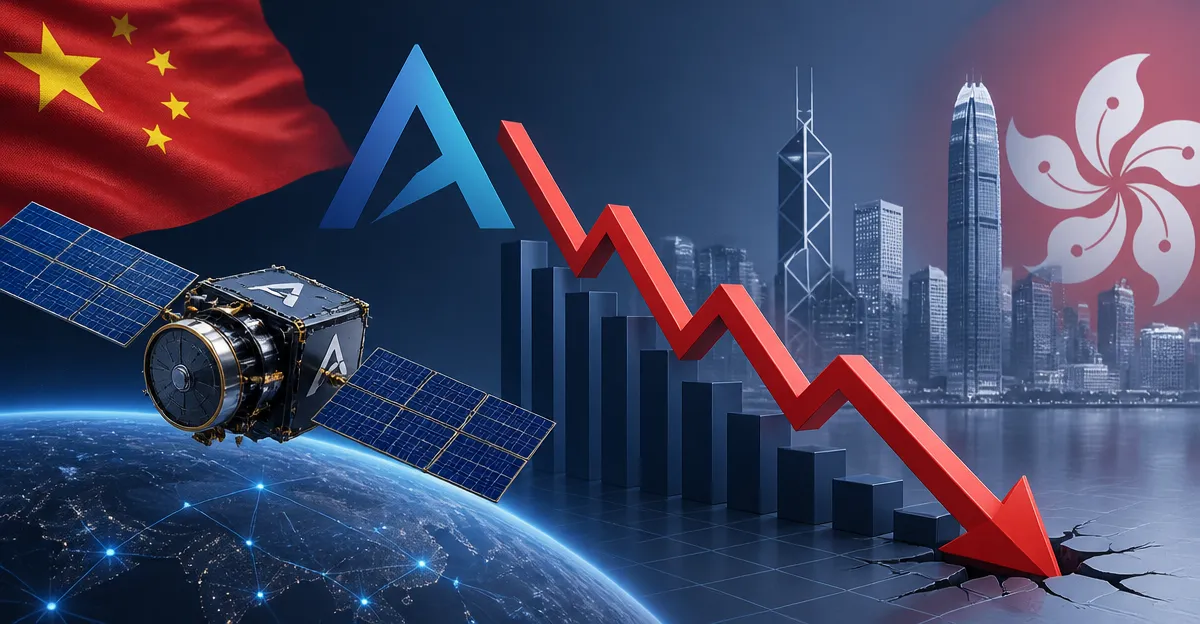
November 13, 2026, (Inside AI) — Chinese AI satellite maker Adaspace Technology slipped 1.2% in its Hong Kong market debut on Friday, after raising HK$750 million (US$95.6 million) in an initial public offering. The lackluster start came despite the company's position in China's commercial space sector, which has drawn increasing government support and investor interest. Adaspace, which trades under the stock code 6935.HK, uses artificial intelligence to process satellite data and provide analytics for sectors such as agriculture, forestry, and disaster monitoring. The company's shares opened lower and never recovered, closing below the IPO price.
The weak debut highlights a broader disconnect between China's ambitious space plans and the appetite of public market investors. Adaspace's IPO was one of the first in Hong Kong by a Chinese AI satellite firm, and its performance may set a benchmark for others waiting to list. The company's technology combines low Earth orbit satellites with AI algorithms to deliver real-time insights, a niche that has attracted venture funding but remains unproven on the public stage. With global competition in satellite data services intensifying, Adaspace now faces the challenge of delivering returns to shareholders while scaling its constellation.
Why AI Satellites Struggle To Win Public Investors
Adaspace operates in a capital-intensive industry where satellite manufacturing, launch costs, and ground infrastructure require sustained investment. The company's AI models analyze imagery and sensor data to detect changes in land use, track natural disasters, and monitor crop health. However, the market for such services is crowded with competitors, including state-backed entities and private firms like Chang Guang Satellite Technology, which has its own constellation. Investors may be wary of Adaspace's path to profitability, given the long sales cycles and reliance on government contracts.
The IPO raised HK$750 million, a modest sum compared to some tech listings, and the 1.2% drop suggests that early buyers were few. According to sources familiar with the offering, the deal was priced at the lower end of its range, reflecting cautious demand. The company plans to use the proceeds to expand its satellite network and invest in AI research. Yet the tepid reception raises questions about whether public markets are ready to value AI-driven space companies, especially those with limited revenue history.
Read: Anthropic IPO Pricing Test
This debut comes amid a wave of Chinese tech IPOs in Hong Kong, as regulators encourage listings to boost the city's status as a financial hub. But investors have grown selective, favoring firms with clear profitability over speculative growth stories. Adaspace's slip may signal that AI satellites, despite their technological promise, are not yet a sure bet. The company's ability to secure government contracts and demonstrate commercial traction will be critical in the coming quarters.
Read: Public Funds AI Investment
For now, Adaspace's listing adds a new name to Hong Kong's tech board, but its first-day performance underscores the gap between innovation and investor returns. As the company navigates the public markets, its progress will be watched by peers and policymakers alike, who see commercial space as a strategic priority. Whether Adaspace can turn its AI advantage into sustainable profits remains an open question, one that will define its next chapter.

Shamil has a low tolerance for AI that only works in controlled demos. He covers agentic systems and generative AI with the skepticism of someone who has seen too many “revolutionary” tools quietly disappear six months after launch.