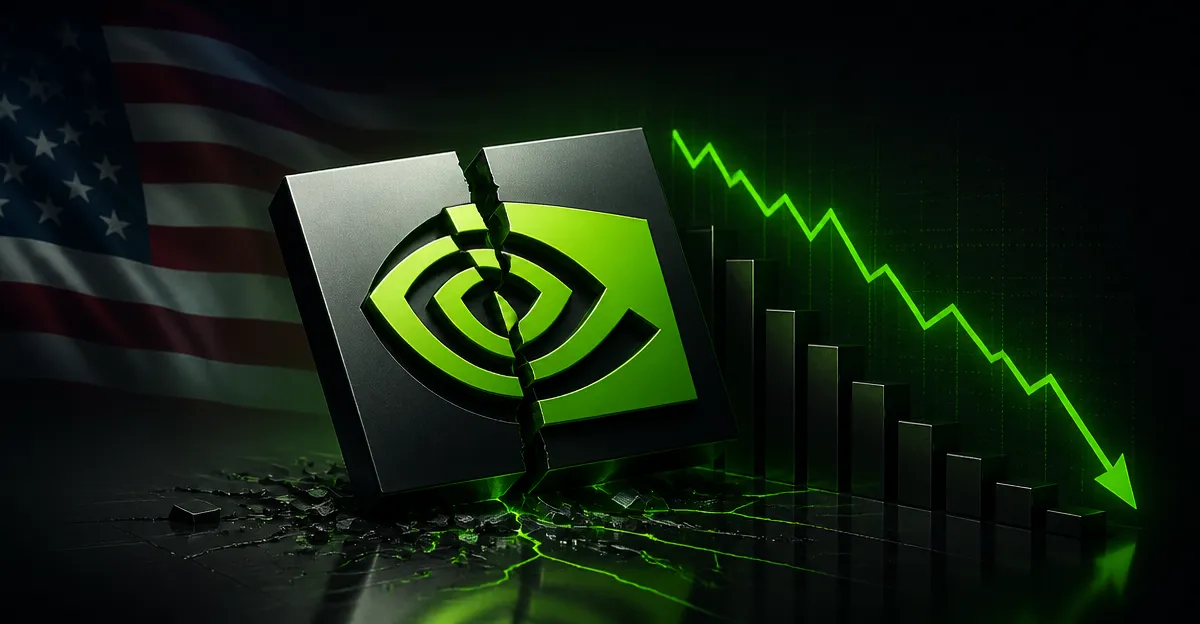
November 13, 2026, (Inside AI) — Nvidia shares fell nearly 10% in early trading Thursday after the company disclosed that CEO Jensen Huang, 63, would take an indefinite medical leave. The announcement, made after Wednesday's market close, rattled investors worldwide and wiped billions from the chipmaker's market value. The crisis has thrust a long-simmering governance question into the spotlight: what happens to a multitrillion-dollar empire when its visionary founder steps away?
Nvidia has become the backbone of the artificial intelligence boom, supplying the graphics processing units that power everything from large language models to autonomous vehicles. Huang, who co-founded the company in 1993, has been its public face and strategic compass for three decades. His absence, even temporary, leaves a void that few corporations are prepared to fill.
The immediate market reaction reflects deep unease about succession planning at founder-led tech giants. Unlike rivals such as Microsoft and Apple, which have established clear lines of succession, Nvidia has no publicly designated heir apparent. The board has not named an interim leader, and the company declined to comment on Huang's condition or a timeline for his return.
Founder Dependency Is a Double-Edged Sword
Huang's leadership has been central to Nvidia's rise. He bet early on accelerated computing, a gamble that paid off spectacularly when AI workloads exploded. His personal credibility with developers and investors has often translated into premium valuations. But that same concentration of influence creates fragility. When a single individual embodies a company's strategy and culture, any disruption to that person becomes an existential risk.
Analysts note that Nvidia's technical moat remains formidable. Its CUDA software platform locks in developers, and its latest Blackwell chips are in high demand. Yet the market's reaction suggests that investors see Huang as more than a figurehead. He is the chief architect of Nvidia's ecosystem, and his relationships with key customers like OpenAI and Google Cloud are deeply personal.
“The market is pricing in uncertainty, not a change in fundamentals,” said Dan Ives, managing director at Wedbush Securities. “Huang is Nvidia's story, and without him, the narrative becomes harder to tell.”
Inside AI could not independently verify the exact nature of Huang's medical condition. The company's statement offered few details, citing privacy concerns. A person familiar with the matter, who spoke on condition of anonymity, said Huang is undergoing treatment and remains engaged with senior leadership, though his day-to-day involvement has paused.
This is not the first time a tech giant has faced a founder health scare. Steve Jobs's prolonged illness at Apple prompted similar questions about succession, ultimately leading to Tim Cook's appointment. Apple's transition was smooth because the board had a plan. Nvidia's board has not publicly outlined one, and that silence is now being tested.
The broader AI industry also has a stake. Nvidia's chips are the scarce resource underpinning the generative AI revolution. Any perception of instability at the company could ripple through supply chains and investment decisions. Competitors like AMD and Intel are watching closely, ready to capitalize on any misstep.
For now, Nvidia's operations continue under the guidance of its executive team, including CFO Colette Kress and President Jay Puri. But the lack of a clear succession plan remains a glaring gap. Governance experts argue that founder-led firms often neglect this area because founders resist ceding control. Huang's own statements in the past have hinted at a desire to remain at the helm indefinitely.
As the market digests the news, one thing is clear: Nvidia's valuation now hinges on more than chip demand. It depends on whether the company can prove that its success is institutional, not just individual. That is a test every founder-led giant eventually faces.

Shamil has a low tolerance for AI that only works in controlled demos. He covers agentic systems and generative AI with the skepticism of someone who has seen too many “revolutionary” tools quietly disappear six months after launch.