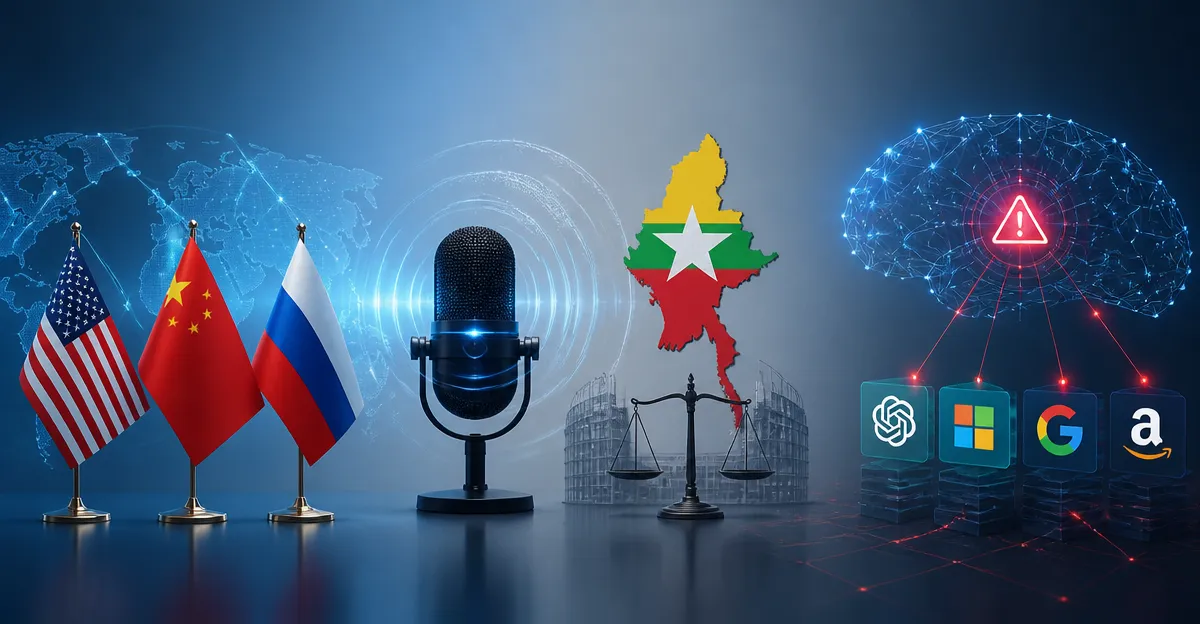
November 19, 2026, (Inside AI) — The leaders of the United States, China, and Russia sat down together for the first time in history, a diplomatic first that dominated global headlines this week. But alongside the historic summit and a landmark genocide ruling against Myanmar's military, a quieter technological warning is emerging: advanced artificial intelligence may be ushering in an era of more frequent and more severe tech outages.
The convergence of these three stories, a trilateral leaders' meeting, a top court's genocide verdict, and a podcast segment on AI reliability, points to a world where geopolitical shifts and technological fragility are increasingly intertwined. The AI outage discussion, featured in a daily news podcast, raises a question that engineers and regulators have quietly debated for months: as AI systems grow more complex and more deeply embedded in critical infrastructure, do they become more brittle?
Why Advanced AI Could Make Outages Worse
The podcast segment did not offer specific technical details, but the underlying concern is well documented. Modern AI models, particularly large language models and the sprawling recommendation and control systems they power, depend on massive compute clusters, vast datasets, and intricate software pipelines. A failure in any one layer can cascade across services. Unlike traditional software, AI systems often behave unpredictably, making root-cause analysis harder and recovery slower.
Industry data supports the worry. According to the Uptime Institute's annual outage analysis, outages are becoming more expensive and more frequent, with a growing share attributed to complex IT architectures. AI adds a new variable: models that retrain continuously or rely on real-time data can drift or fail silently, producing wrong outputs before anyone notices a problem. That silent failure mode is what worries operators most.
Read: AI's Measurable Impact on Global Challenges Documented in Decade Review
"The more autonomous the system, the harder it is to know why it broke," said one infrastructure engineer who spoke on condition of anonymity because they were not authorized to discuss client incidents.
This is not a hypothetical. In recent years, major cloud providers have suffered outages traced to automated scaling systems and AI-driven load balancers. Each incident has prompted calls for better observability and human override mechanisms. The podcast's framing suggests the issue is now entering mainstream awareness, not just engineering circles.
A Trilateral Summit and a Genocide Verdict
The same podcast also covered the first-ever meeting of the US, China, and Russia leaders, a diplomatic event with no modern precedent. Details of the agenda were not disclosed in the source material, but the symbolic weight is enormous. Analysts have long speculated about a trilateral framework for global security, and this meeting appears to be the first concrete step. The Myanmar genocide ruling, handed down by the world's top court, adds another layer of international legal consequence. The court found that Myanmar's military committed genocide against the Rohingya people, a verdict that carries moral and legal weight but limited enforcement power.
These two stories, while unrelated to AI directly, share a common thread with the outage discussion: a growing recognition that global systems, whether political, legal, or technological, are under strain. The AI outage era, if it arrives, would compound those strains by disrupting communications, supply chains, and financial networks at moments of geopolitical tension.
My original commentary: The juxtaposition of a historic trilateral summit and a genocide verdict with an AI reliability warning is not coincidental. As AI systems become the connective tissue of global commerce and governance, their failures will no longer be isolated IT incidents. They will become geopolitical events. The absence of a coordinated international framework for AI outage reporting and response is a gap that the same leaders meeting this week have yet to address.
The podcast's inclusion of the AI outage topic signals that the concern has moved from technical forums to general news agendas. That shift matters. When mainstream outlets begin treating AI reliability as a headline issue, regulators tend to follow. The European Union's AI Act already includes provisions for incident reporting, but enforcement remains patchy. In the United States, no federal equivalent exists.
Read: Harvard Economist Jason Furman: AI Race Has No Finish Line, U.S. and China Face Shared Risks
For now, the world waits to see whether the trilateral meeting produces any joint statement on technology risks. The Myanmar verdict will likely dominate legal discussions for months. And the AI outage question, still without a clear answer, will keep engineers and policymakers awake at night. The podcast offered no solutions, only a warning. That warning is worth heeding.

Sofia spent years studying how machines parse human language before pivoting to cover the systems now rewriting it. She reads technical papers the way others read news and looking for what the numbers are actually saying beneath the headlines.