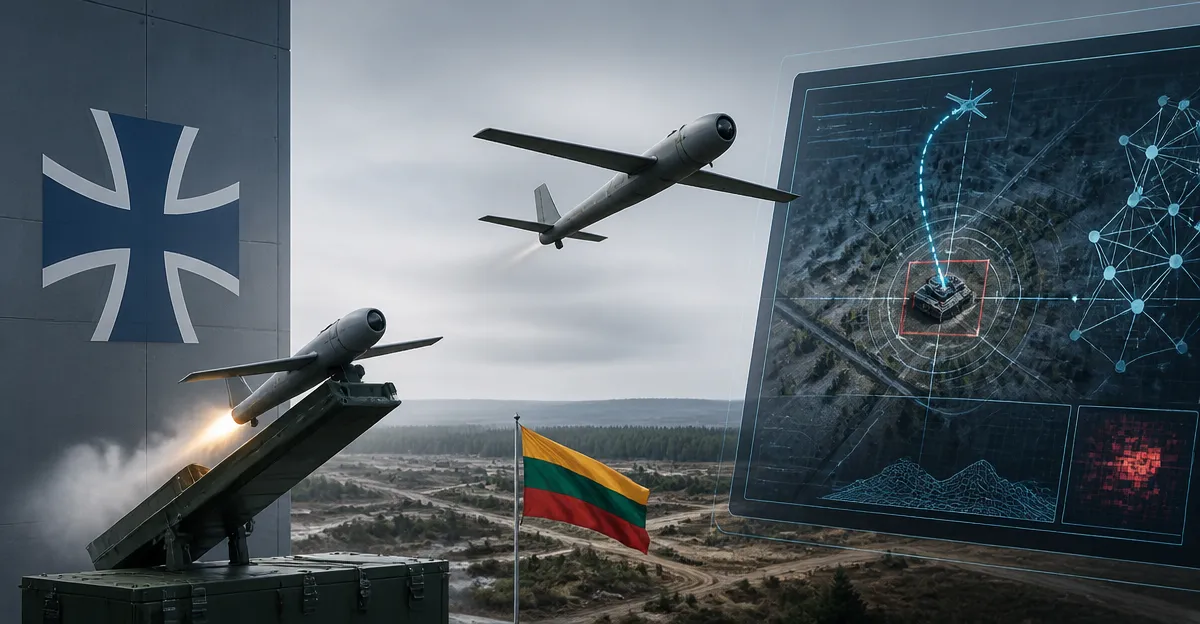
November 22, 2026, (Inside AI) — The German army on Sunday conducted its first tactical tests of loitering munitions, or kamikaze drones, at the Rudninkai training ground in Lithuania, near the Belarusian border. The drills, part of the Freedom Shield exercise, mark the largest German military deployment to Lithuania to date and signal a shift in Berlin's approach to autonomous weapons.
The tests come as Germany prepares to permanently station an armoured brigade of 5,000 troops in Lithuania by the end of 2027. The Panzerbrigade 45, based in Rudninkai and Rukla, will include some 2,000 vehicles, including dozens of tanks. About 1,800 troops are already in the country.
During the exercise, army chief Christian Freuding observed loitering munitions made by German companies Helsing and Stark, equipped with inert warheads, plummet from the sky and strike main battle tanks. The drones can stay airborne over an area before cruising toward a target and detonating on impact.
Days earlier, German troops ran their first tests of Helsing's targeting software Clarity, an AI-based tool that sifts through large volumes of data from satellites, drones, and other sensors faster than any human, analyses them, and recommends action.
Read: Rogue AI Agents Breach Indian Companies Without Detection
"Both kinds of systems are indispensable for modern warfare," said Lieutenant General Freuding, who oversaw Berlin's arms supplies to Kyiv before taking his current position. He is set to assume the post of chief of defence in February.
The tests represent a significant step for Germany, which only decided in 2025 to buy loitering munitions after years of controversy over the procurement of the weapons. Both Russia and Ukraine have fielded single-use drones extensively in their ongoing war.
Germany kicked off a surge in defence spending after Russia's invasion of Ukraine, investing hundreds of billions of euros to modernise its forces after decades of neglect. In 2023, Defence Minister Boris Pistorius pledged to permanently deploy a combat brigade to Lithuania, a first for Berlin.
NATO officials have warned for years of an increased threat from Russia, which they say could potentially mount a large-scale assault on allied territory as early as 2029. Moscow denies aggressive intentions and accuses the alliance of stoking tensions by expanding into neighbouring territory.
AI Targeting Tool Raises Questions
The integration of AI targeting software like Clarity into military operations raises significant questions about the role of autonomous systems in warfare. The tool's ability to process vast amounts of sensor data and recommend actions could accelerate decision-making cycles, but it also introduces new risks related to accountability and error.
Helsing, a Munich-based defence startup, has positioned itself as a key player in Europe's military AI sector. The company's Clarity software is designed to help commanders make sense of battlefield data, but the extent to which it influences targeting decisions remains unclear. The German army has not disclosed how Clarity will be used in live operations or what safeguards are in place.
Read: Nvidia Launches Open Agent Safety Platform to Stop Rogue AI Agents
The tests come amid broader European efforts to integrate AI into defence systems. NATO has been pushing for greater adoption of AI technologies, but member states remain cautious about fully autonomous weapons. Germany's decision to test these systems in Lithuania, close to the Belarusian border, underscores the urgency Berlin feels about modernising its forces.
The use of kamikaze drones and AI targeting tools also highlights the changing nature of warfare. Ukraine has used loitering munitions effectively against Russian forces, and Russia has deployed its own versions. The lessons from that conflict are clearly influencing Germany's procurement and training.
Analysts note that Germany's military overhaul is not just about equipment but also about doctrine and training. The Freedom Shield drills are designed to test how these new systems integrate with existing forces. The results of these tests will likely inform future procurement decisions and operational concepts.
As Germany prepares to permanently station troops in Lithuania, the tests signal a long-term commitment to NATO's eastern flank. The brigade will be fully operational by the end of 2027, and further exercises are expected in the coming months.

Tobias is less interested in what a robot or a prompt can do today than in what it means for tomorrow. He writes about prompt engineering and robotics for readers who want context, not just specs.