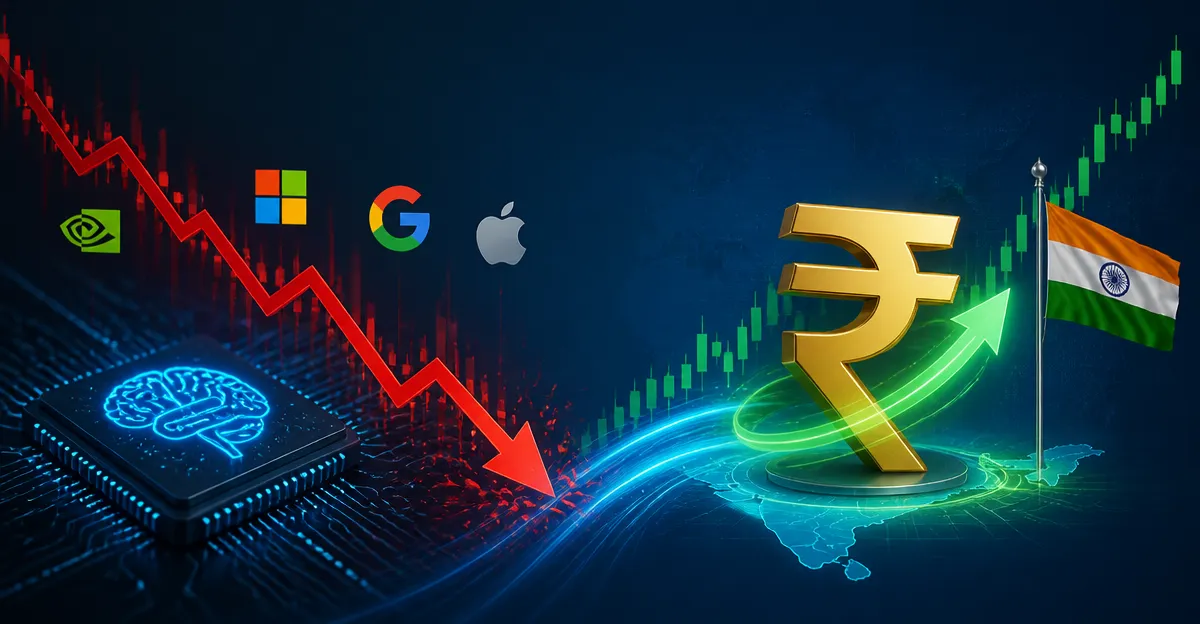
November 23, 2026, (Inside AI) — The Indian rupee is set to extend its rally on Monday, opening in the 92.60-92.64 range per dollar, as a deepening rout in global technology stocks drives foreign capital into Indian equities. The currency settled at 92.67 on Friday, capping a week of gains that saw it break past the 93 level for the first time in months.
The turnaround is striking. Just six weeks ago, the rupee threatened to slide past 97 per dollar, prompting aggressive intervention from the Reserve Bank of India and measures to curb dollar demand. Now, a rotation away from AI-heavy markets is providing fresh momentum. On Friday, the Nasdaq Composite fell more than 5% as the selloff in technology stocks accelerated, pushing overseas investors to pour over $1 billion into Indian equities in a single session. That brings the month's total inflows to $12.9 billion, according to market data.
The surge in foreign buying has been a boon for the rupee, which had been under pressure for much of the year. Traders say the flows are largely custodial, with foreign banks selling dollars on behalf of clients. The rupee advanced in every session last week, and the pace quickened on Friday as the currency blew past the 93 mark.
"The strength of the flows we are seeing is pushing the rupee to levels that few would have thought possible just a few weeks back," a currency trader at a private sector bank said. "The rally looks extremely overstretched and the currency appears overbought. While these levels look unsustainable, you can't argue with the price action."
The AI-driven equity rotation is not the only factor. Expectations for a Federal Reserve rate hike in December have slightly diminished amid heightened risk aversion. While a 25-basis-point increase remains the most likely outcome, markets are now assigning a small probability of no change, according to futures pricing. A less aggressive Fed would further weaken the dollar and support the rupee.
The rupee's recovery also reflects the success of the RBI's interventions. Earlier this year, the central bank sold dollars and introduced measures to discourage speculative dollar buying. Those steps, combined with the recent equity inflows, have reversed the currency's fortunes. The rupee has now gained over 4% from its low near 97.
However, the rally may face headwinds. The trader's warning about overbought conditions is echoed by some analysts, who note that the rupee's rapid ascent could prompt profit-taking. Additionally, the AI selloff could reverse if technology stocks stabilize, potentially reducing the flow of foreign capital into Indian equities. The RBI may also step in to smooth volatility if the rupee strengthens too quickly, though it has not signaled any discomfort with the current level.
For now, the currency's trajectory hinges on the interplay between global risk sentiment and domestic fundamentals. India's equity market has been a beneficiary of the AI shakeout, but whether that trend persists depends on how long the technology rout lasts. Traders will also watch the Fed's December meeting for clues on the dollar's direction.
The rupee's rally is a rare bright spot in an otherwise turbulent year for emerging market currencies. Many peers have struggled against a strong dollar, but India's combination of central bank action and equity inflows has set it apart. Whether that divergence continues will be a key test for the currency in the weeks ahead.

Shamil has a low tolerance for AI that only works in controlled demos. He covers agentic systems and generative AI with the skepticism of someone who has seen too many “revolutionary” tools quietly disappear six months after launch.