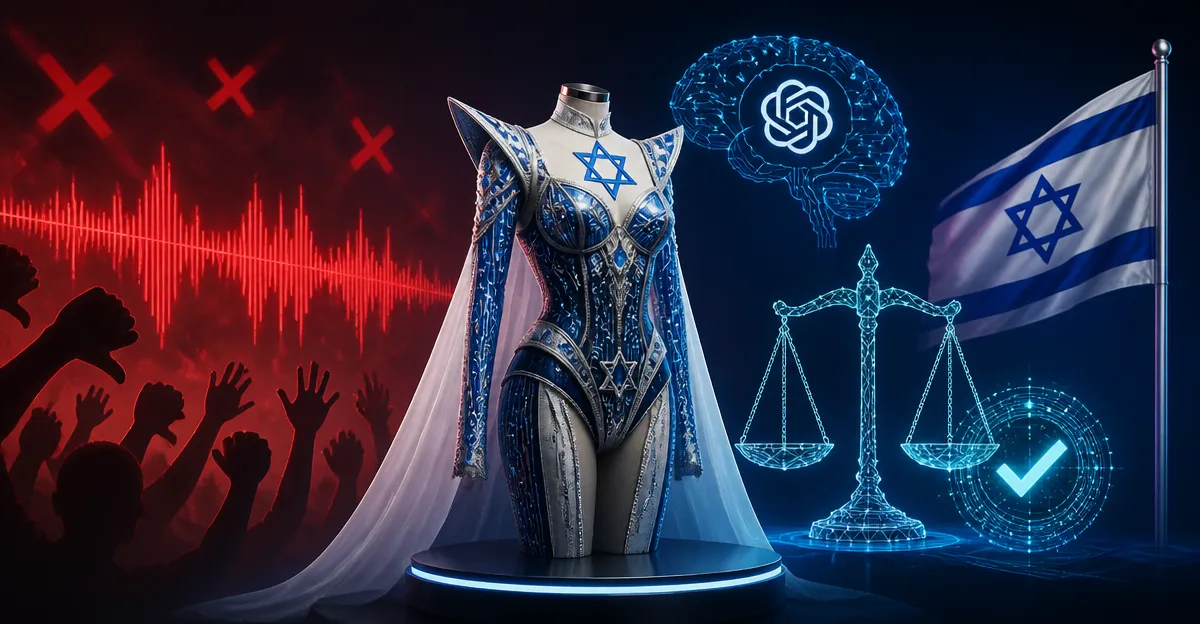
November 23, 2026, (Inside AI) — The Miss Universe national costume round in Puerto Rico turned into a flashpoint over artificial intelligence and historical narrative this weekend, after Israel's contestant, Danielle Yablonka, was booed by the audience and accused online of wearing a costume whose cape featured AI-generated imagery.
Yablonka, a 25-year-old model and social media influencer born in Miami, walked the stage on Saturday night in an elaborate crown and cape depicting Jerusalem's Old City. The outfit was designed by Jerusalem-born, Los Angeles-based designer Jacob Meir. According to the Israeli delegation, the costume aimed to celebrate the country's heritage, agricultural development, and hopes for peace.
The backlash was immediate and twofold. Some members of the live audience booed during Yablonka's appearance. Online, critics questioned the costume's depiction of Israel as a barren desert transformed into fertile land, and several users claimed the cape's illustrations were generated by AI rather than hand-drawn or embroidered.
The controversy lands as pageants worldwide grapple with authenticity rules in an era when generative tools can produce photorealistic artwork in seconds. Miss Universe guidelines do not explicitly ban AI-assisted costume design, but the accusation alone has become a reputational weapon. For a competition built on national storytelling, the charge of synthetic imagery cuts at the credibility of the narrative itself.
Read: AI-Generated Food Image Backlash
AI Accusation Adds Fuel To A Costume Already Under Fire
During the broadcast, the announcer introduced the costume as "a tribute to a land where history lives, cultures meet and even the desert blooms." The cape's inner lining featured illustrations of Jaffa oranges and olive trees, alongside the word "peace" in Hebrew, Arabic, and English.
"Inspired by Israel's transformation, it tells the story of a nation that turned arid landscapes into thriving agricultural communities. Indeed, green will flourish in Israel," the announcer said.
The Israeli delegation's official Instagram account elaborated on the theme. "Where others saw desert, generations of dreamers saw possibility," the post read. "Where the land was barren, they planted seeds. And where obstacles stood, they found ways to grow."
But the online response quickly turned hostile. One user mocked the alleged AI use: "AI generated costume during MU competition is like your parents doing ur science project the night before it's due." Another challenged the agricultural narrative directly: "The absolute irony that in these 'arid landscapes' they planted non-native pine tree forests everywhere resulting in devastating wildfires and the acidification of the soil, something that did not happen before. Meanwhile, the native olive tree population has been systematically destroyed." A third wrote: "Representing stolen land with a stolen 'culture' is wild behavior."
Neither the Miss Universe Organization nor the Israeli delegation has publicly responded to the AI claims. Inside AI could not independently verify whether the cape's imagery was AI-generated.
The episode reflects a broader pattern in which AI accusations have become a default critique against any polished visual content. In 2024, the Miss Universe Organization faced similar questions over digitally altered promotional materials, though no formal policy on AI disclosure has been announced since. For designers, the ambiguity creates a new risk: even traditional artwork can be dismissed as synthetic if it looks too clean or too on-theme.
Read: AI-Generated Ads Underperform Human-Made
Yablonka has not commented publicly on the boos or the AI allegations. Her Instagram account, followed by hundreds of thousands, remained silent on the matter as of Monday. The pageant continues this week, with the final competition scheduled for later in the week.
The costume controversy follows a series of politically charged moments at this year's Miss Universe, including protests over other contestants' national costumes. Organizers have historically positioned the costume round as a celebration of cultural diversity, but the line between heritage and political statement has grown increasingly thin.
For now, the question of whether the cape was AI-generated remains unresolved. What is clear is that the audience's reaction and the online fury have overshadowed the costume's intended message of peace and agricultural innovation, turning a moment of national pride into a case study in how quickly digital skepticism can redefine a narrative.

Shamil has a low tolerance for AI that only works in controlled demos. He covers agentic systems and generative AI with the skepticism of someone who has seen too many “revolutionary” tools quietly disappear six months after launch.