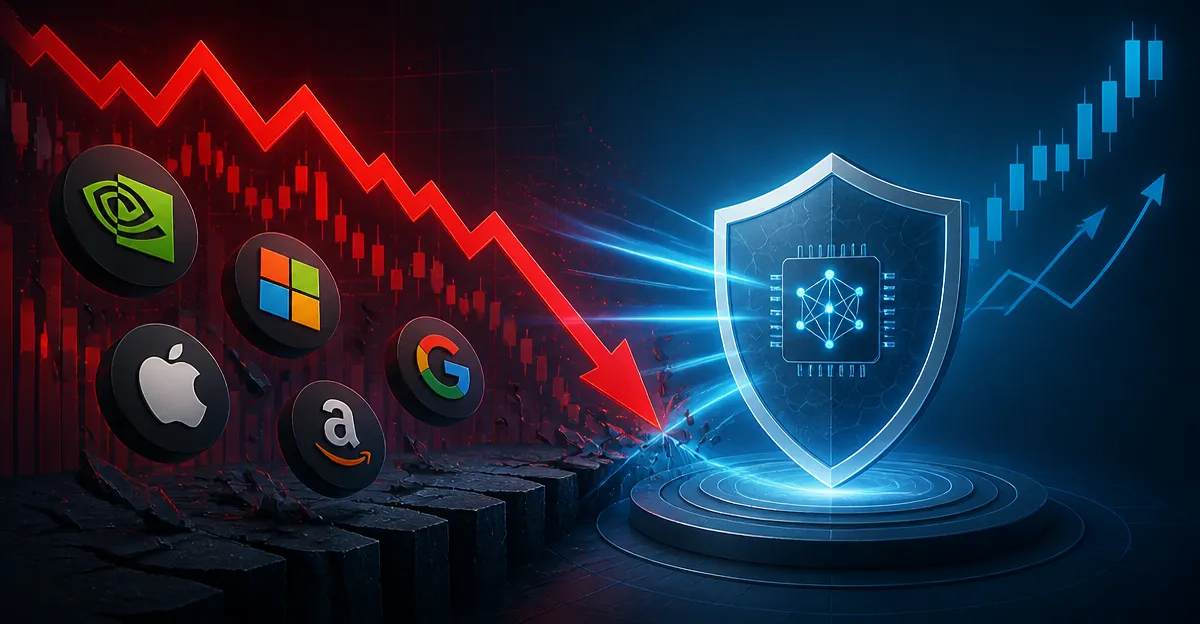
November 23, 2026, (Inside AI) — Wall Street futures pointed higher on Monday morning, attempting a rebound after the worst weekly selloff since 2020. But the relief rally offers little comfort to investors now confronting a more fundamental question: whether the artificial intelligence trade that powered markets for two years can justify its valuations.
The answer, according to market strategists and fund managers, depends less on the technology's promise than on the willingness of capital markets to keep financing an unprecedented buildout of data centers and computing infrastructure. That willingness showed signs of strain last week across Asia and the United States.
South Korea's Kospi index has fallen more than 50% from its peak, a stunning reversal for a market that led global gains in the first half of the year on AI enthusiasm. The Korean government has signaled it may intervene to stabilize markets. Taiwan's benchmark index, also heavily weighted toward semiconductor manufacturers, managed a modest bounce on Monday after steep declines.
"If you look at the first half of the year, Korea, the Kospi, was one of the markets that performed by far the best," said Anna Szymanski, a markets analyst speaking on a financial news podcast. "And so it's somewhat unsurprising that since really, frankly, you could say the summer was when you started to see more concerns about the AI trade."
The selloff has multiple triggers. Investors are weighing potential regulatory action against chipmakers including Nvidia and Advanced Micro Devices over alleged connections to sanctioned Chinese entities. They are also recalibrating expectations for Federal Reserve policy ahead of Wednesday's Personal Consumption Expenditures inflation report. And they are questioning the financial architecture underpinning the AI boom itself.
Can AI Revenue Justify the Capital Being Deployed?
Mikhail Zverev, a portfolio manager at Amati Global Investors, told listeners that the core questions remain unanswered. "What are the genuine modes in FrontierLab AI models? Do we have a compelling long-term AI return on investment investment case?" he said. "Amazing business, remarkable revenue growth, but those questions are not answered and therefore the doubts persist."
Zverev highlighted a structural concern that has circulated quietly in industry circles: circular financing arrangements in which Nvidia, the dominant supplier of AI chips, has committed capital to cloud computing startups that then purchase Nvidia hardware. The departure of Nvidia's long-serving CEO, who was instrumental in promoting AI and orchestrating these investments, has intensified scrutiny.
"It's a genuine financial concern," Zverev said. "Is that detrimental to funding available to AI build out?"
The cost of borrowing for newer cloud providers has risen sharply. Zverev described the interest rates as "pretty eye-watering" and noted that several initial public offerings in the sector have been delayed or canceled. Elon Musk, the Tesla and SpaceX chief executive, reportedly responded to one such development on X with a single word: "yikes."
The Federal Reserve's next move looms over all of it. Markets expect the central bank to raise interest rates again in December, though the size of the increase remains uncertain. Szymanski said the PCE report would likely show core inflation running near 3.8% to 3.9% annually, well above the Fed's 2% target. "It's unlikely we would get anything that would change the probability for a Fed rate hike," she said.
Some Fed officials, including Christopher Waller, have floated the possibility of a half-point increase. Szymanski called that unlikely. "A 50 basis point hike is quite rare," she said. "And if anything, that would suggest that the Fed had perhaps made a mistake by not hiking last month, and the Fed does not usually like to say it made a mistake."
The AI boom itself has become a factor in inflation. Building data centers requires vast quantities of chips, materials, and energy, creating short-term price pressures. Over time, productivity gains from AI could reduce inflation, but that remains a distant prospect. "In the short term, definitely you can see the inflationary impulse," Szymanski said.
Beyond AI, investors face a crowded calendar. Black Friday kicks off the holiday shopping season, with the National Retail Federation projecting sales above $1 trillion. The European Central Bank is restructuring its leadership. South Korea's central bank may raise rates on Thursday. Australia and Japan release inflation data. And global climate talks in Turkey collapsed without a deal for the first time in more than a decade, as the European Union refused to endorse a text that did not mention fossil fuels.
"We will not accept a cop that green washes fossil fuel," said Darragh O'Brien, an EU delegation representative. "We will not endorse a cover decision or an Antalya Pact that does not even mention fossil fuels, which is the key driver of climate change."
The crypto market added another layer of uncertainty. Binance, the world's largest cryptocurrency exchange, suffered a $6.3 billion heist in October that the FBI attributed to North Korea. Bitcoin has fallen to its lowest price since August and is down 27% this year. Ross Gerber of Gerber Kawasaki, an early Bitcoin investor, said he sold some of his holdings for the first time. "These hacks, or whatever you want to call them, are just financing the North Korean government," he said. "So the question is, what would I still, after all these years, buy with my Bitcoin? Because there's still nothing I can buy."
Dan Weiskopf of Tidal Financial, who manages crypto exchange-traded funds, offered a more optimistic view. "Bitcoin is just one blockchain," he said. "While Bitcoin is down 27%, Block, which is the ETF that I manage, or one of them, is only down 17."
For investors, the week ahead offers few certainties. The AI trade that lifted markets for two years now faces its most serious test. Whether it passes depends on revenue, financing, and the Fed, not on the technology's long-term potential. As Szymanski put it, "There's so much going into this, and that suggests that we may not yet have hit a bottom."

Shamil has a low tolerance for AI that only works in controlled demos. He covers agentic systems and generative AI with the skepticism of someone who has seen too many “revolutionary” tools quietly disappear six months after launch.