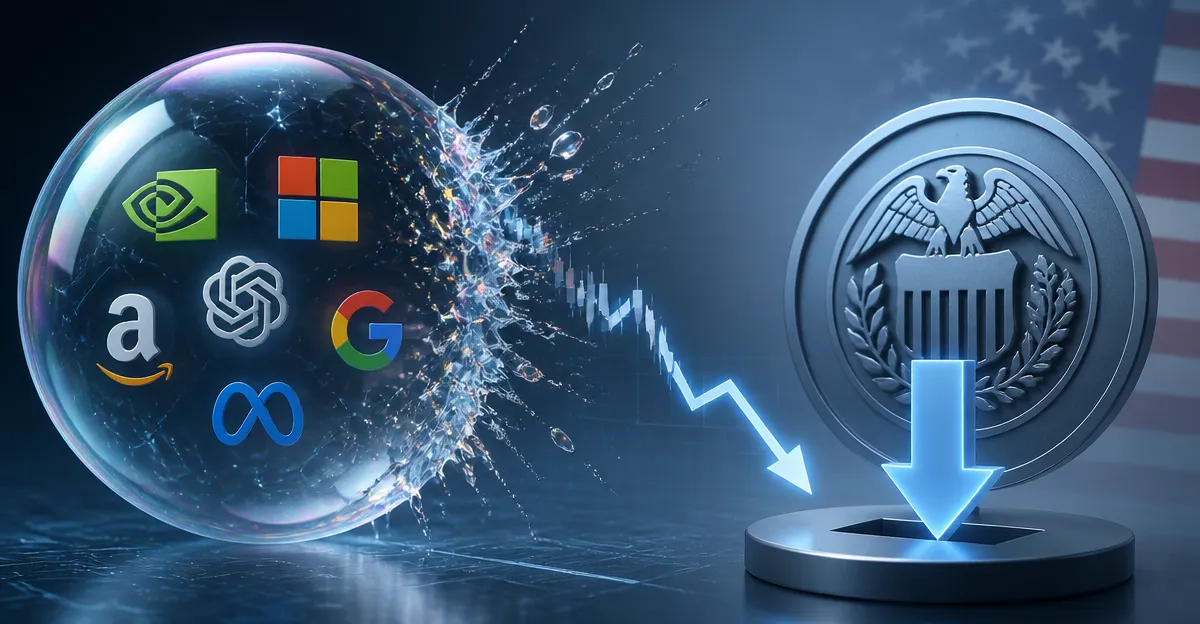
November 23, 2026, (Inside AI) — The artificial intelligence trade, which powered Wall Street to record highs for most of the past two years, is now unraveling at a pace that has forced economists and investors to confront an uncomfortable question: could the Federal Reserve be compelled to cut interest rates to contain the fallout?
Just weeks ago, that scenario seemed implausible. Inflation has remained above the Fed's 2% target for nearly six years, the economy is expanding at a solid pace, and unemployment sits near historic lows. The Fed raised rates in September and was widely expected to hike again at its December 9 meeting. As recently as last week, Fed Governor Christopher Waller reiterated that a 50 basis point increase could be on the table.
But the ground has shifted violently. Nvidia (NVDA.O), the chipmaker whose fortunes have become synonymous with the AI boom, saw its shares plunge 23% last week alone. Since peaking on October 6, the company has lost nearly half its value, more than $2.5 trillion in market capitalization. The S&P 500 has fallen 12% over the same period, and the Nasdaq is down 18%, hovering near bear market territory.
The trigger for Nvidia's collapse was not a single earnings miss but a cascade of revelations. Founder Jensen Huang resigned as CEO on November 12 following disclosures of multiple extramarital affairs, including one with an alleged Chinese spy at Singapore-based chip firm Megaspeed. The company now faces several probes, including a Securities and Exchange Commission investigation into its accounting practices.
Those developments have exposed a deeper structural vulnerability. According to Michael Cembalest of JP Morgan Wealth Management, 54 AI-related stocks have accounted for more than half of the S&P 500's market cap since January 2024, 66% of earnings growth, 59% of the index's return, and 82% of capital expenditure and research and development growth among its constituents. The AI investment boom added roughly 1.3 percentage points to real GDP growth over the last three quarters, according to Torsten Slok of Apollo Global Management, representing two-thirds of the economy's cumulative 2% expansion.
Those figures explain why the Fed cannot simply ignore the selloff. While asset prices are not part of its dual mandate of maximum employment and stable prices, financial stability has repeatedly forced the central bank's hand. The Fed cut rates during the 1998 Long-Term Capital Management crisis, the 2000 dotcom bust, the 2008 global financial crisis, and the 2020 pandemic. In most of those episodes, it moved swiftly and aggressively.
The wealth effect amplifies the risk. US households have never been richer on a net worth basis, and equities now account for record-high shares of household financial and total assets. Rising asset prices have sustained consumer spending, particularly among wealthier cohorts. A sharp reversal could hit Main Street as well as Wall Street.
Can The Fed Separate AI Hype From Financial Stability?
The central bank's dilemma is compounded by stretched valuations. The S&P 500's price-to-earnings ratio has fallen below 21 times trailing 12-month earnings, still above the average of 18.2 since 1985. Economist Lars Christensen notes that the market's P/E ratio now stands at 23.4, above the long-run average of 18.4. Earnings as a share of GDP are 70% above their average since 1947 and near record levels.
"Normalisation could easily take several years, and in the meantime, the economy grows and absorbs part of the adjustment. But it tells you how far we are from 'cheap,'" Christensen says.
The coming weeks will be decisive. A rebound and consolidation could cool temperatures and buy the Fed time. A repeat of last week's volatility would be far more damaging. The Fed's next move may depend less on inflation data than on whether the AI trade stabilizes.
For now, the central bank faces a bind it has not encountered in decades: inflation still elevated, growth still solid, but a market convulsion that threatens the very investment boom sustaining both.

Shamil has a low tolerance for AI that only works in controlled demos. He covers agentic systems and generative AI with the skepticism of someone who has seen too many “revolutionary” tools quietly disappear six months after launch.