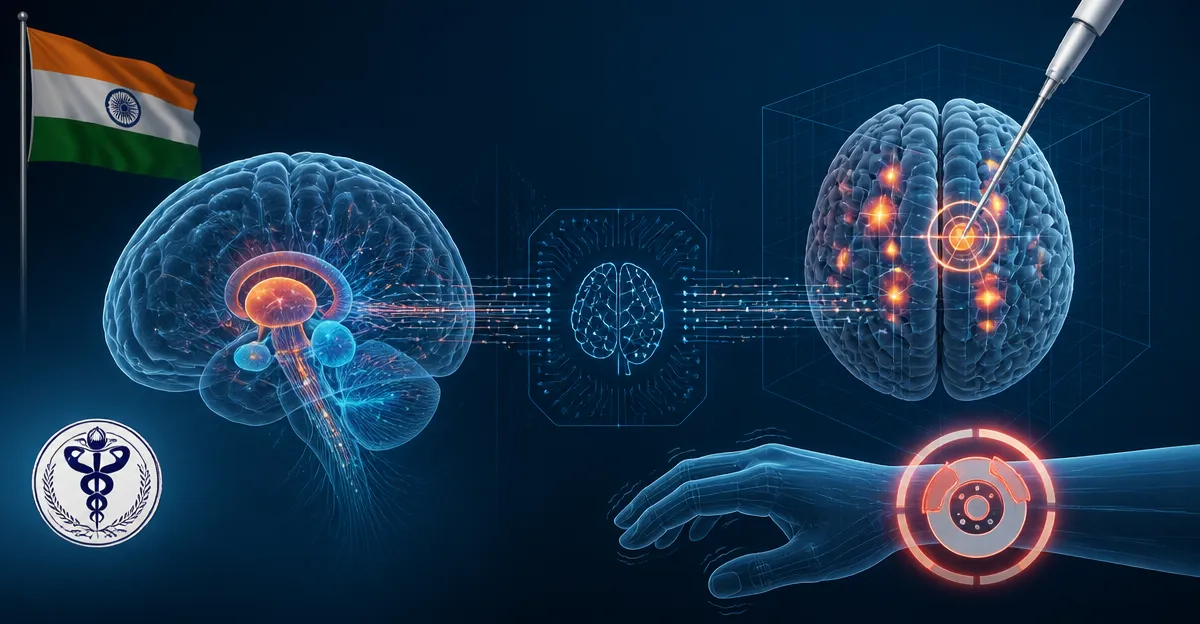
November 29, 2026, (Inside AI) — Neurosurgeons at the All India Institute of Medical Sciences (AIIMS) in New Delhi have performed India's first robot-guided deep brain stimulation (DBS) procedure, using an artificial intelligence algorithm to map abnormal brain signals in a patient with Parkinson's disease. The operation, conducted on November 25, was led by Dr P Sarat Chandra, head of neurosurgery at AIIMS, alongside Dr Ido Strauss of Tel Aviv University in Israel. The procedure marks a step toward more precise electrode placement in a surgery where millimetres matter.
Deep brain stimulation involves implanting thin electrodes deep within the brain to deliver steady electrical pulses that calm the abnormal neural activity responsible for tremor, stiffness, and slowed movement. The electrodes connect to a pacemaker-like device under the skin, usually near the chest. The technique is not a cure, but it can ease symptoms and improve quality of life for patients whose medication no longer controls their condition.
The AIIMS team's robotic approach relies on identifying beta oscillations, a specific rhythm of electrical activity in the brain's movement circuits. In a healthy brain, these oscillations appear at rest and fade when movement begins. In Parkinson's, they persist even during movement. Dr Chandra likened the phenomenon to a car's handbrake remaining engaged while the vehicle is moving, leading to symptoms such as bradykinesia and rigidity. An AI algorithm analyzes the brain's signals and generates a heat map of where beta activity is strongest. The surgeon then uses that map to decide the final electrode position.
The robotic method also reduces invasiveness. Surgeons shave only a coin-sized patch of the scalp rather than the entire head, and the electrode passes through a 2.5-millimetre hole instead of a larger incision. The fixation caps used in conventional surgery are not needed, and the cosmetic outcome improves. Dr Elavarasi, associate professor of neurology at AIIMS, noted that the technology is currently used in selected centres worldwide.
Read: AI Moves Into the Lab
However, Dr Elavarasi cautioned that no direct evidence yet shows robotic surgery is superior to conventional methods. "The technology is being used in selected centers across the world," she said. Whether patients fare better years later remains unanswered and will require comparative studies.
The robot works alongside microelectrode recording, a technique in which doctors listen to the electrical activity of individual neurons during surgery. Each brain region has its own electrical signature, helping surgeons confirm when they have reached the target. At a workshop held alongside the surgery, Dr Genela Morris of Tel Aviv University demonstrated an AI-based method for interpreting those signals in real time. Dr Elavarasi emphasized that AI assists but does not replace human judgment. "Advanced imaging and M.E.R. have made targeting more precise," she said. "A.I. helps identify the entry and exit zones better. That reduces errors, shortens the time taken to find the target and brings uniformity. It does not replace human judgment."
Not every Parkinson's patient qualifies for DBS. At AIIMS, a multidisciplinary team assesses candidates with significant motor fluctuations, a good response to levodopa, and no clinical red flags before considering surgery. The cost remains a barrier. "The cost of the DBS implant starts at around Rs 10 lakh at AIIMS, while the surgery itself is technically free. Private hospital costs can exceed Rs 35 lakh," Dr Elavarasi said.
Read: AI Virtual Drug Trials
The integration of AI into surgical navigation reflects a broader trend in neurosurgery, where real-time data analysis is beginning to augment intraoperative decision-making. While the AIIMS procedure is a milestone for India, the absence of long-term outcome data means the debate over robotic versus conventional DBS will continue. For now, the technology offers a more precise and less invasive option, but its true value will be measured in patient outcomes years down the line.

Sofia spent years studying how machines parse human language before pivoting to cover the systems now rewriting it. She reads technical papers the way others read news and looking for what the numbers are actually saying beneath the headlines.