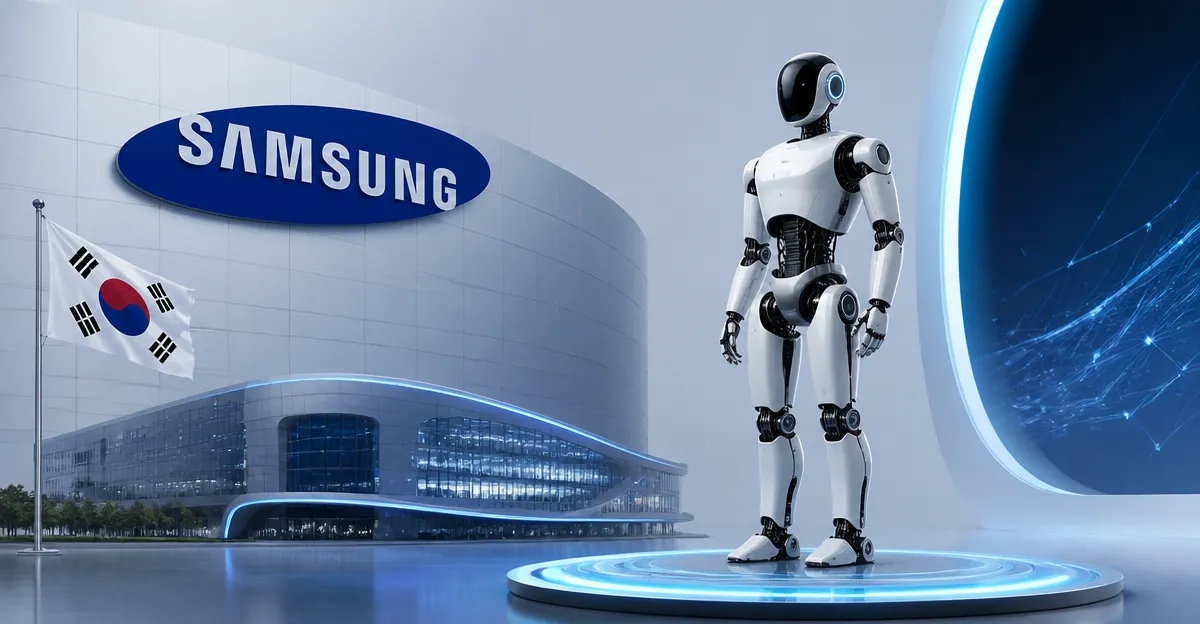
November 29, 2026, (Inside AI) — Samsung Electronics has shown a humanoid robot prototype to its board of directors and plans to reveal the machine to the public at CES in Las Vegas in January, according to a person familiar with the matter. The Seoul-based company declined to comment on the demonstration, which took place last week at its robotics research hub and was attended by co-CEO TM Roh.
The prototype session centered on full-body control and object manipulation, with the robot using its arms and hands to pick up and reposition items. Samsung is betting that hand dexterity, not locomotion, will decide whether humanoids earn a place on factory floors. The company created a dedicated Robotics eXperience (RX) division in July, reporting directly to Roh, to run research, long-term strategy and commercialization.
The move puts Samsung into a market already occupied by Tesla, Hyundai Motor's Boston Dynamics, and China's Unitree. It also marks a strategic pivot for a company whose growth has leaned on memory chips, smartphones and displays. Samsung said in March it aims to convert its factories into AI-driven plants by 2030 and to introduce humanoids into manufacturing. It plans a humanoid production line in Gumi, the southeastern city that hosts its smartphone factories, and runs robotics research in the US, China and Japan.
Why 99% Success Rates Fail Factory Tests
The hardest problem is not building a robot that walks. It is building one that grasps reliably, thousands of times a day, without error. Kris Hauser, head of the robotics lab at Samsung's RX unit, described the bar in September.
"You go to the factory owner and you say that your robot acts with a 99% success rate, they're still going to laugh because it has to be at a 99.99% success rate for them to actually deploy it on your factory line," Kris Hauser, head of the robotics lab at Samsung's RX, said in September.
"This is a very punishing kind of game."
That gap between 99% and 99.99% is where most humanoid programs stall. A robot that drops one object in a hundred attempts looks impressive in a demo and useless on a production line running millions of cycles. Samsung's focus on hands reflects that arithmetic. Grippers and end effectors remain the least mature hardware in the humanoid stack, and manipulation data is far scarcer than the video data used to train walking policies.
Samsung's answer leans on ownership rather than partnership. In 2024 it became the largest shareholder in South Korean robotics firm Rainbow Robotics, and it has said it will consider acquisitions where needed to speed development. The RX unit's direct line to Roh signals that robotics now sits alongside chips and mobile as a top-level priority, not a side project.
The consumer angle is further out. Hauser said in September that Samsung's longer-term ambitions include robots that handle household chores and assist older people. That market carries different requirements from factories: lower cost, safer force limits and tolerance for messy environments.
January's CES reveal will be judged less on spectacle than on specifics. Rivals have shown polished videos for years while shipping few units. Samsung's credibility rests on whether it discloses manipulation benchmarks, deployment timelines and the Gumi line's actual capacity. A prototype that picks up objects on stage proves little. A stated error rate and a factory date would prove more.
Read: China’s Humanoid Robot Boom: When Is the ChatGPT Moment?
The board preview also hints at internal urgency. Samsung has watched Hyundai turn Boston Dynamics into a credible industrial robotics brand and watched Chinese vendors cut humanoid prices aggressively. Entering late with a strong manufacturing base and captive factories could work, but only if the manipulation problem is solved at production grade. The company has not said which factories will receive the first units or how many it intends to build in Gumi.

Tobias is less interested in what a robot or a prompt can do today than in what it means for tomorrow. He writes about prompt engineering and robotics for readers who want context, not just specs.