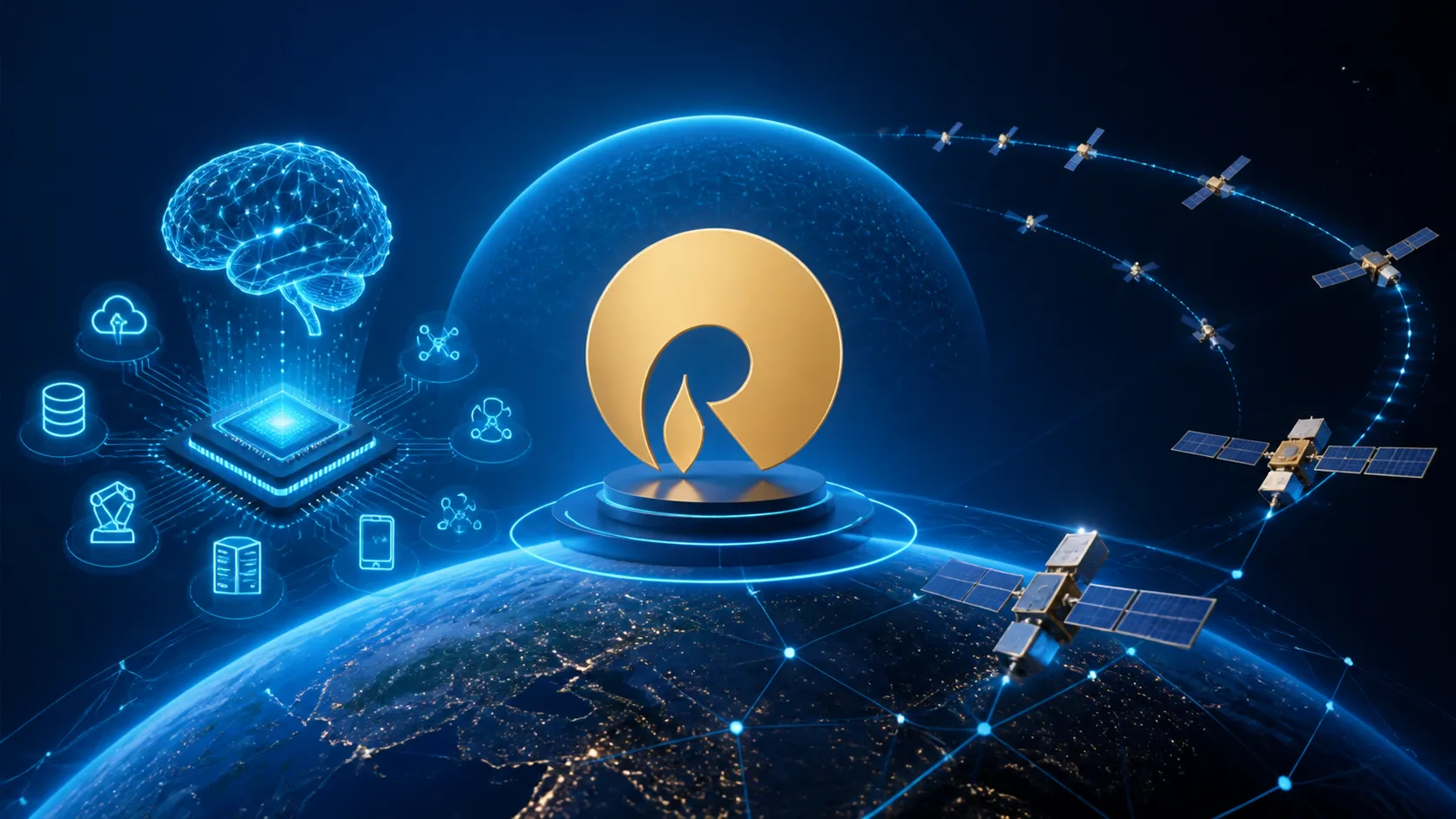
June 19, 2026, (Inside AI) — Reliance Industries Limited (RIL) will build a sovereign artificial intelligence ecosystem in India under its new Reliance Intelligence initiative, Chairman Mukesh Ambani announced at the company’s annual general meeting. The AI backbone will rise in Jamnagar, powered entirely by clean energy from RIL’s Kutch solar platform.
The first phase delivers 120 megawatts of AI compute by end of 2026, using an initial fleet of NVIDIA GB300 GPUs. Ambani said this capacity equals over 75,000 H100 GPUs on an inference basis, scalable to more than two lakh H100-equivalent GPUs once fully operational. He framed the move as a global-scale infrastructure play.
“When compute becomes affordable, innovation becomes inevitable.”
Reliance Intelligence will offer sovereign hosting within India, model transparency, and portability so enterprises can own their AI journey. The platform supports 22 Indian languages. Two major partnerships anchor the strategy: Google’s Gemini-powered Google AI Pro is already free for Jio users, and a joint venture with Meta operationalizes the open-source LLaMA model for Indian businesses.
Satellite Ambitions Bridge the Last Mile
Jio Platforms is evaluating a sovereign low Earth orbit satellite constellation while leasing capacity from global providers to speed service delivery. This dual approach aims to connect remote villages, islands, and border outposts beyond terrestrial reach.
“For them, satellite connectivity will be the bridge to the rest of India.”
Jio is building its own ground station infrastructure to support partner constellations and future satellites, creating an end-to-end satellite broadband ecosystem. Ambani said the move strengthens India’s self-reliance in space and places it on the global satellite broadband map.
Infrastructure, Partners, and the Clean Energy Edge
The Jamnagar AI hub’s clean energy sourcing from the Kutch renewable platform differentiates it from fossil-fuel-dependent data centers. Reliance’s vertical integration—from solar generation to compute—could lower operational costs and carbon footprint. Still, questions linger about GPU supply chains and the timeline for scaling beyond the initial 120 megawatts.
Industry observers note that sovereign AI infrastructure is a growing priority for nations, but execution risks include regulatory hurdles, talent shortages, and the rapid pace of chip evolution. Reliance’s partnerships with Google and Meta provide immediate model access, yet building a fully indigenous stack remains a long-term bet.
Separately, Reliance Foundation plans a 410-acre university campus at Dronagiri, a garden, and a medical city in Mumbai, after receiving Maharashtra government approval for a state private university. Chairperson Nita Ambani called it a world-class initiative to elevate India’s higher education and healthcare.