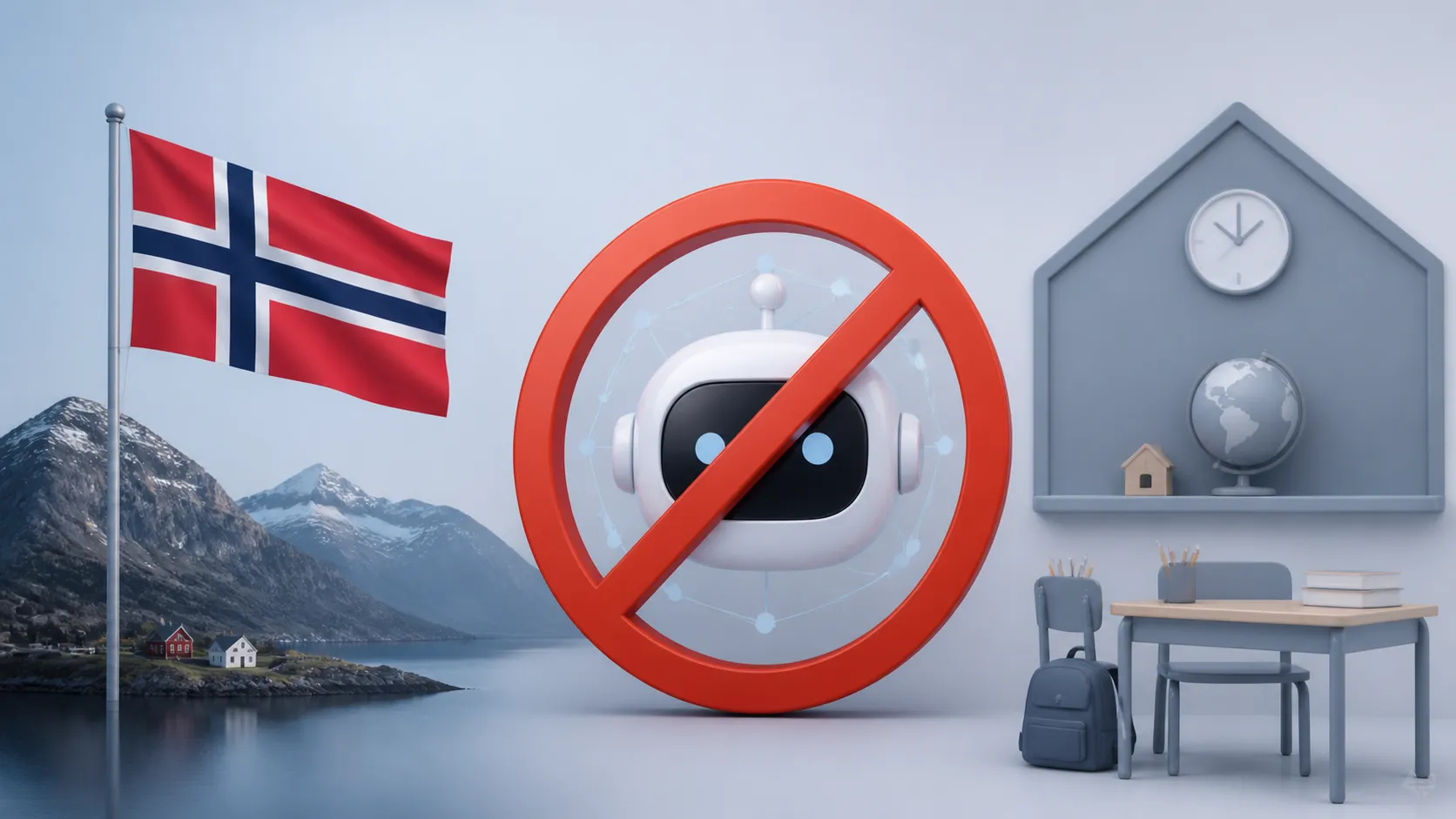
June 20, 2026, (Inside AI) — Norway will enforce a near-total ban on generative AI use by elementary school pupils starting in late August, Prime Minister Jonas Gahr Stoere announced Friday. The move restricts AI for children aged 6 to 13 while permitting cautious, supervised use for older students.
A Digital Reversal in Nordic Classrooms
The policy marks a sharp pivot from Norway’s decades-long embrace of classroom technology. Since the 1990s, the country introduced computers, then tablets after the iPad’s 2010 launch, steadily reducing reliance on books and handwriting. Now, the government is reversing course, citing falling test scores and the need to protect foundational learning.
Stoere framed the decision as a defense of basic skills. “The most important thing in school is that our children learn to read, write and do mathematics,” he said. The new standards take effect with the school year beginning in late August.
Three Tiers of AI Access
The rules create a tiered system. Pupils in grades 1 through 7 (ages 6–13) face a general prohibition on generative AI. Those in lower secondary school (ages 14–16) may use AI only under teacher supervision. Upper secondary students (ages 17–19) should learn to use AI appropriately to prepare for further education and work.
The government also plans legislation to fund more physical books in classrooms, directly countering the tablet trend. This follows a 2024 smartphone ban in schools and renewed teacher disciplinary powers, part of a broader effort to refocus on traditional pedagogy.
Why Norway Is Hitting Pause on AI
Norway’s move aligns with growing global skepticism about screen-based learning. In April, the government proposed banning social media for children under 16, following Australia’s lead. The AI restriction goes further, targeting tools like ChatGPT that generate text, images, or code.
Critics argue such bans ignore AI’s potential to personalize learning. Proponents counter that young children lack the metacognition to use AI without undermining skill development. Norway’s policy reflects a bet that delaying AI exposure preserves cognitive foundations.
What the Ban Leaves Unanswered
The government has not detailed enforcement mechanisms or exemptions for students with disabilities. It also hasn’t clarified how teachers will be trained to supervise AI use for older students. Without robust implementation, the policy risks becoming symbolic.
Moreover, the ban does not address AI’s presence outside school. Children may still access generative tools at home, raising questions about the policy’s real-world impact on learning outcomes.
A Broader Backlash Against Digital Learning
Norway’s decision echoes Sweden’s recent shift back to printed textbooks and UNESCO’s 2023 call for technology in education to be used only when it supports learning. As AI capabilities accelerate, expect more nations to grapple with where to draw the line between innovation and protection.