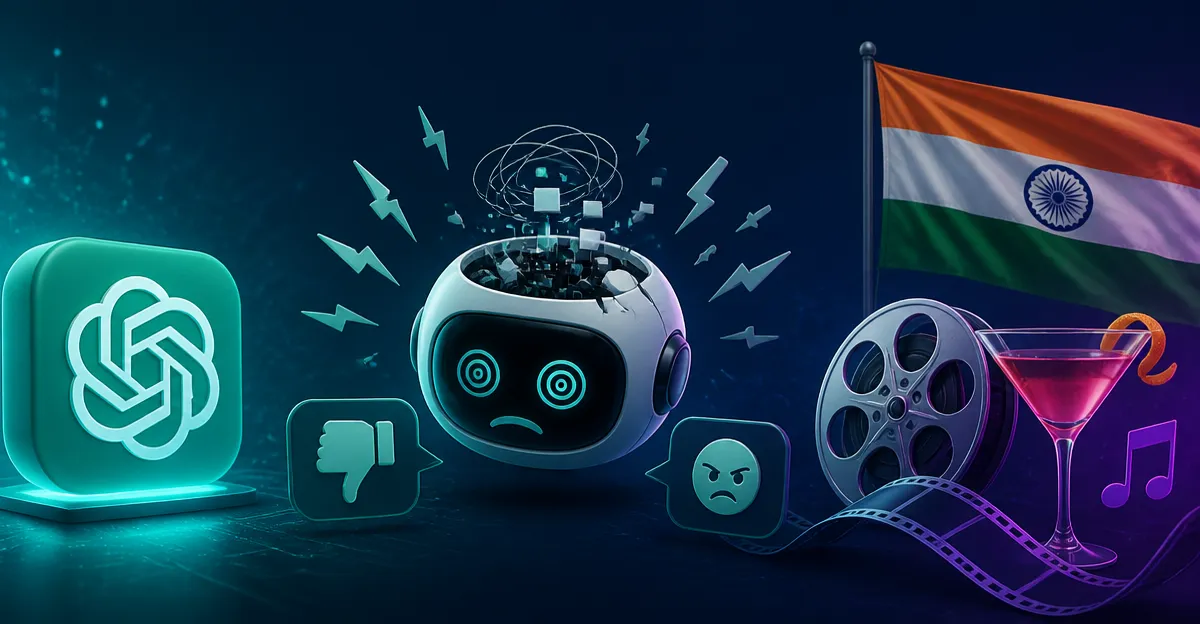
August 1, 2026, (Inside AI) — Playback singer Madhubanti Bagchi has dismissed current generative AI tools as more annoying than unnerving, describing them as “stupid” in their handling of creative work. Bagchi, known for her recent recreation of the iconic Rambha ho track for the film Dhurandhar, shared her blunt assessment during a conversation about technology and artistic integrity.
Her remarks come as AI-generated music continues to flood streaming platforms, with tools like Suno and Udio enabling users to produce songs from simple text prompts. Bagchi’s critique focuses on the lack of intentionality in machine output. “AI is stupid… more annoying than unnerving,” she said, drawing a line between the unpredictable nature of human performance and the sterile results of algorithms.
Bagchi’s recent project placed her directly in the shadow of a legendary voice. She was tasked by composer Shashwat Sachdev to reinterpret Rambha ho, the 1981 disco anthem originally sung by Usha Uthup. Her first instinct was refusal. “With remakes, when the first version has worked so well, I don’t think one is required to mess with it, unless you are thinking about something revolutionary or placing it in a new context,” Bagchi said.
Sachdev’s treatment changed her mind. His concept allowed the original and new versions to flow into each other, punctuated by on-screen gunshots. “Shashwat is an impulsive composer and he lets you be in your element,” Bagchi explained. She recorded the track in a frantic studio session just two days before the film’s grand music launch, finding room within the classic to sound like herself.
Read: Suno Launches New AI Music Models With Warner Music and BMG
Ultimate validation came from Uthup herself. “I played her the song and she was very encouraging,” Bagchi said. This human-to-human approval stands in stark contrast to the algorithmic judgments of AI systems, which Bagchi sees as lacking the nuance required for artistic evaluation.
AI’s Creative Ceiling Remains Low
Bagchi’s frustration echoes a growing sentiment among professional musicians. While AI can generate technically proficient compositions, it fails to replicate the intentional imperfections that define great performances.
Industry data supports the persistence of human artistry. Despite the proliferation of AI tools, IFPI’s 2026 Global Music Report noted that 78% of consumers still prefer music they know was created by humans. The same report highlighted that AI-generated tracks accounted for less than 2% of total streaming revenue, suggesting that novelty has not yet translated into lasting demand.
Bagchi’s own career trajectory reinforces the value of human adaptability. Trained in classical music, she has navigated Bollywood’s shifting landscape by working with composers who prioritize live recording over synthetic production. Her approach aligns with research from Spotify’s audio analysis team, which documented that micro-timing variations and breath sounds are key drivers of listener engagement.
Remakes Demand Human Judgment
The Dhurandhar project underscores why AI remains inadequate for culturally sensitive recreations. Sachdev’s decision to blend old and new required an understanding of the original’s emotional core, a task that current models cannot perform without explicit, frame-by-frame instruction. Bagchi’s initial hesitation was rooted in respect for the source material, a concept foreign to algorithms trained on pattern matching.
Uthup’s encouragement served as a crucial gatekeeping function. In an era where AI can clone voices and generate infinite variations, the endorsement of the original artist carries weight that no metric can quantify. Bagchi’s experience suggests that the future of music will depend less on replacing humans and more on augmenting their capabilities with tools that respect creative intent.
Read: AI-Generated Song Hits Half a Billion Views, Igniting Debate on Music’s Future
As AI developers push for more sophisticated generative models, Bagchi’s critique offers a reality check. The technology may be advancing rapidly, but for working artists, it remains a clumsy imitator rather than a genuine collaborator. Until machines can understand why a singer chooses to hold back on a note or push through a phrase, they will continue to be, in her words, simply stupid.