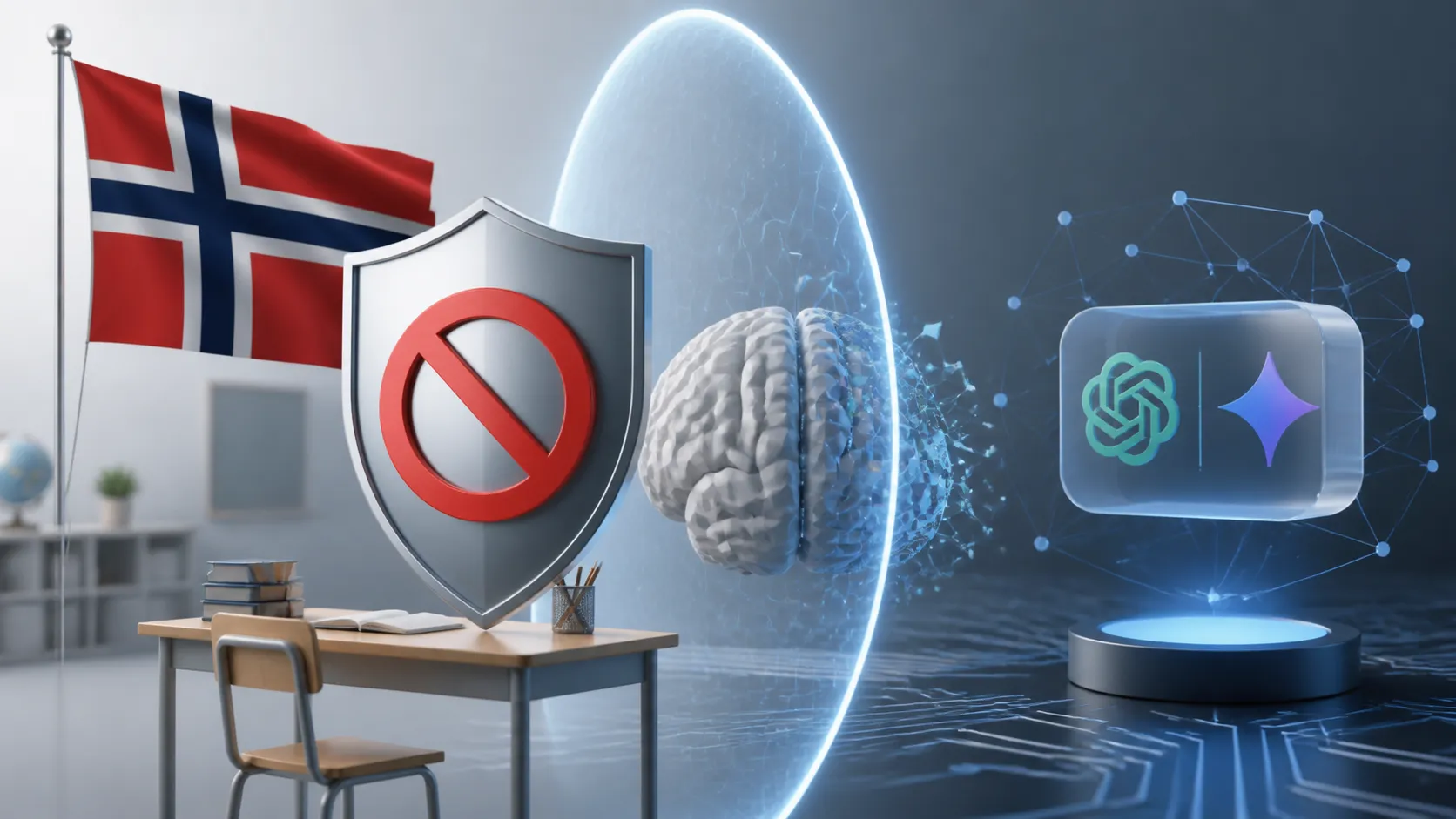
June 20, 2026, (Inside AI) — Norway will impose a near-total ban on generative AI in elementary classrooms and restrict usage in higher education, Prime Minister Jonas Gahr Støre announced Friday. The policy, set for late August, aims to protect foundational learning and curb cognitive skill erosion among students.
The Core Mandate: Reading, Writing, and Arithmetic Over Algorithms
At a national education conference, Støre framed the intervention as a defense of basic competencies. He stressed that early exposure to AI tools short-circuits essential developmental steps. The government will enforce new standards when the school year begins.
Primary and middle school students face a complete prohibition on generative AI in classrooms. Lower secondary pupils may use such tools only under direct teacher supervision. Upper secondary students gain limited access to prepare for advanced studies and modern workplaces.
“The most important thing in school is that our children learn to read, write and do mathematics,” Støre said.
The prime minister argued that unchecked AI use among younger children damages cognitive development and causes them to skip critical educational stages. The policy explicitly prioritizes handwriting and physical books over screen-based shortcuts.
From Tablet Classrooms to a Book-First Reset
Norway’s pivot marks a sharp reversal from its decades-long embrace of classroom technology. The country integrated computers in the 1990s and rolled out tablets widely in the 2010s. Officials now say that shift reduced reliance on traditional reading and handwriting practice.
To counteract those effects, the government will channel funds into purchasing more physical books. This material investment signals a structural retreat from the digital-first philosophy that once defined Norwegian education.
The AI restrictions build on Norway’s 2024 decision to limit smartphone use in schools. That earlier move responded to falling student performance and rising screen exposure. Teachers retain authority to enforce both sets of rules in their classrooms.
Global Echoes and a Broader Tech Backlash
Norway’s stance aligns with a growing international reconsideration of youth screen time. The government plans to ban social media for younger children in April, following similar frameworks adopted by Australia and other nations.
This cascade of restrictions reflects a maturing debate: whether early digital immersion helps or harms cognitive growth. Critics of generative AI in education point to risks of plagiarism, shallow learning, and eroded problem-solving skills. Proponents argue that guided AI use can personalize instruction and boost efficiency.
Yet Norway’s near-ban rejects that middle ground for the youngest learners. The policy assumes that foundational skills must be hard-wired before students encounter AI’s shortcuts. Whether other nations follow this model remains an open question.
The announcement did not detail enforcement mechanisms or penalties for non-compliance. It also left unclear how teachers will distinguish between supervised AI use and outright prohibition in lower secondary settings. These gaps may spark debate as the August rollout approaches.
Norway’s experiment will test whether peeling back technology can restore academic rigor. For now, the message is unambiguous: in the race to modernize, some steps cannot be skipped.