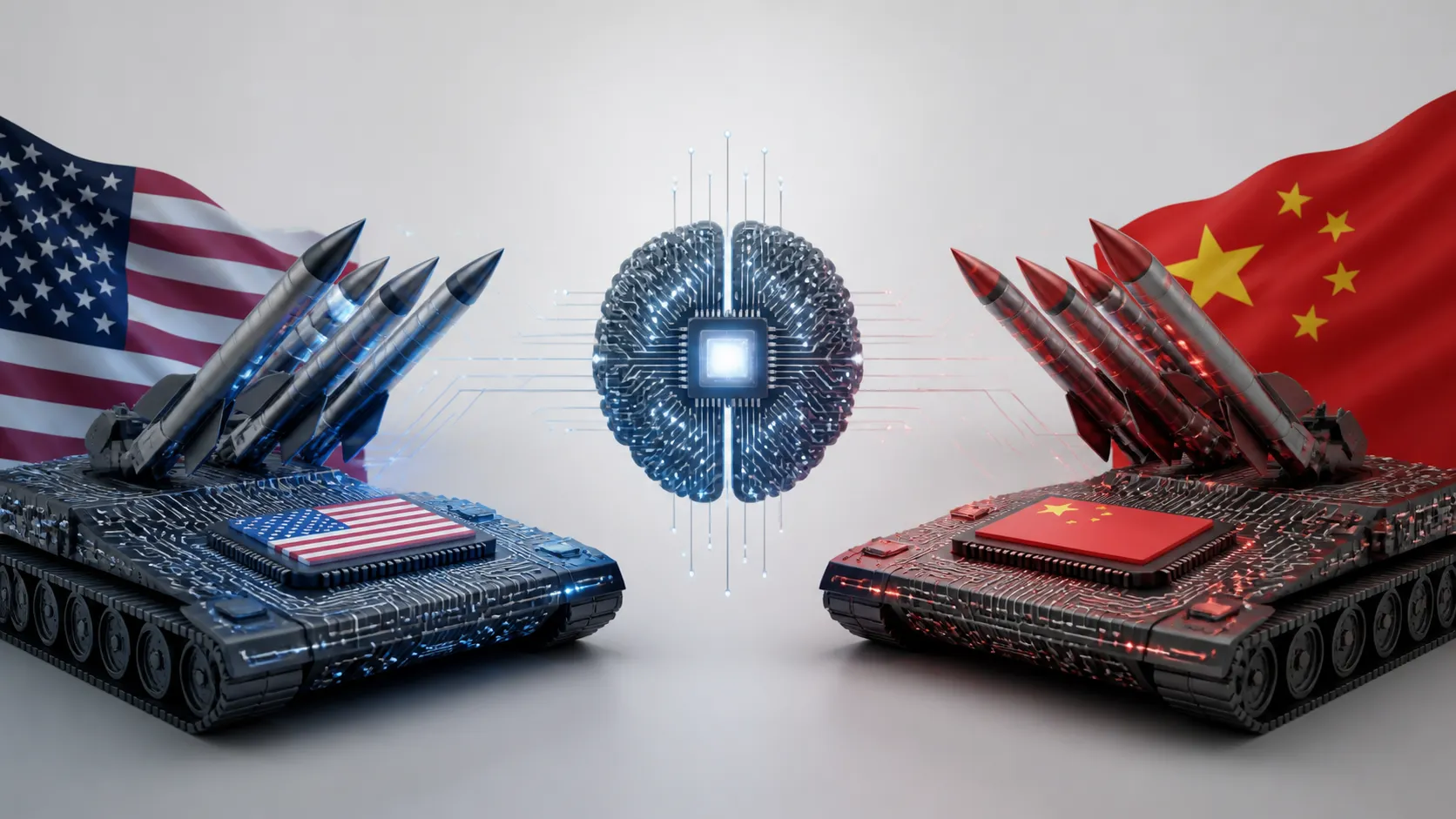
June 22, 2026, (Inside AI) — The United States and China are both treating artificial intelligence like a weapon in a zero-sum arms race, but recent actions reveal a shared, outdated mindset that misreads the nature of the technology.
Two Nations, One Flawed Script
Beijing restricted overseas travel for top AI engineers from private firms like DeepSeek and Alibaba. Washington ordered Anthropic to suspend access to its frontier models for foreign nationals, including its own employees. A widely used commercial product was abruptly pulled.
One country treats software engineers like nuclear physicists. The other treats a software product like a munition. Both policies flow from the same story: AI as a weapon of mass destruction to be contained through non-proliferation.
How the Arms Race Narrative Took Hold
Frontier labs have promoted this narrative to gain market share and shape regulation. Export controls, hardware tracking of chips, and travel bans all stem from this framing. It makes coercion feel like prudence, but the analogy misrepresents the technology.
Unlike rare, controllable fissile material, AI models are mathematical artefacts. They are easily reproducible and constantly diffusing. Chinese firms built competitive models despite chip export controls. Powerful open-source models remain freely downloadable.
The Real Bottleneck Is Adoption, Not Proliferation
The true barriers to unlocking productivity are widespread adoption: bridging the capability-reliability gap, navigating learning curves, driving organisational reforms, and ensuring regulatory compliance. The arms race narrative ignores these mundane but critical challenges.
A More Honest Framing: The Geopolitical Innovation Race
A more accurate view is a geopolitical innovation race. A dense web of public and private actors worldwide compete and collaborate, driven by national security, economic advantage, and market incentives. This framing leads to constructive policies: compute investment, skilling, industrial policy, strategic partnerships, and organisational reforms.
India’s Path: Diffusion, Resilience, and Openness
For a middle power like India, the response is to lean into AI as a general-purpose technology while acknowledging the geopolitical innovation race. The value lies not just in inventing the frontier but in diffusing it widely and well. The Supreme Court’s draft guidelines on AI use in courts exemplify this approach.
Returns will accrue to countries that put AI to work in health, agriculture, law, and public services. That points to three priorities. First, diffusion over denial: spend political energy on adoption infrastructure, regulatory clarity, and sector deployment. Second, plurilateral resilience over self-sufficiency: coalitions of the like-minded, such as India and the EU, can share open-source development costs and build trusted supply chains. Third, open over closed: the Anthropic suspension shows that dependence on a nationally controlled, closed model risks access being withdrawn overnight. Open-weight models, open standards like RISC-V, and open alternatives to proprietary stacks are resilient because no single government can switch them off.