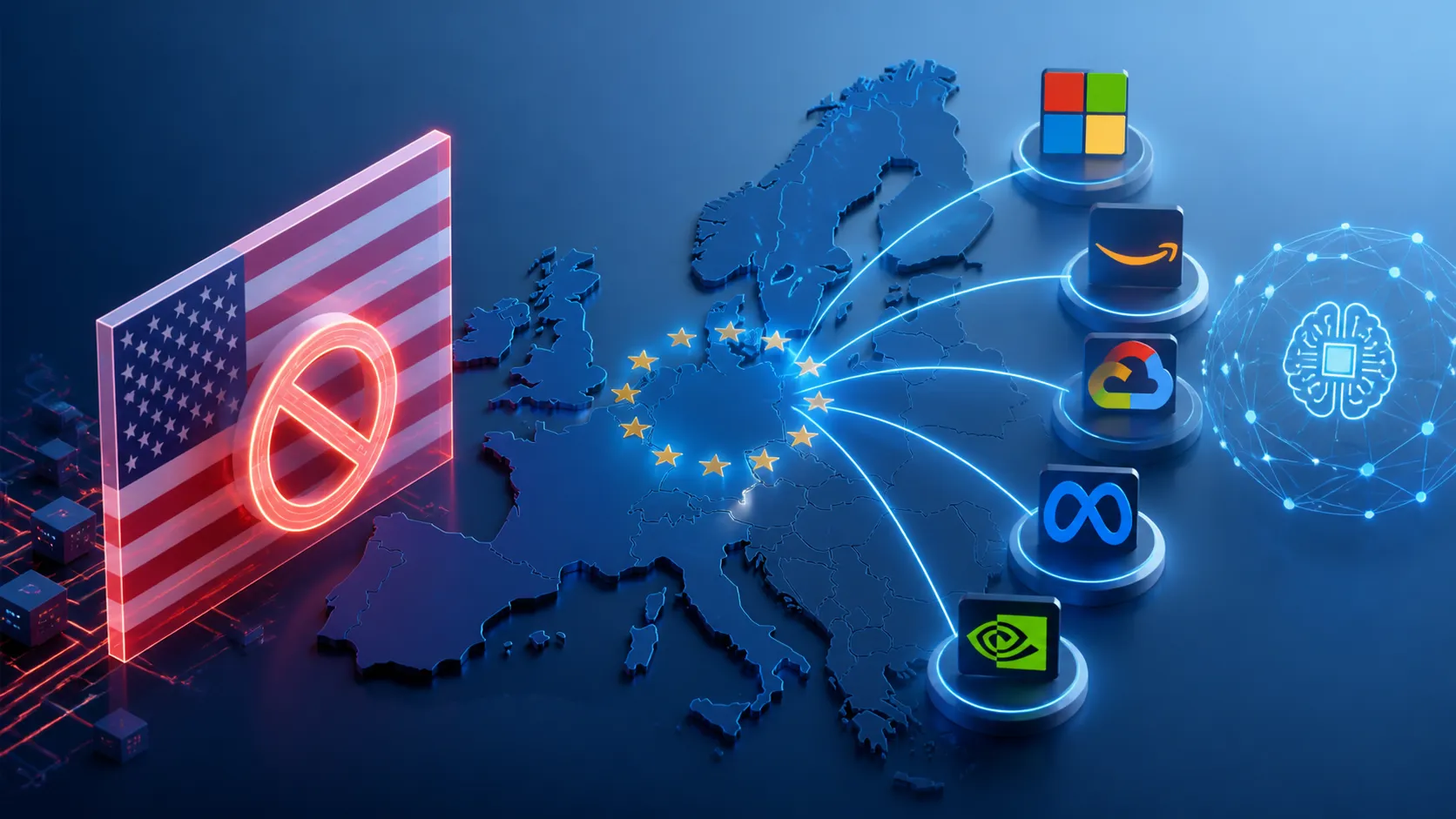
June 22, 2026, (Inside AI) — U.S. government restrictions on foreign access to certain AI models are accelerating a strategic pivot among Europe’s largest firms. Companies from Siemens to Renault are actively diversifying their AI suppliers, blending U.S., Chinese, and European models to reduce dependency on any single provider.
The immediate trigger: Anthropic, the San Francisco-based AI lab, suspended access to its Fable 5 and Mythos 5 models for foreign nationals, citing national security concerns. The move exposed a structural vulnerability for enterprises relying on proprietary, remotely delivered AI services—services that can be cut off without recourse.
At last week’s VivaTech conference in Paris, executives detailed their multi-vendor strategies. Siemens confirmed it uses Chinese models DeepSeek and Alibaba’s Qwen, alongside Nvidia’s Nemotron and other U.S. and European models. Renault Group works with Google, Microsoft, Mistral, DeepSeek, and Dataiku, though it said DeepSeek is not yet used meaningfully. Telecom giant Orange and defense-tech firm ChapsVision echoed the approach.
The Sovereignty Spectrum: From Autarky to Choice
EU officials have long framed digital dependence as an economic threat, compiling a sovereignty package to bolster semiconductors, AI, and digital autonomy. But corporate leaders are redefining the term.
Cedrik Neike, CEO of Digital Industries at Siemens, told Reuters:
“You need flexibility. Sovereignty often gets confused with autarky, and autarky is absolutely not the way to do it.”
For Orange, the lesson is stark. The company said its infrastructure can run all open-source models, including Chinese ones. It likened running a Chinese model on European servers to buying a painting in China and bringing it home—the model is self-operated, no data leaves the premises. The Anthropic restrictions, Orange said, made it “patently clear, if it wasn’t before, how important it is for Europe to have access to an AI service that it can control, that will never be switched off on a whim.”
Orange CEO Christel Heydemann, in a keynote, urged Europe to build AI it can access, govern, and challenge on its own terms. ChapsVision, which has won French and German government contracts to replace U.S. rival Palantir, sees sovereignty as having a credible alternative ready if a key service is cut.
The Open-Source Gap and the Cost Crunch
Europe’s general-purpose AI providers remain scarce. France’s Mistral leads, while others like translation specialist DeepL occupy niches. The market splits into two camps: open-weight models run on a company’s own servers, and proprietary models accessed remotely under the developer’s control.
Octave Klaba, CEO of cloud provider OVHcloud, offered a blunt assessment:
“Today, in open source, when you look at European models, they’re not impressive. At one point, the Americans were there, then they moved to closed source, and now there are only Chinese models in open source.”
Cost pressures compound the risk. Token fees—charges per unit of information processed—are surging as companies deploy AI agents that perform tasks automatically. Orange warned executives will be “obsessed with cost per token” by year-end, citing Uber as a company that burned through its 2026 token budget in just four months. Renault said token costs “have risen sharply and are pushing us to adapt.”
Rudy Kahn, a senior executive at German software firm Celonis, whose clients include BMW and Siemens, stressed the need for context models to avoid bill blowouts:
“If you do not provide a context model, AI needs to extract every single fact from the data itself. This will just blow your token bill completely.”
Software giants SAP and Sopra Steria agreed resilience comes through diversification, not isolation. Capgemini noted most AI providers are adapting offerings beyond remote access to ease European dependency concerns, though it remains a work in progress. For now, Europe’s industrial titans are betting that a mesh of global models—and a push for controllable alternatives—will keep them running when the next switch flips.