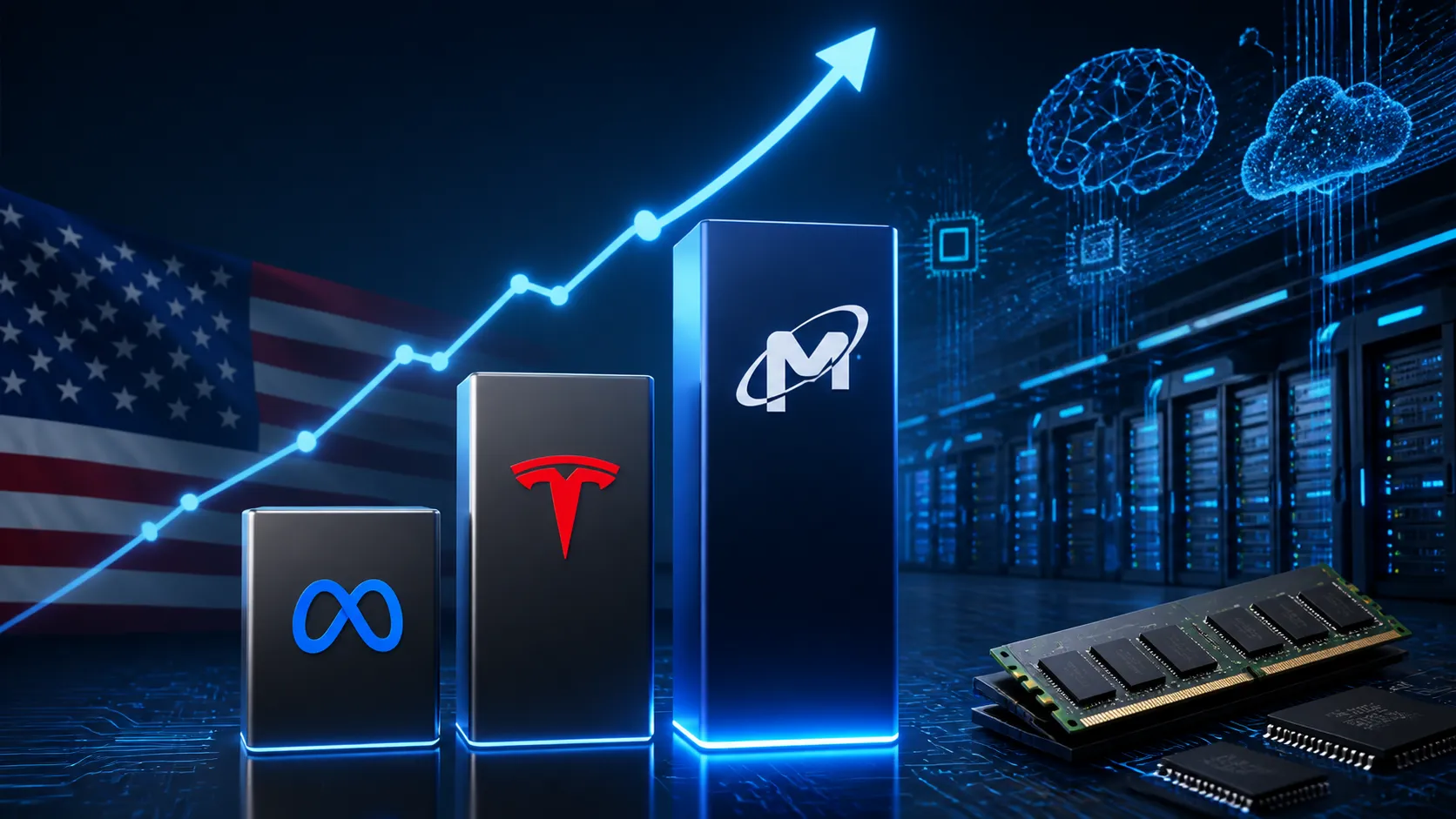
June 25, 2026, (Inside AI) — Micron Technology’s market capitalization surged past Meta Platforms and briefly overtook Tesla on Thursday, propelled by a robust forecast that signals unrelenting demand for memory chips in AI infrastructure. The chipmaker’s shares jumped 18.4% to $1,236, pushing its valuation to $1.398 trillion, edging out Meta’s $1.392 trillion and Tesla’s $1.4 trillion.
The rally followed Micron’s disclosure that customers have committed $22 billion to secure memory chip supplies, underscoring the critical role of high-bandwidth memory in powering AI systems. This milestone comes just a month after Micron first crossed the $1 trillion mark on May 26, joining South Korea’s Samsung Electronics in an elite club of memory chipmakers benefiting from Big Tech’s massive AI spending.
Micron’s ascent reflects a structural shift in the semiconductor industry, where memory chips have become a bottleneck for AI training and inference. The company’s fourth-quarter revenue and profit forecasts reversed a recent stock slump, as investors recalibrated the value of essential hardware in an AI-driven economy. Unlike GPUs, which have dominated AI narratives, memory chips are now recognized as equally vital for handling vast datasets with low latency.
This market cap crossover is more than a symbolic milestone. It highlights how AI infrastructure spending is redistributing value across the tech supply chain. While Meta and Tesla are key consumers of AI, Micron’s position as a supplier of non-discretionary components gives it a distinct advantage. Competing viewpoints note that memory markets are historically cyclical, and some analysts warn that current demand could be front-loaded, risking oversupply. Still, the $22 billion in customer commitments suggests near-term visibility that tempers such concerns.
What’s missing from the narrative is the geographic concentration of this demand. A significant portion of Micron’s growth is tied to AI data center buildouts in the United States and Asia, particularly China, where geopolitical tensions add risk. Additionally, the environmental toll of manufacturing advanced memory chips—requiring vast water and energy—remains underreported, even as sustainability pressures mount on the tech industry.
Micron’s trajectory mirrors previous tech booms but with higher stakes. The last time a memory chipmaker commanded such valuation was during the dot-com era, when infrastructure plays briefly outpaced consumer-facing giants. Today, the AI boom is more grounded in enterprise spending, yet the cyclical nature of memory pricing could test Micron’s durability. For now, the company’s ability to lock in long-term contracts sets it apart from historical patterns.
Looking ahead, Micron’s rise may pressure competitors like SK Hynix and Samsung to accelerate their own high-bandwidth memory roadmaps. It also raises questions about whether other AI infrastructure providers—such as networking or cooling companies—could see similar valuation jumps. As AI models grow larger, the demand for memory bandwidth will only intensify, potentially making Micron’s market cap milestone a harbinger of a broader reordering in tech.