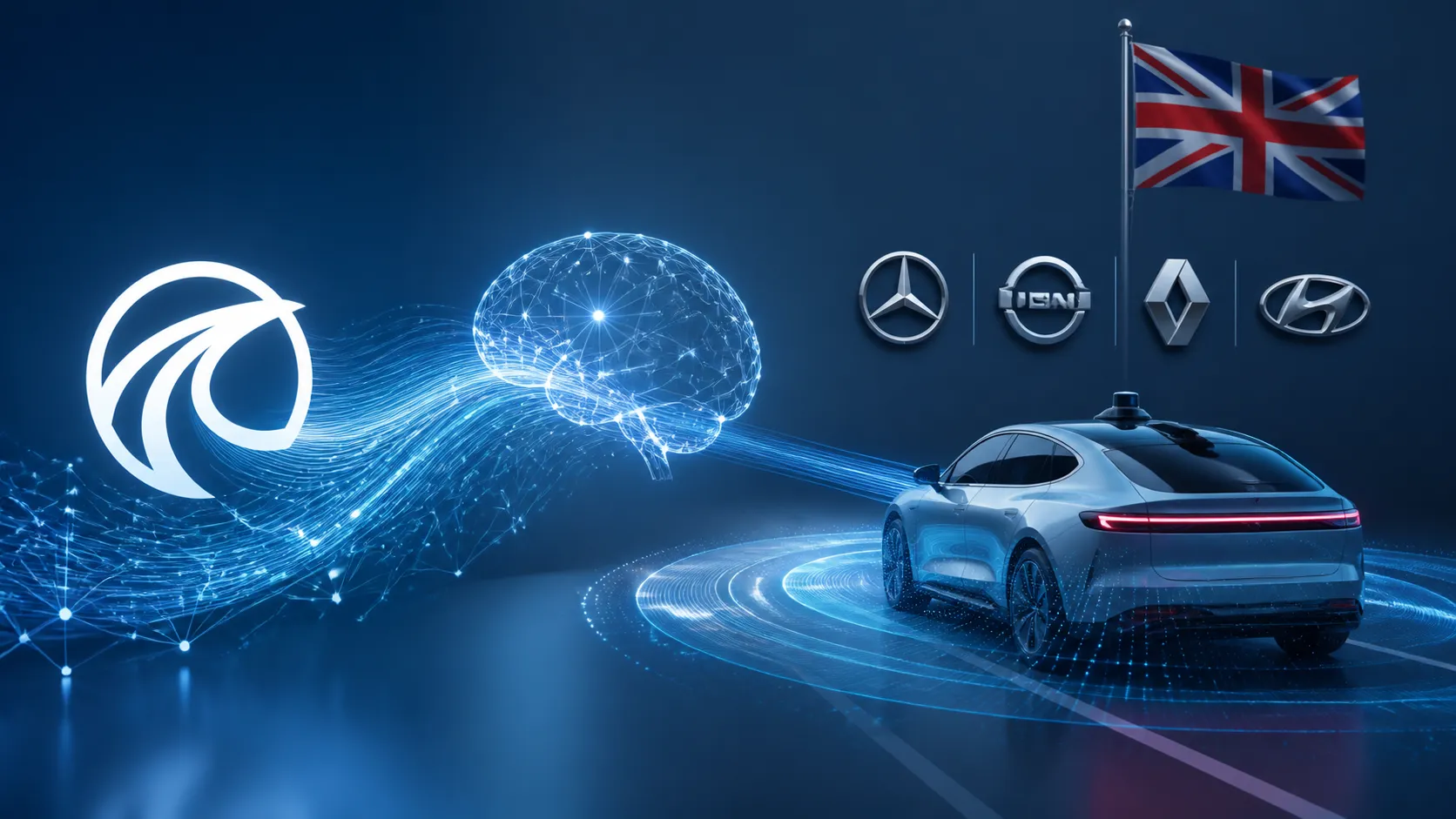
July 1, 2026, (Inside AI) — Autonomous-driving startup Wayve is pitching automakers on an AI system that learns to drive much like a human, eschewing the painstaking process of mapping roads and hand-coding rules. The London-based company has raised $2.8 billion from backers including Nvidia, Mercedes-Benz, and Nissan, and in June said it will deploy its tech in Stellantis robotaxis on Uber‘s network.
Wayve’s end-to-end machine learning translates sensor data directly into driving decisions, a departure from conventional systems that layer AI atop explicit software rules and high-definition maps. CEO Alex Kendall, who co-founded the company in 2017 after a Cambridge PhD, says the approach can scale to any vehicle, brand, or geography without tedious localization.
“We want to make full self-driving possible for any vehicle, any brand, and anywhere around the world,” Kendall told Reuters earlier this year during a demo ride in a Ford Mustang Mach-E navigating San Francisco Bay Area streets.
The system is sensor-agnostic, unlike Tesla‘s camera-only end-to-end model, allowing Wayve to license its AI to diverse driverless-car developers. But the “black box” nature of end-to-end learning raises safety questions: it is hard to interpret why the vehicle chooses a given path.
Read: Why Frontier AI Still Hallucinates in 2026 and What to Do About It
Wayve counters that its AI produces a safety map of unfolding traffic and identifies safe paths, arguing that pre-programmed safety logic “becomes brittle” in unusual scenarios. “Human drivers remain safe because they adapt conservatively when they do not know what comes next,” said Vijay Badrinarayanan, Wayve’s VP of AI.
Competing Safety Philosophies Collide
Waymo, which now offers paid rides in about a dozen cities, uses end-to-end AI but still relies on rules-based safeguards. “End-to-end models aren’t enough to guarantee safety at scale,” a Waymo spokesperson told Reuters. The company’s expansion has rekindled investor interest after years of missed deadlines.
Nissan, one of Wayve’s customers, is scrutinizing the system ahead of a planned 2028 deployment in Japan on the Elgrand van. Tech chief Eiichi Akashi called Wayve’s tech the “most advanced” but said it is “difficult to peer into it and see how it makes decisions.”
End-to-end models should be faster to commercialize, said Siddartha Khastgir, a professor at the University of Warwick, but he cautioned, “I wouldn’t say that one technology is safer than the other.”
Phil Koopman, a Carnegie Mellon University professor, sees Wayve’s method as one viable path among many, yet believes widespread U.S. deployment is at least a decade away. “It will most likely demand new innovations to get us there,” he said.
Read: Amazon Explores Selling Trainium AI Chips, Challenging Nvidia’s Dominance
Wayve has tested its system in hundreds of cities without prior mapping, with major tech centers in Tokyo, Stuttgart, and Vancouver. The startup’s ability to skip tedious localization could accelerate expansion, but the industry remains split on whether pure end-to-end learning can match the safety assurances of hybrid approaches.