Tencent has officially released Hy3, the latest large language model in its Hunyuan family, with a smaller parameter base than several major open-source flagships but performance results that put it in a similar range for agent, coding and reasoning tasks. Hy3 has 295 billion total parameters, 21 billion activated parameters and a 256K context window, making the release less about raw scale and more about whether a smaller model can handle workloads usually associated with much larger systems.
The most useful way to read Hy3 is through the tasks it is built to handle. Large language models are no longer being used only for chat-style responses. They are increasingly being placed inside coding assistants, office agents, search tools and automation systems, where a single answer is rarely enough.
In those settings, a model may need to read long context, follow layered instructions, write or revise code, call tools, interpret intermediate results and continue working after an error. These are agent-style tasks, and they tend to expose weaknesses that may not appear in ordinary chatbot use.
Hy3’s release is focused on that more demanding category. Its 256K context window gives the model room to work with long documents, extended task histories and code-related information. That matters for agents and productivity tools because the model often needs to keep several pieces of information active at the same time.
This is also why the parameter comparison matters. Hy3 is smaller than some larger rivals, but it is placed against models such as GLM-5.1, GLM-5.2, DeepSeek V4 Pro and Qwen 3.7 Max. GLM-5.1 has 744 billion total parameters and 40 billion activated parameters, while Hy3 has 295 billion total parameters and 21 billion activated parameters.
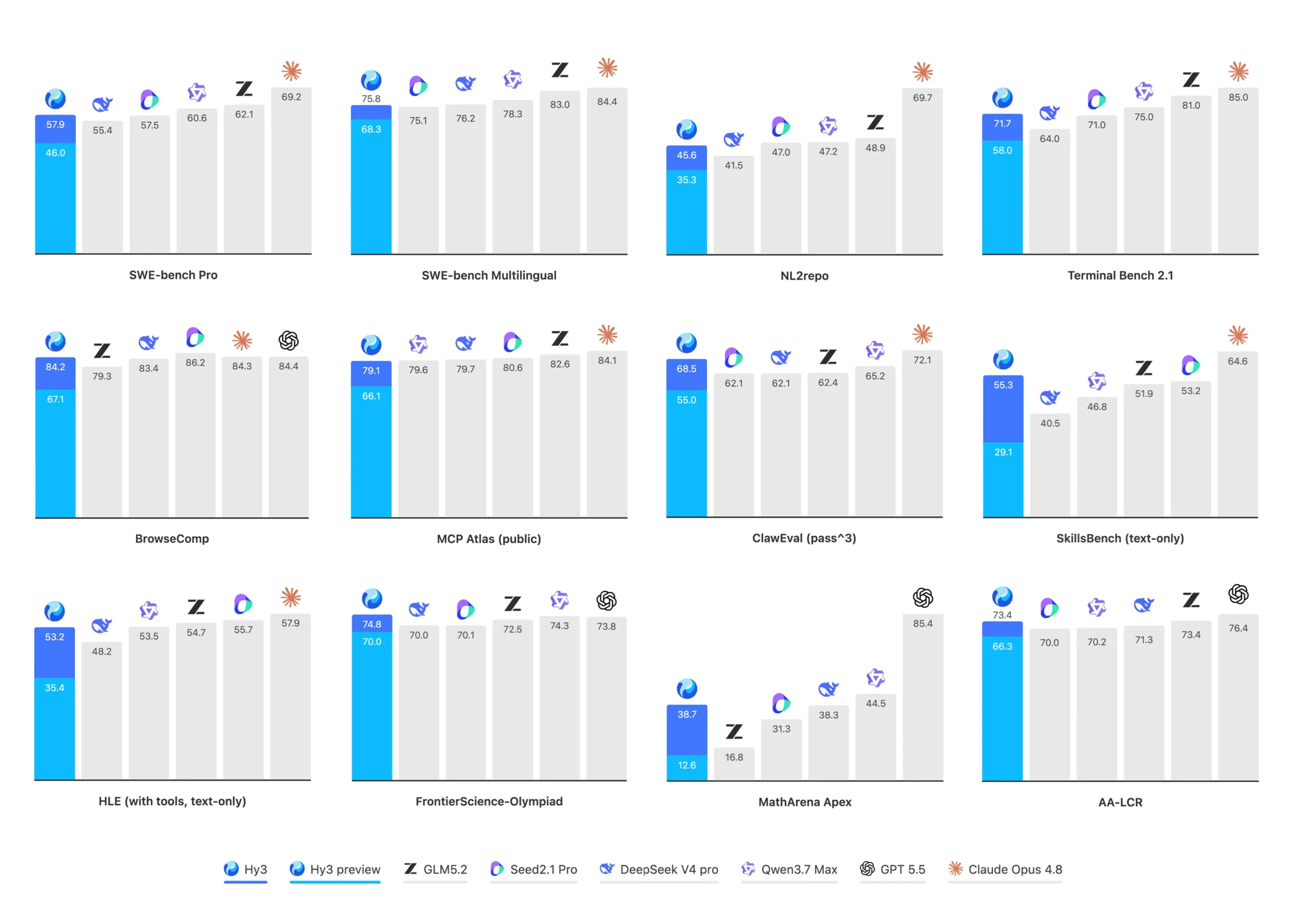
The size gap makes Hy3’s performance profile more meaningful. The model is not trying to compete by having the largest parameter count. Its case depends on capability per active parameter: whether it can deliver strong enough performance in agent, coding and reasoning tasks while using a smaller parameter base.
That distinction is important for real-world deployment. A larger model may look stronger on paper, but developers also need to consider latency, cost, tool use, long-context handling and instruction following. A model that is powerful enough but cheaper and easier to run can be more attractive for high-volume products.
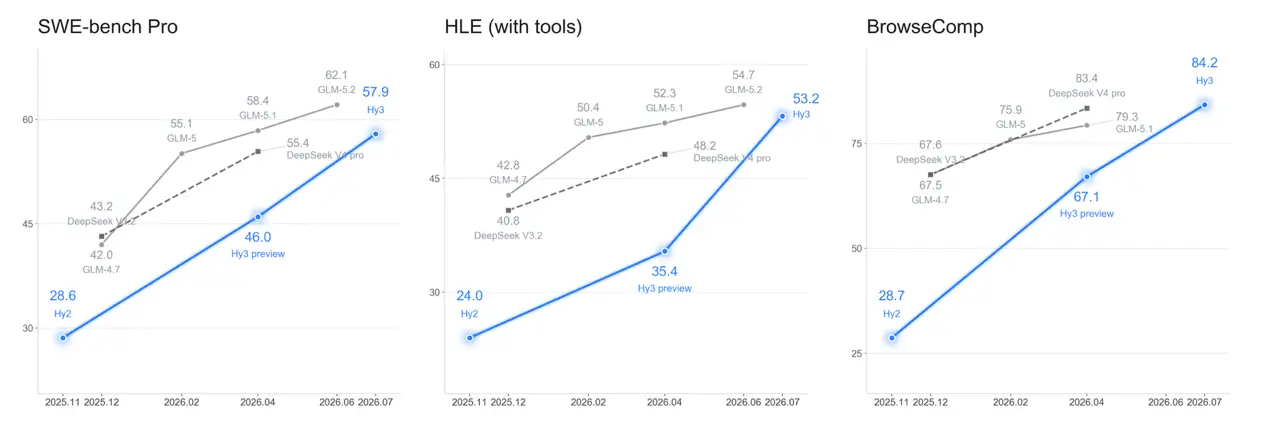
The official release also marks a quick step forward from Hy3 Preview. Tencent released the preview version in April and moved to the official version roughly two months later. The new version brings gains in code generation, agent capabilities and stability, following a broader reconstruction of Hunyuan’s model infrastructure earlier this year.
That shorter cycle matters because agent models are difficult to improve only through static benchmarks. A useful agent has to perform across messy workflows, not just isolated prompts. It may need to combine reasoning, dialogue, coding, tool use and long-context understanding in one process. Improvements in stability and agent capability therefore matter directly to whether the model can work inside actual products.
Tencent says Hy3 has also been tested across internal business scenarios, including productivity and office-agent tasks. That gives the release a practical dimension beyond public comparisons. The model is being evaluated not only as a language model, but also as part of workflows where output quality, reliability and task completion are more important than a single benchmark score.
The pricing follows the same practical logic. On Tencent Cloud, Hy3 is priced at 1 yuan per million input tokens, 4 yuan per million output tokens and 0.25 yuan per million cache-hit input tokens. Agent and coding applications often consume large numbers of tokens because they involve repeated context, multiple steps and ongoing interaction. In those cases, cost can become part of the model’s usability.
The cache-hit input price is especially relevant for repeated-context workflows. A coding assistant may keep returning to the same project files. An office agent may repeatedly use the same documents, spreadsheets or knowledge base. Lower cache-hit pricing can reduce the cost of those repeated interactions, making long-context use more practical.
Open-source licensing is another part of Hy3’s accessibility. The model is being released under Apache 2.0, a mainstream and commercially permissive open-source license. Developers can download, modify and use the model for free in commercial projects, which lowers the barrier for companies and independent teams that want to test or integrate it.
The model will be available through Tencent Cloud TokenHub and open-source communities including Hugging Face and ModelScope. Tencent also plans to bring Hy3 to global developer platforms such as OpenRouter, Hermes, Kilo, Cline, OpenClaw, OpenCode and CherryStudio.
The remaining question is how the model performs after wider release. Hy3’s benchmark comparisons and product testing provide the starting point, but coding assistants, office agents and tool-using systems will be the more practical test. Agent workloads can fail in small but important ways, especially when the model has to manage long context or recover from mistakes.
For Hunyuan, Hy3 gives the model family a clearer direction. It is a smaller model being compared with larger flagships, with strong emphasis on agent capability, coding, cost efficiency and open commercial use.
Hy3 does not need to be the largest model to be relevant. Its release is about whether a smaller model can be powerful enough for agent workloads, affordable enough for repeated use and open enough for global developers to adopt.
Update: Tencent Hunyuan Open-Sources Hy4 preview, Marking Its Third Major Release in Six Months