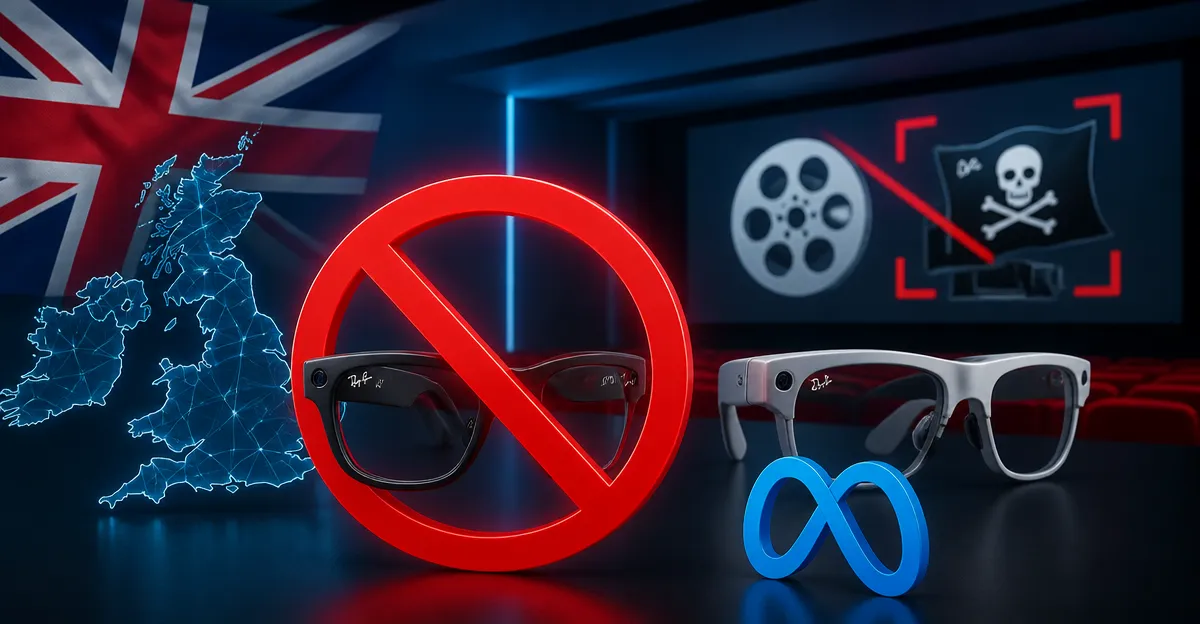
August 20, 2026, (Inside AI) — UK cinema operators are moving to ban or restrict camera-enabled smart glasses, including Meta’s AI-powered eyewear, over fears of covert film piracy and audience privacy breaches.
The UK Cinema Association confirmed the policy shift on Thursday. It follows rising legal and public scrutiny of wearable cameras in sensitive spaces.
This month, courts in England and Wales prohibited Meta smart glasses because of restrictions on taking images and videos in courtrooms.
The cinema restrictions are not a single national law. They are a coordinated industry response driven by individual operators.
Smart glasses can record high-definition video without a visible red light. That makes them harder for staff to detect than a phone held up in a dark theater.
Piracy remains a serious financial threat. The Motion Picture Association estimates global online piracy costs the industry tens of billions of dollars annually.
UK cinemas already ban camcorders and often ask patrons to silence phones. Extending rules to smart glasses closes a growing loophole.
Meta’s Ray-Ban smart glasses include a 12-megapixel camera and open-ear audio. A small LED indicates recording, but critics say it is too subtle.
Privacy advocates have long warned that always-on cameras normalize surveillance. Cinema operators now face pressure to act before a major leak occurs.
The UK Cinema Association said the policies are designed to protect both films and moviegoers. It cited privacy and film piracy concerns as the dual drivers.
Some chains may require guests to remove smart glasses entirely. Others may ask users to switch them off or place them in sealed pouches.
Enforcement will be challenging. Staff must distinguish prescription smart glasses from ordinary eyewear without violating disability or medical privacy rules.
This is not the first time wearables have clashed with content protection. Google Glass faced bans in bars, casinos, and cinemas after its 2013 launch.
Meta has sold millions of Ray-Ban smart glasses. The company has not yet issued a public statement on the UK cinema restrictions.
Legal experts say private businesses can set conditions of entry. Cinemas have broad discretion to refuse service if customers do not comply with recording bans.
The court ban in England and Wales sets a precedent. It signals that institutions are unwilling to tolerate camera-enabled eyewear in controlled environments.
Smart glasses are also raising concerns in gyms, hospitals, and schools. The UK cinema move may accelerate similar policies in other sectors.
For now, moviegoers who wear smart glasses should expect new signage and staff checks. The era of frictionless wearable recording is ending in public venues.