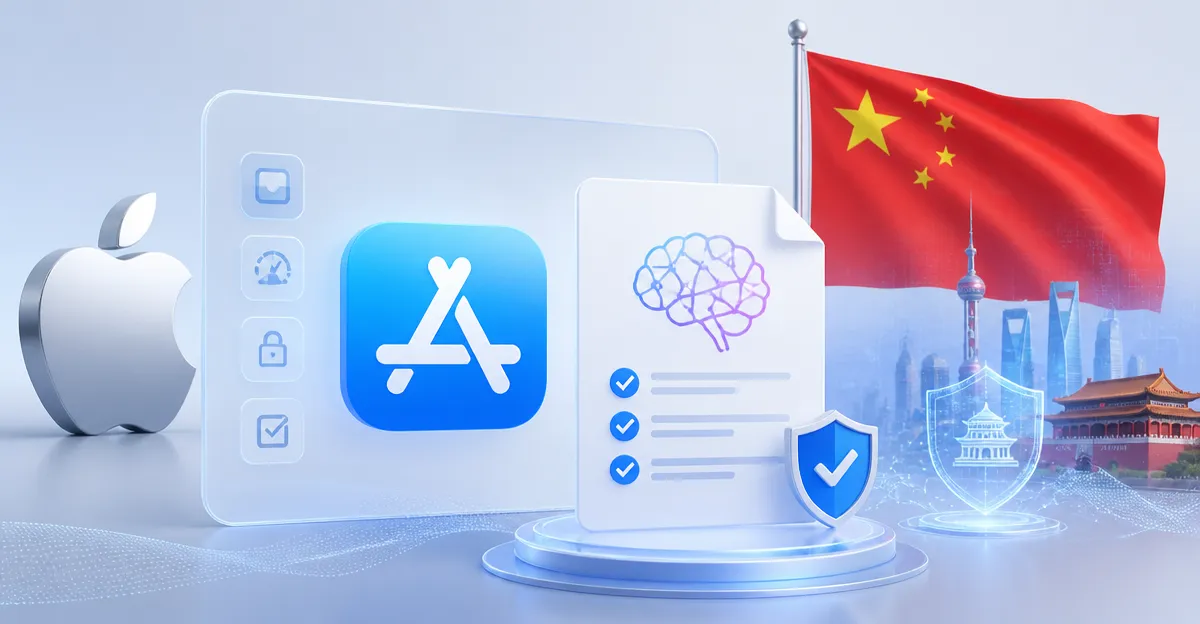
November 17, 2026, (Inside AI) — Apple has introduced a compliance declaration page within App Store Connect for developers distributing apps in mainland China. The page requires developers to submit declarations for apps that offer AI-generated or synthetic content, or features subject to a security assessment. Existing apps covered by the requirements have until January 31, 2027, to submit the information. New apps must provide it at the point of submission.
The move formalizes a filing process that aligns Apple's developer workflow with China's evolving AI content regulations. It shifts the burden of compliance documentation onto developers, who must now explicitly declare AI features such as chatbots, image and video generation, and voice or face editing. The requirement applies to both existing and new apps, creating a dual-track deadline that could strain smaller development teams.
China's regulatory framework for synthetic content has been tightening since 2023, when the Cyberspace Administration of China introduced rules requiring labels on AI-generated media. Those rules, known as the Deep Synthesis Provisions, mandate that service providers prevent and label synthetic content. Apple's new page effectively operationalizes that mandate at the app distribution layer, making the App Store a checkpoint for compliance.
Developers using third-party AI technology may need to submit an authorization or usage agreement alongside their filing. For features requiring a security assessment, the page accepts records and reports documenting that assessment. This suggests Apple is not conducting the assessment itself but is collecting evidence that developers have done so. The approach mirrors Apple's existing practices for other regulated content categories in China, such as gaming and news.
Read: US Tightens AI Chip Export Rules, Targets Remote Cloud Access from China
The deadline of January 31, 2027, gives existing apps roughly two and a half months from today to file. New apps face immediate compliance. The timing could disrupt release schedules for developers planning winter or early spring launches. It also raises questions about enforcement: Apple has not specified penalties for non-compliance, but apps that fail to file may face removal from the China App Store, a market that generated an estimated $17 billion in developer revenue in 2023, according to Apple's own figures.
Why China's AI Rules Reshape App Distribution
The filing requirement extends China's regulatory reach into the App Store's review process. By requiring declarations at submission, Apple becomes a gatekeeper for AI compliance. This is a notable shift: historically, app stores have focused on content moderation and privacy, not on verifying adherence to AI-specific regulations. The new page effectively deputizes Apple to collect compliance data on behalf of Chinese regulators.
Industry observers have noted that similar requirements could spread to other jurisdictions. The European Union's AI Act includes transparency obligations for generative AI, and the United States has proposed labeling rules for synthetic media. If Apple builds a compliance infrastructure for China, it could reuse that system elsewhere. That prospect worries some developers who fear a patchwork of declarations across regions.
Apple's move also highlights the growing tension between global platform policies and local regulations. The company has long navigated China's unique requirements, such as removing apps that violate local laws. This latest step is more procedural but equally consequential. It forces developers to document their AI supply chains, including third-party models and security assessments. For small teams, the paperwork could be onerous.
The requirement for authorization agreements with third-party AI providers adds a layer of contractual complexity. Developers must ensure their vendors permit use in China and that the technology has undergone any required security review. This could disadvantage startups that rely on foreign AI models not yet approved by Chinese authorities. It may also accelerate the adoption of domestic AI providers that already hold necessary certifications.
Apple's compliance page arrives as China continues to refine its AI governance. In 2025, the country introduced draft rules on generative AI service management, emphasizing data security and content labeling. While the final text is still pending, the direction is clear: regulators want traceability and accountability. Apple's filing system provides a mechanism for both.
Read: EU Leaders Hold First AI Summit in Dublin to Close Gap With US and China
For developers, the immediate task is to assess whether their apps fall under the new requirements. Chatbots, image generators, and voice editing tools are explicitly named. But the definition of "synthetic content" could be broad, potentially covering filters, avatars, and recommendation algorithms. Developers may need legal guidance to determine their obligations. Apple has not published detailed guidance beyond the page itself, leaving room for interpretation.
The deadline of January 31, 2027, is firm for existing apps, but Apple has not stated how it will verify submissions. The company could cross-check declarations against app functionality during review. Non-compliant apps might be rejected or removed. Given the size of the Chinese market, even a small enforcement action could have a chilling effect.
Apple's initiative follows similar moves by other platforms. Google has not announced an equivalent for its Play Store in China, largely because Google Play is not available there. Domestic app stores like Tencent's MyApp and Huawei's AppGallery have their own compliance processes, but Apple's centralized approach could set a precedent for international platforms.
The new page also reflects Apple's broader strategy of localizing compliance. The company has increasingly tailored its services to Chinese regulations, from iCloud data storage to App Store operations. This latest step is consistent with that pattern. It may help Apple maintain good relations with regulators while shifting liability to developers.
For now, developers must act quickly. The filing process requires gathering documentation, reviewing third-party agreements, and potentially conducting security assessments. Those who miss the deadline risk losing access to a lucrative market. Apple has not indicated whether extensions will be granted, but given the regulatory backdrop, flexibility seems unlikely.

Sofia spent years studying how machines parse human language before pivoting to cover the systems now rewriting it. She reads technical papers the way others read news and looking for what the numbers are actually saying beneath the headlines.