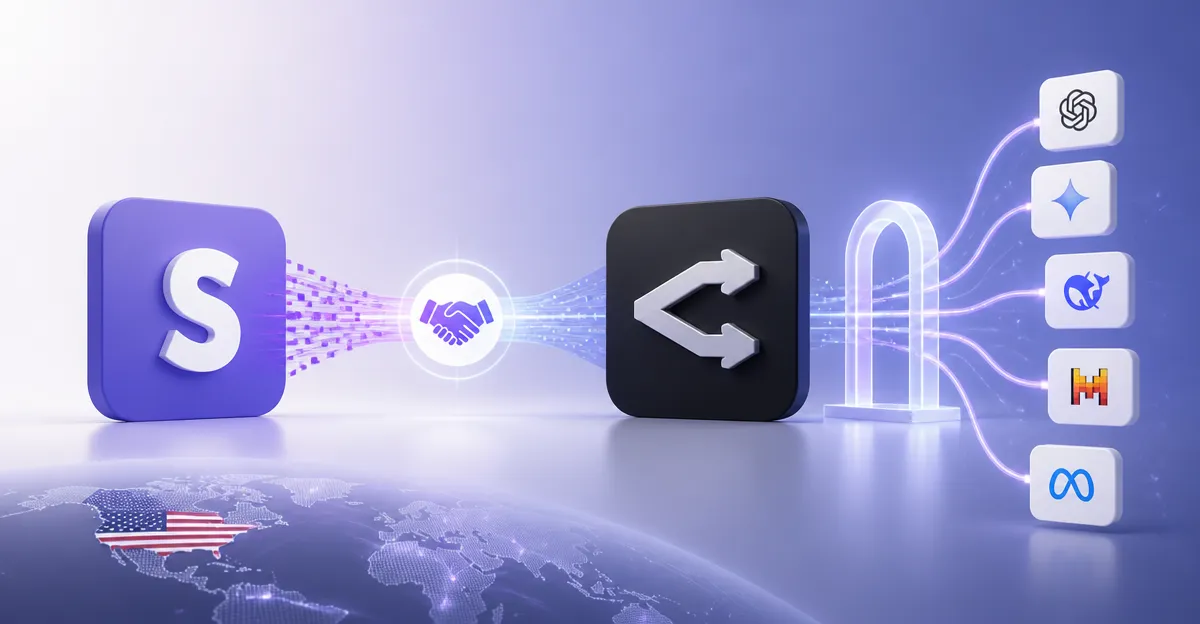
August 20, 2026, (Inside AI) — Stripe confirmed on Wednesday it will acquire OpenRouter, a platform that lets developers access multiple AI models through a single API. The deal is valued at over $7.5 billion, with $1.5 billion going to the two founders, according to The New York Times.
The acquisition pairs a payments giant with an AI model gateway, a category that has grown rapidly as companies seek to control soaring AI costs. Stripe CEO Patrick Collison framed the move as building economic infrastructure for AI. OpenRouter CEO Alex Atallah said joining Stripe accelerates a mission to bring the full AI ecosystem to every business.
OpenRouter lets developers route token spending to different large language model providers. It is often compared to Stripe itself. In May, Atallah described OpenRouter as the AI version of Stripe. While Stripe directs payments to businesses, OpenRouter directs token spending to model labs. That symmetry made the deal strategically obvious to many observers.
Why a payments company bought an AI model gateway
Stripe’s move follows a broader fintech push into AI. Earlier this week, Indian firm Razorpay launched Razorpay Vulcan, an AI payments foundation model built with Nvidia and AWS. Trained on three trillion data points across four billion payments, it aims to route payments better and detect fraud.
OpenRouter’s monthly revenue has more than tripled to about $13 million since April, according to The Information. In May 2026, it raised $164 million from investors including Andreessen Horowitz, Sequoia Capital, Nvidia, and Alphabet’s investment arm at a $1.3 billion valuation, per PitchBook. Stripe is paying roughly five times that valuation.
The price reflects strategic urgency, not just financial metrics. Stripe has been acquisitive. In 2025, it bought stablecoin platform Bridge for $1.1 billion. Last week, The Wall Street Journal reported Stripe and private equity firm Advent made a $53 billion offer for PayPal. OpenRouter is a different kind of bet, one aimed at the infrastructure layer of AI spending.
Collison called OpenRouter a “truly delightful” developer tool in a statement. He added:
“Stripe is building the economic infrastructure for AI, and together with OpenRouter we’ll help businesses maximize profitability by routing their requests intelligently and spending their tokens efficiently.” Patrick Collison, CEO, Stripe
Atallah emphasized a multi-model future:
“We believe intelligence will be multi-model: no single model will be optimal for every task, and developers need a neutral layer to orchestrate and manage them all. Joining Stripe lets us accelerate that mission and bring the full AI ecosystem to every business.” Alex Atallah, CEO and co-founder, OpenRouter
OpenRouter’s rise and the routing race
OpenRouter gained traction as a gateway to open-weight AI models, many from Chinese labs like DeepSeek and Zhipu AI. These models offer cost advantages over proprietary systems from OpenAI and Anthropic. Developers use OpenRouter to switch between models based on task complexity and price.
That switching capability addresses a real business problem. Companies initially pushed employees to use AI heavily, a trend dubbed “tokenmaxxing.” But productivity gains did not match spending. Many firms then capped internal token use. AI model routing emerged as a way to send simple tasks to cheap models and complex queries to expensive ones.
Competition is intensifying. Vercel is another leading platform in the space. Smaller players include Switchboard, Concentrate AI, and Requesty. Larger AI companies are also reportedly developing their own router offerings. The technical barrier to building an API router is not high, raising questions about OpenRouter’s moat.
Deedy Das, a partner at Menlo Ventures and former OpenRouter board member, defended the platform’s value in a post on X:
“OpenRouter provides a really valuable service to model labs: predictability in capacity and distribution. And to users: a simple way to access all models. With scale, OpenRouter is able to provide better uptime, more models, with the cheapest discounts and have model labs prioritise launching on OR first!” Deedy Das, Partner, Menlo Ventures
OpenRouter’s appeal also grew alongside open-weight Chinese models. Kimi K3, developed by Moonshot AI, saw a popularity surge as companies looked for cheaper alternatives. The gateway model lets businesses adopt such models without managing multiple API contracts and billing systems.
Stripe, founded in 2010, has a valuation near $160 billion. It remains private and profitable. The OpenRouter deal signals that AI infrastructure, not just payments, is now central to Stripe’s strategy. The acquisition is expected to close later this year, pending regulatory approval.