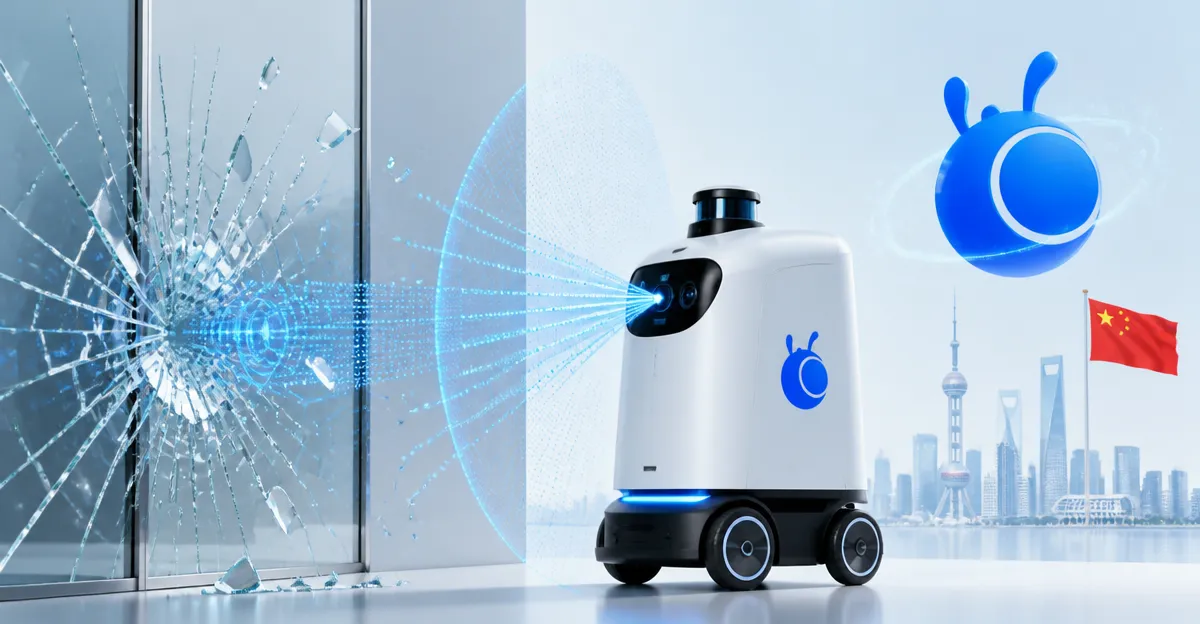
July 7, 2026, (Inside AI) — A new vision model from Ant Group’s AI unit, Robbyant, is claiming a breakthrough in robotic depth perception that could dramatically reduce costly glass crashes in warehouses and factories. The model, called LingBot-Vision, is trained specifically to detect object edges with sub-pixel precision, giving machines a sharper three-dimensional understanding of their surroundings.
The technology underpins LingBot-Depth 2.0, a depth-estimation system designed to solve a critical bottleneck in robotics: enabling machines to “accurately and stably” see in unpredictable, real-world environments. Robbyant, also known as Ant Lingbo Technology, says this is the first model trained explicitly to recognize the boundaries of objects.
By pinpointing edges down to a fraction of a single pixel, the AI allows robots to navigate cluttered spaces without colliding into transparent or reflective surfaces—a persistent challenge in logistics and manufacturing. Such collisions, often involving glass, cause millions in damage annually.
How Edge-Aware AI Slashes Collision Risks
Traditional depth-sensing systems rely on stereo cameras or LiDAR, which often fail on transparent or shiny surfaces. LingBot-Vision takes a different approach: it learns to infer depth from edge information, using a lightweight architecture that requires far less data and compute than existing giants.
Read: Wayve Courts Automakers with AI Driving System That Learns Like Humans
According to a research paper published by the Robbyant team, LingBot-Vision surpassed the 7-billion-parameter DINOv3 across multiple metrics on the NYUv2 depth-estimation benchmark. It achieved this using one-seventh as many parameters and less than a third of the training data.
This efficiency is key. Smaller models run faster on edge devices, making real-time deployment feasible on factory floors. The team claims the model’s edge-detection training is what sets it apart—most vision models learn depth as a secondary task, but LingBot-Vision treats edge awareness as a primary objective.
“It was the first model of its kind trained specifically to recognise the edges of objects,” the firm said. “This allowed the AI to pinpoint boundaries with high precision—down to a fraction of a single pixel—giving robots a sharper understanding of the 3D spaces around them.”
Competing Approaches and Industry Skepticism
While Ant Group’s advance is notable, it enters a crowded field. Startups like Luma AI and Nerfstudio are pushing neural radiance fields for 3D reconstruction, and Intel RealSense has long offered depth cameras with edge-preserving filters. However, these often require calibrated multi-camera setups or dense point clouds.
Robbyant’s monocular approach—using a single RGB camera—could be cheaper and more flexible. But some researchers urge caution. Dr. Sarah Chen, a robotics perception expert at MIT, noted that benchmarks like NYUv2 are indoor-only and don’t capture the harsh lighting and vibration of real warehouses.
“Edge-based depth is promising for transparent objects, but we’ve seen papers before that don’t hold up outside the lab,” Chen said. “The real test is whether it works when a forklift is shaking and sunlight is streaming in.”
Read: AWS and Vexcel Optimize Multimodal AI for Searchable Aerial Imagery
Ant Group has not yet disclosed field trial results. The research paper remains under peer review, but the benchmark numbers suggest a leap in parameter efficiency—a trend the industry is watching closely as it seeks to trim the ballooning costs of large AI models.
Historical context is instructive. In 2023, Google’s RT-2 model combined vision and language for robotic control but struggled with transparent objects. Amazon has invested heavily in depth-sensing for its warehouse bots, yet glass crashes remain a multimillion-dollar problem. A solution that works robustly could have immediate commercial impact.
Robbyant’s parent, Ant Group, is better known for fintech, but its AI unit has been quietly building robotics capabilities. The firm says LingBot-Vision is the “critical engine” driving its new depth system, which could eventually be licensed to logistics companies.
For now, the advance is a research milestone. But if it translates to real-world reliability, it could reshape how robots perceive fragile and transparent obstacles—and finally put a dent in those glass crash statistics.