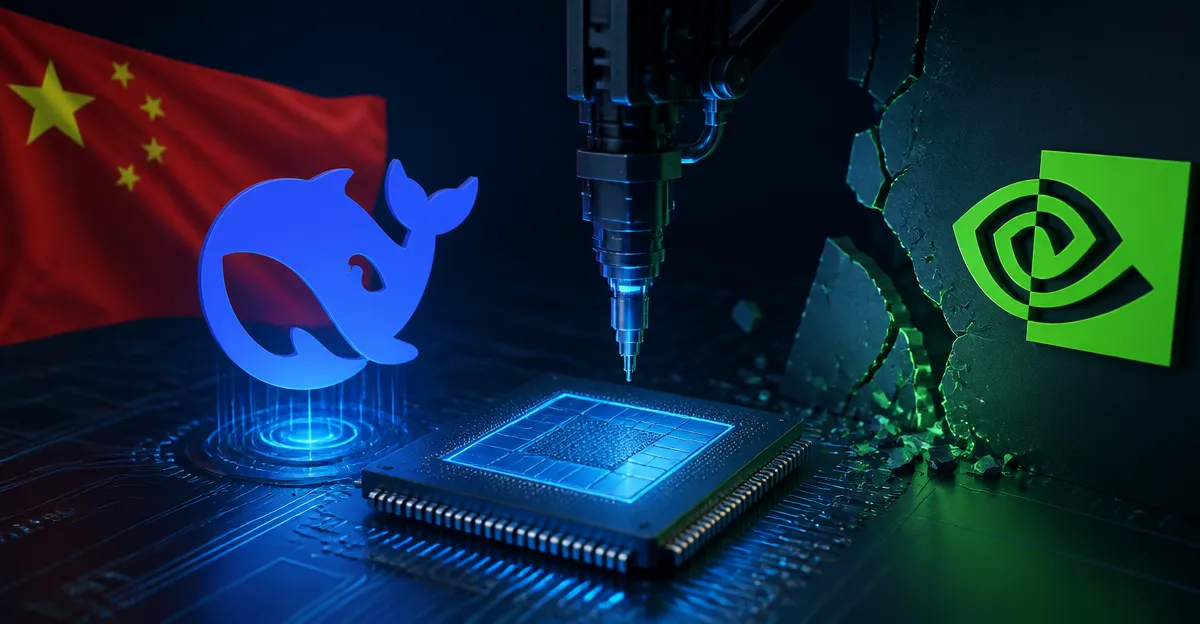
July 8, 2026, (Inside AI) — Chinese AI startup DeepSeek has quietly launched an in-house chip development project, targeting inference workloads to reduce reliance on NVIDIA GPUs, sources told Reuters. The effort, which began about a year ago, remains in early stages and focuses on custom-designed processors for cost-efficient inference rather than model training.
As generative AI pivots from training to large-scale inference, custom silicon has become a strategic imperative. DeepSeek, known for its open-source DeepSeek-V3 and reasoning model R1, now joins global peers like Google and Amazon in pursuing bespoke chips to tame soaring compute costs.
Sources said the company has ramped up hiring in recent months, quietly recruiting experienced chip engineers through targeted outreach rather than public postings. The team spans chip architecture, verification, and software enablement. DeepSeek has not commented publicly on the project.
Inference—serving millions of real-time user requests—demands sustained throughput and energy efficiency, unlike training’s bursty compute needs. Custom chips can optimize for these patterns, potentially slashing costs per query. For DeepSeek, whose services are growing rapidly, infrastructure expenses now dominate operating costs.
“Compute-related costs may account for more than half of operating expenses for many AI companies,” industry analysts note, while the limited supply and high cost of advanced GPUs have encouraged more firms to pursue custom chip development.
DeepSeek’s move mirrors a broader trend. OpenAI, Meta, and Microsoft have all explored in-house silicon to escape the NVIDIA premium. But chip development is a multi-year, capital-intensive gamble. From architecture design to tape-out and mass production typically takes over a year, meaning DeepSeek’s chips won’t hit the market soon.
The startup is also seeking its first external funding round, reportedly aiming to raise about $7 billion at a valuation between $52 billion and $59 billion. If successful, chip development and AI infrastructure investment would be key priorities.
Yet, China’s semiconductor ambitions face unique hurdles. U.S. export controls have restricted access to advanced chipmaking tools and technologies. DeepSeek may need to rely on domestic foundries like SMIC, which lag behind TSMC in process nodes. This could limit performance and prolong development.
Despite these challenges, the inference chip market is projected to grow as AI adoption accelerates. Custom solutions could offer DeepSeek a competitive edge in deployment efficiency and long-term cost control. But the immediate landscape remains unchanged.
As the AI chip race intensifies, DeepSeek’s quiet push signals a strategic bet on vertical integration—a path that could redefine its infrastructure independence, if it can navigate the technical and geopolitical maze.