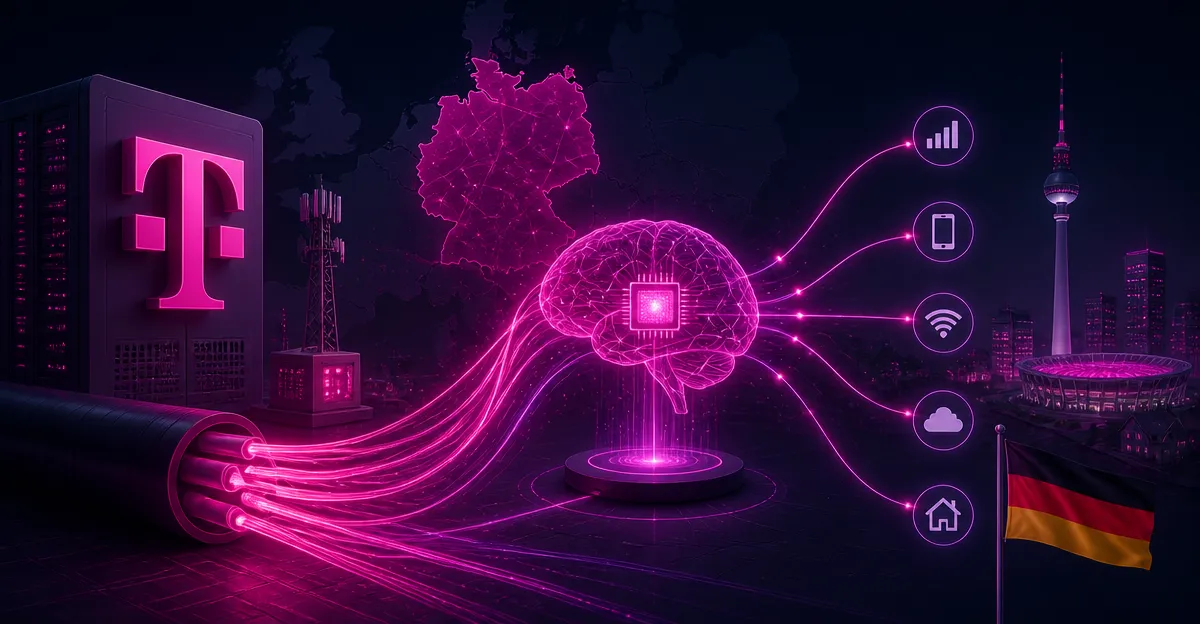
July 10, 2026, (Inside AI) — Deutsche Telekom, a telecommunications giant serving over 300 million customers across Europe and the U.S., is executing a bold strategy to become one of the world’s first AI-native telcos. The company is embedding generative AI into customer care, network operations, and core voice services, moving far beyond simple productivity gains.
In an exclusive interview, Jonathan Abrahamson, Chief Product & Digital Officer at Deutsche Telekom, detailed how the company is rewiring its entire operating model. “We can use AI to bring intelligence into the voice network where customers already are,” Abrahamson said, signaling a fundamental shift in how telecommunications services are conceived and delivered.
The Blueprint for an AI-Native Telco
The transformation began with a top-down push combined with grassroots adoption. Deutsche Telekom rolled out ChatGPT Enterprise to employees, sparking rapid uptake. Workers, already familiar with AI in personal contexts, clamored for more. This created a fertile ground for redesigning customer-facing workflows, starting with customer care—a notoriously cost-heavy and friction-prone area.
Abrahamson acknowledged that AI-powered customer service is nascent but holds transformative potential. As systems gain context and learn from interactions, they could eliminate handoffs and wait times. He believes AI can ultimately outperform traditional support in specific scenarios, a claim that challenges the industry’s long reliance on human agents.
Read: How AI-Native Companies Turn Workflows Into Operating Capability
Yet, the vision extends further. Deutsche Telekom is partnering with OpenAI and others to weave AI directly into everyday communications. Features like live translation, in-call assistants, and post-call summaries are being integrated without requiring new apps. This approach sidesteps the adoption barrier that plagues many tech rollouts.
Network operations are also getting an AI overhaul. By analyzing real-time data—from commuter patterns to stadium crowds—AI dynamically adjusts mobile network resources. This optimization, done with various partners, promises more reliable service without massive infrastructure overhauls.
Reinventing Voice in the Age of Intelligence
The most audacious bet is on voice communications. For decades, telcos merely connected calls. Now, Deutsche Telekom sees AI as a tool to reinvent the experience. Real-time translation, intelligent assistance, and automated summarization are being explored using multiple models. The goal is to democratize AI, making it accessible through familiar channels rather than specialized devices.
This push comes as competitors like AT&T and Vodafone also experiment with AI, but Deutsche Telekom’s scale and early mover stance set it apart. Industry analysts note that telcos have historically struggled to monetize beyond connectivity; AI could finally unlock new value streams. However, challenges loom: data privacy regulations in Europe are stringent, and AI hallucinations in critical communications could erode trust.
Abrahamson’s team is aware of these hurdles. They emphasize that AI is not replacing human judgment but augmenting it, especially in network decisions where milliseconds matter. The company is also investing in robust testing to ensure reliability, a non-negotiable in telecom.
Deutsche Telekom’s journey reflects a broader industry inflection point. As AI matures, the line between tech company and telco blurs. The firm’s 200,000 employees are being retrained, and legacy systems are being overhauled—a massive undertaking that will take years to fully realize. Early results, however, show tangible impact: reduced call times, fewer network outages, and higher employee satisfaction.
Read: OpenAI Reveals GPT‑Live Architecture for Realtime Voice AI
The next phase focuses on scaling these AI capabilities across all customer touchpoints. If successful, Deutsche Telekom could set a template for how utilities evolve into intelligent service platforms. For now, the message is clear: AI-native is not a distant dream but a present reality being built one call, one network adjustment, at a time.