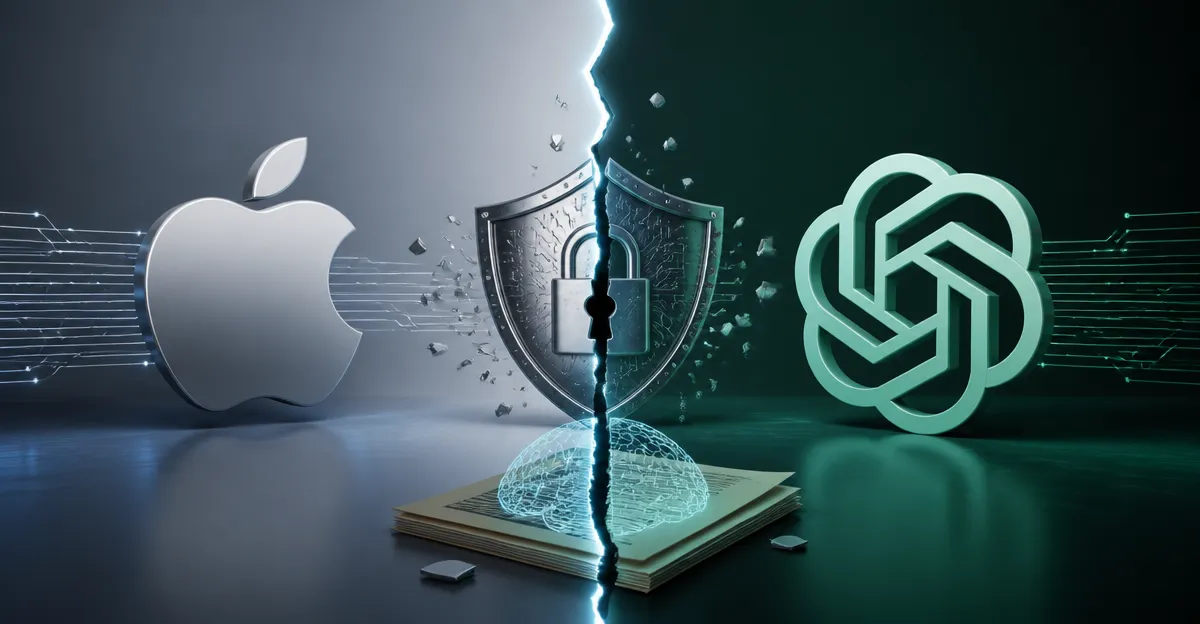
July 12, 2026, (Inside AI) — Apple filed a trade secrets lawsuit against OpenAI in California federal court on Friday, July 10, accusing the AI company and its hardware chief of orchestrating a campaign to steal confidential product information. The suit names former Apple employees Tang Tan and Chang Liu, who now work at OpenAI.
The lawsuit, lodged in the US District Court for the Northern District of California, alleges OpenAI systematically solicited Apple trade secrets from job candidates and employees. Apple claims the misappropriation fuels OpenAI’s nascent hardware division, built on a $6.5 billion acquisition of io Products.
Tang Tan, OpenAI’s chief hardware officer, previously led iPhone and wearable design at Apple. He left in 2024 to co-found io Products with Jony Ive and Evans Hankey, who are not named in the suit. OpenAI acquired the startup last year.
Chang Liu, a former iPhone hardware engineer, joined OpenAI in January 2026. Apple alleges he downloaded dozens of confidential files from a company laptop to share with OpenAI.
Read: Amazon Loses Court Ban
Apple’s complaint states: “At every level, from members of its technical staff to its chief hardware officer, and in coordination with business partners, OpenAI has been stealing Apple’s trade secrets and confidential information. As a natural result, OpenAI’s nascent hardware business now rests on the shakiest of foundations, rotten to its core by its illegal reliance on misappropriated trade secrets.”
OpenAI denied the allegations, saying: “We have no interest in other companies’ trade secrets. We remain focused on building innovative technology that empowers people everywhere.”
The clash marks a dramatic reversal from the companies’ earlier collaboration. In 2024, Apple integrated ChatGPT into its operating systems, signaling a high-profile partnership. Now, the dispute reveals deeper fractures over AI talent and the race to control AI-first devices.
Apple’s lawsuit details five key accusations. OpenAI allegedly asked job candidates to reveal secret project details and bring unreleased device components to interviews. The suit claims Liu downloaded internal documents over several weeks while developing OpenAI hardware.
Apple also says OpenAI coached departing employees on how to avoid detection, advising them not to disclose their new employer and to evade the “dreaded walk out” that would immediately revoke access. Further, OpenAI allegedly used stolen information to contact Apple’s manufacturing partners, asking one to demonstrate proprietary metal-finishing techniques.
Apple sent a warning letter to OpenAI in February 2026, but the startup allegedly never responded. The suit seeks a jury trial, an injunction blocking OpenAI from using any Apple trade secrets, and an order to return or destroy all proprietary materials. Apple also demands OpenAI redesign products to exclude any of its technology.
Read: Microsoft’s Project Solara
The Talent War’s Escalating Stakes
This legal battle is not an isolated incident. It echoes a broader industry pattern where tech giants aggressively protect intellectual property amid an AI talent shortage. In 2024, Tesla sued a former engineer who joined xAI, alleging trade secret theft. Google’s Waymo and Uber settled a similar high-profile case in 2018.
Apple has historically guarded its hardware secrets fiercely, often pursuing legal action against leakers and ex-employees. The company’s lawsuit frames OpenAI’s actions as a deliberate strategy to shortcut hardware development. OpenAI, backed by Microsoft and valued at over $150 billion, has been expanding into consumer devices, aiming to challenge Apple’s ecosystem.
Legal experts note that trade secret cases hinge on proving the information was confidential and misappropriated. Apple’s detailed allegations—including specific employee actions and partner outreach—could strengthen its case. However, OpenAI’s denial and the absence of named co-founders Ive and Hankey may complicate the narrative.
When Collaboration Curdles into Conflict
The Apple-OpenAI partnership was once hailed as a landmark in AI integration. At WWDC 2024, Apple announced ChatGPT would power Siri and other features, with privacy safeguards. But behind the scenes, tensions simmered. OpenAI’s hardware ambitions, led by Tan, directly threaten Apple’s core business.
OpenAI’s io Products acquisition signaled a serious move into AI-first devices, potentially rivaling the iPhone. Apple’s lawsuit suggests OpenAI used illicit means to accelerate that vision. The dispute highlights the precarious balance between collaboration and competition in the AI era.
As the case unfolds, it could set precedents for how trade secret laws apply to AI hiring and hardware development. For now, the courtroom will decide whether OpenAI’s foundation is truly “rotten to its core” or if Apple is overreaching to protect its turf.