
July 17, 2026, (Inside AI) — Chinese startup Moonshot AI on Friday released Kimi K3, a 2.8 trillion-parameter open-weight model that it claims is the largest publicly available AI system in the world. The model’s performance approaches that of Anthropic’s frontier Fable model, which was withdrawn last month by the U.S. government over security concerns.
The launch signals that China’s open AI ecosystem is closing the gap with top U.S. systems faster than many Western analysts expected. Moonshot, along with peers Z.ai and MiniMax, is releasing increasingly powerful models at sharply lower costs, undercutting the notion that Chinese developers are months behind.
Kimi K3 is the first open-weight model to near the 3 trillion-parameter threshold. It is designed for advanced reasoning, long-horizon coding, and knowledge work. A 1 million-token context window lets it process far more information in a single prompt than earlier generations.
Moonshot stated that “Kimi K3 performed competitively with Fable 5 (with fallback) and substantially outperformed (OpenAI’s) Opus 4.8, GPT 5.6 Sol, and GPT 5.5 in GPU kernel optimization, which maximizes hardware utilization and minimizes latency.“
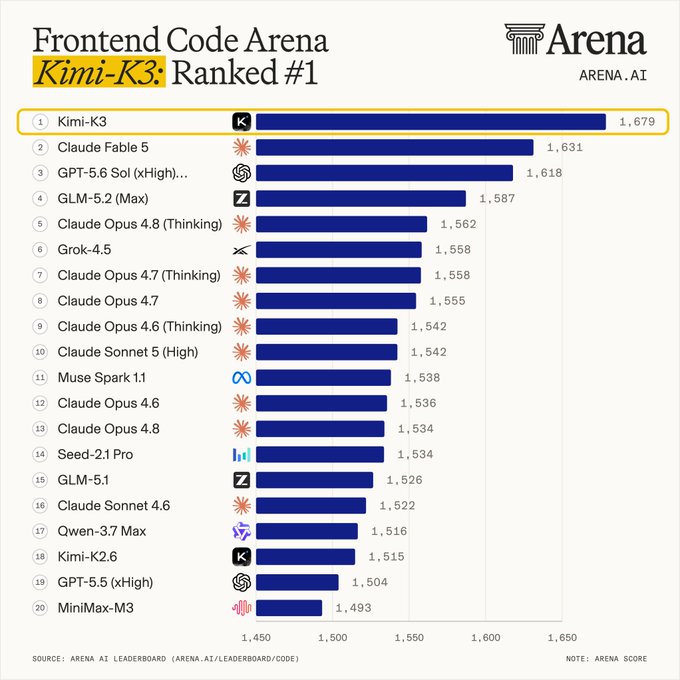
Third-party evaluations reinforce the claim. Arena.ai ranked Kimi K3 first in web interface-building benchmarks. Vals AI placed it second overall, behind Fable 5 but ahead of GPT-5.6 Sol. Artificial Analysis found its performance comparable to OpenAI’s GPT-5.5 and Anthropic’s Claude Opus 4.8 on complex, multi-step tasks.
China’s Accelerating Release Cycles Reshape the Global Race
The model’s debut follows Z.ai’s GLM-5.2, which shocked observers by matching top U.S. closed-source models on benchmarks. That result challenged the consensus that Chinese AI lagged by at least six months. Now, release cycles are compressing further.
Pricing makes the proposition even sharper. K3 costs $15 per million output tokens, compared to roughly $50 for Fable, delivering frontier-adjacent capability at a third of the price. The full model weights go public on July 27, meaning anyone can download and run it for free. That move directly challenges the subscription-based access that Western labs have long relied on.
Hong Kong-listed MiniMax is also developing a 2.7 trillion-parameter model for release as early as the third quarter of 2026. It also plans a frontier multimodal model, H3, soon after. The push toward trillion-parameter systems reflects surging demand for autonomous reasoning and recursive self-improvement capabilities.
Kimi K3 is roughly 75% larger than DeepSeek’s V4 Pro at 1.6 trillion parameters and dwarfs Zhipu’s 744-billion-parameter GLM-5 series. Moonshot says this is the ninth time in a year that a Kimi release has set a new open-source size record, a streak that began when K2 crossed the one-trillion mark.
Open-weight models let users download, run, and customize the underlying systems unlike proprietary, closed-source alternatives. Kimi K3 includes two architectural upgrades that boost computing efficiency and enable long-horizon coding with minimal human supervision.
Backed by Alibaba and Tencent, Moonshot is expanding aggressively. Bloomberg reported last month that the startup is seeking $2 billion in fresh funding at a $30 billion valuation ahead of a potential Hong Kong listing.
The timing—just ahead of Shanghai’s AI conference underscores Beijing’s strategic use of open-source as a geopolitical tool. By releasing K3’s weights, China not only showcases technical prowess but also invites global developers onto its ecosystem, potentially shaping the next wave of AI applications.