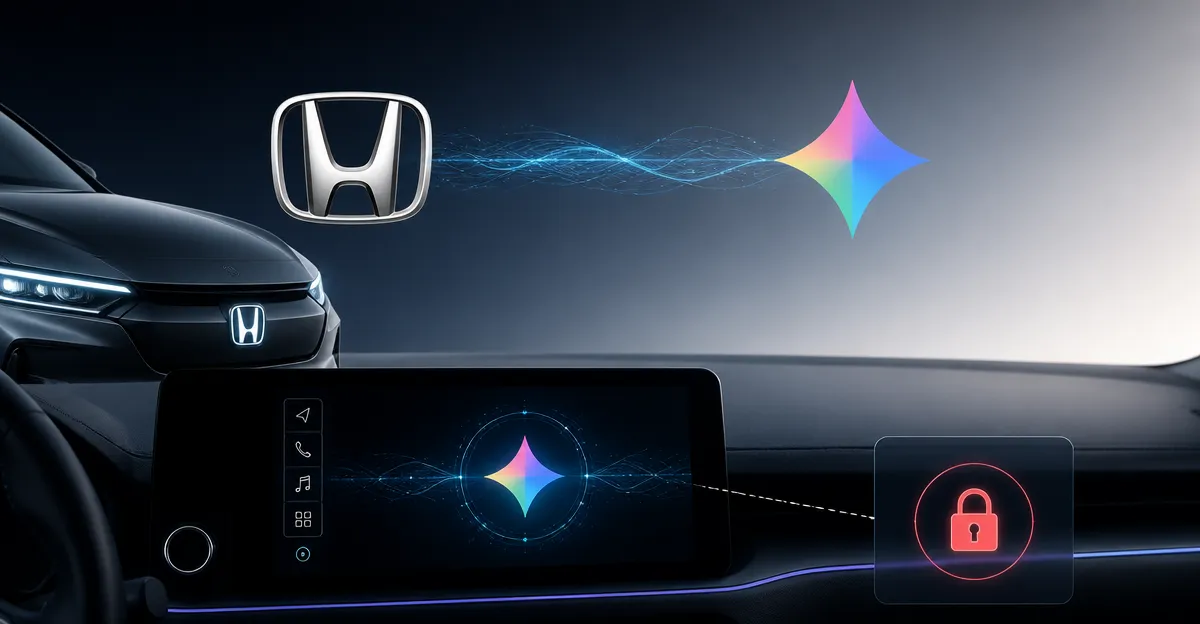
July 20, 2026, (Inside AI) — Honda is rolling out Google Gemini to replace Google Assistant in select vehicles, bringing a more conversational and context-aware AI to the dashboard. The upgrade, announced this week, lets drivers use natural speech instead of rigid voice commands, and the system remembers previous questions within a session.
But there is a catch: Gemini is only available on models with Google built-in hardware, locking out many affordable trims. In the U.S., the Civic Sedan’s three base trims are excluded; buyers need the Civic Si at $31,495 or the Civic Sport Touring Hybrid at $32,395 to get it. The move signals a strategic push to bundle advanced AI with higher-margin vehicles.
Jessika Laudermilk, assistant vice president of Honda National Auto Sales, framed the update as a response to evolving driver expectations.
“Connected technology has become an important part of today’s driving experience,” she said, adding that the company wants to help drivers stay informed and productive while traveling.
Read: Google Limits Meta's Access to Gemini AI Models, Disrupting Projects
Gemini’s In-Car Abilities and Hardware Hurdles
Gemini can summarize daily news, suggest restaurants, create travel plans, and brainstorm work ideas—all hands-free. It learns from interactions over time to sharpen its understanding. Crucially, it retains conversational context, so a driver can pause mid-discussion to handle traffic and resume without repeating themselves.
This is a leap beyond the old Google Assistant, which relied on isolated commands. But the requirement for Google built-in hardware means the feature is absent from Honda’s most popular, budget-friendly models. The 2026 Pilot and Passport SUVs get Gemini standard on all trims, while the CR-V only offers it on the priciest Sport Touring Hybrid. The Ridgeline pickup and Odyssey minivan lack support entirely in the current model year.
Honda’s electrified lineup shows broader adoption. The now-discontinued Prologue had it standard, and the upcoming Prelude sports coupe will offer it across all variants. This pattern mirrors an industry trend where automakers use AI as a differentiator for premium trims, a tactic seen with GM’s Super Cruise and Ford’s BlueCruise.
Tactile Controls Survive the Touchscreen Tide
Amid the AI push, Honda is resisting the all-touchscreen trend. Physical controls for climate and audio remain, a decision that contrasts with Tesla’s minimalist approach and even some recent updates from Volkswagen. Studies from the AAA Foundation for Traffic Safety show that physical buttons reduce driver distraction compared to touchscreens, a point Honda seems to embrace.
Competing automakers are also integrating generative AI. Mercedes-Benz is expanding its MBUX voice assistant with ChatGPT-like capabilities, while BMW’s iDrive 9 uses natural language processing. However, Honda’s reliance on Google’s cloud-based Gemini raises questions about latency and privacy in areas with poor connectivity—details the company has not yet addressed.
Industry analyst Sam Abuelsamid of Guidehouse Insights noted that while Gemini’s contextual memory is impressive, its real-world value depends on seamless integration. “Drivers won’t tolerate lag or misunderstanding when they’re navigating a busy intersection,” he said in a recent report. Honda has not disclosed whether on-device processing is used for any functions to mitigate this.
Read: AI Personality Problem: Why Conversational Style Matters More Than Speed
The rollout also highlights the growing importance of over-the-air updates. Honda has not confirmed if older models with Google built-in will receive Gemini retrospectively, leaving some early adopters in limbo. As voice AI becomes a cockpit battleground, the gap between base models and top trims may widen, turning software into a luxury feature.