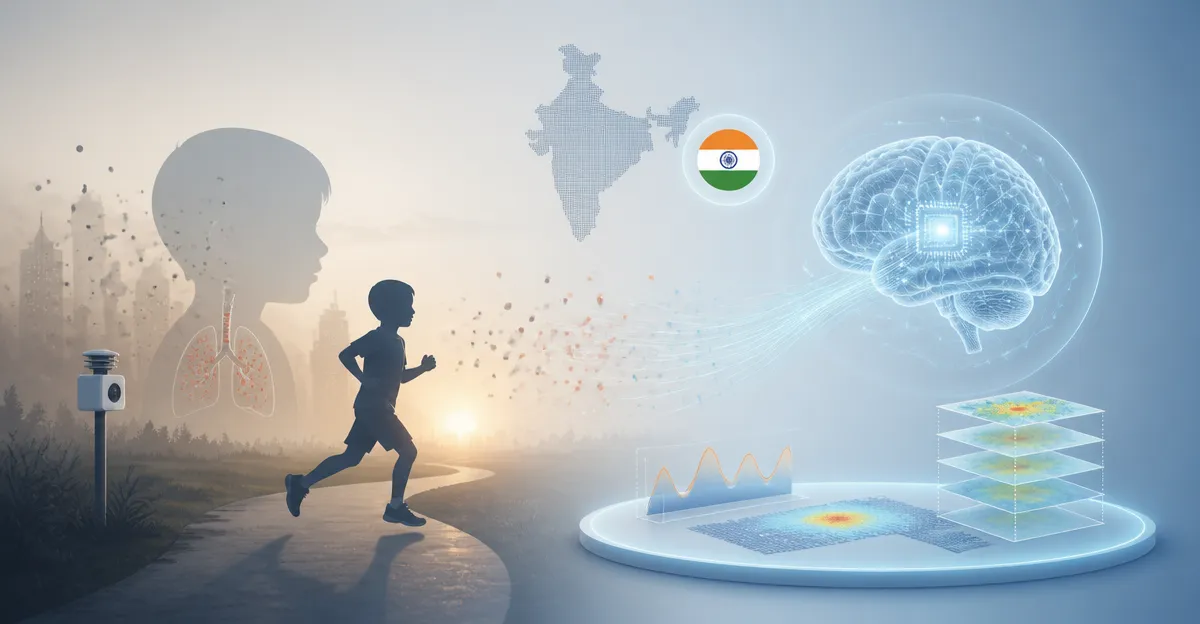
July 21, 2026, (Inside AI) — As Delhi rolls out a permanent winter pollution framework, a pressing question emerges: is the city's morning exercise culture exposing children to peak pollution? New analysis suggests a clear answer, and AI may hold the key to safer schedules.
The framework, with staggered office hours and construction curbs, targets emissions. But it overlooks timing. Millions of children, athletes, and workers follow fixed morning routines, even as winter inversions trap PM₂.₅ near the ground.
Researchers Manmeet Singh and Sandeep Juneja from Ashoka University's Safexpress Centre for Data, Learning and Decision Sciences compared PM₂.₅ levels at key Delhi monitoring stations. They found a stark contrast between morning (9 am–12 pm) and late afternoon (3 pm–6 pm).
At Anand Vihar, the average plunged from 275.3 μg/m³ to 170.4 μg/m³—a 38% drop. Rohini saw a 40% reduction. Even cleaner Lodhi Road recorded a 29% decline. Levels from 6 am to 9 am were similarly high.
This pattern stems from Delhi's winter atmosphere. Pollution lingers near the surface through the morning, dispersing only with stronger afternoon mixing. The safest window consistently falls between 3 pm and 6 pm.
For children playing football or cricket, this timing is critical. Vigorous exercise can spike breathing rates up to twentyfold, driving fine particles deep into lungs. A two-hour game in morning haze can deliver a far higher dose than passive exposure.
Shifting sports to late afternoon could slash exposure without new infrastructure. But daily pollution varies with wind, temperature, and farm fires. Broad historical patterns aren't enough.
This is where AI steps in. Machine learning models, trained on weather forecasts, satellite data, and ground sensor readings, can predict hour-by-hour pollution evolution days ahead. Such tools already inform cyclone and heatwave responses in India.
AI-enabled forecasts could answer operational questions: Should a school sports meet start at 9 am or shift to 4 pm? Will pollution remain hazardous all day, forcing postponement? Which neighborhoods will clear first?
“AI models can combine weather forecasts, satellite observations, ground-level monitoring and emissions data to predict how pollution will evolve hour by hour,” the researchers note, turning air quality bulletins into decision-support systems.
Delhi's new framework rightly focuses on reducing emissions. AI forecasting would complement those efforts by helping governments, schools, and communities reduce exposure while controls take effect. The evidence already supports one simple recommendation: wherever possible, winter school sports should shift to late afternoon.
India already uses predictive science for cyclones and floods. Air pollution deserves the same treatment. As Singh and Juneja argue, the next step is to use AI-powered forecasts to help people decide when it is safest to step outside. Their views are personal.
Meanwhile, the Central Pollution Control Board continues to expand its monitoring network, a critical data source for any AI system. Integrating these streams with meteorological models could make dynamic activity scheduling a reality, protecting millions from the invisible threat of winter smog.